Annual Rent 25.8 Billion Won... SPC Replaces Pulmuone
SPC Samlip Gapyeong Rest Area, Operating Rights Impairment of 13 Billion Won
SPC Samlip's operating rights for 'Gapyeong Rest Area,' on which it bet 260 billion KRW, have recorded impairment losses exceeding 10 billion KRW over the past two years. This means that the expected profits did not materialize as SPC Samlip submitted a higher-than-anticipated bid price.
According to SPC Samlip's 2023 business report released on the 8th, the company reflected an impairment loss of 7.562 billion KRW on the right-of-use asset for Gapyeong Rest Area last year. Impairment losses on right-of-use assets are recognized when the future cash flows expected to be generated are judged to be less than the book value of the right-of-use asset due to deteriorating earnings. This suggests that the revenue obtained through leasing was lower than expected.
Located on the Seoul-Chuncheon Expressway, Gapyeong Rest Area began full-scale operations in September 2019 after SPC Samlip won the concession business (re-leasing stores in multi-use facilities such as airports, railways, and rest areas) in July 2019. The company agreed to pay 258 billion KRW in rent over 10 years in installments to Seoul-Chuncheon Expressway Co., Ltd., the private road operator.
In its 2020 business report, SPC Samlip recognized 226 billion KRW of right-of-use assets for Gapyeong Rest Area as part of 231.5 billion KRW in tangible assets, but impairment losses have occurred every year since the following year. The right-of-use asset value of this rest area was reduced by about 2.7 billion KRW in 2021, about 3 billion KRW in 2022, and more than 7.5 billion KRW last year.
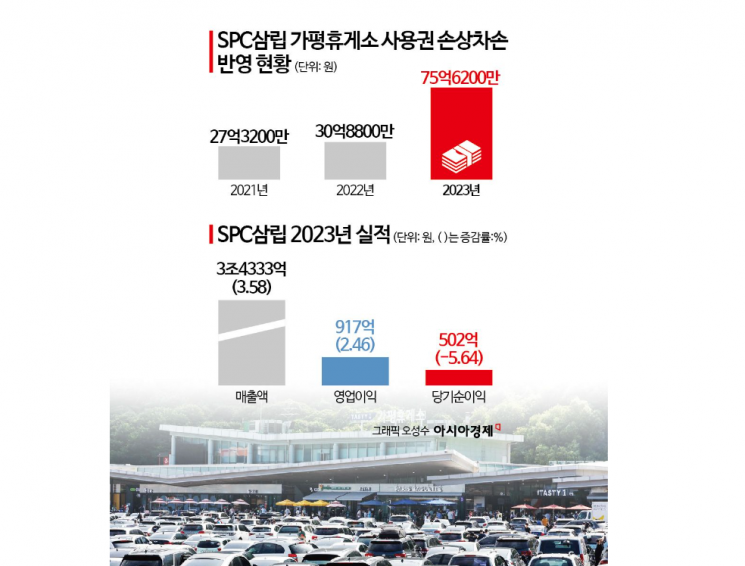
As a result, SPC Samlip achieved record-high sales and operating profit last year, recording 3.4333 trillion KRW and 91.7 billion KRW respectively, but net profit shrank by more than 5% compared to the previous year to 50.2 billion KRW.
SPC Samlip operates rest areas and gas stations at five locations: Gimcheon (both directions), Jinju (Busan direction), Hwangjeon (both directions), Yongin (both directions), and Gapyeong (both directions). Based on its operational know-how from managing rest areas such as Gimcheon and Jinju, SPC Samlip aimed to increase sales at Gapyeong Rest Area to 100 billion KRW within four years. To this end, it introduced many of its well-known brands such as Baskin Robbins, Dunkin Donuts, and Pascucci.
However, performance was sluggish. Last year, the food business division of SPC Samlip, which includes the rest area business on a consolidated basis, recorded sales of 765.3 billion KRW, down about 4% from 798 billion KRW the previous year. During the same period, operating loss was 1.1 billion KRW, turning from a 13.9 billion KRW operating profit the previous year. The securities industry views that rising operating costs such as labor and energy in SPC Samlip's rest area business led to a decline in profitability.
As of last year, the total sales forecast for rest areas operated by SPC Samlip was 242 billion KRW. Dividing this by five business sites suggests that each site recorded sales around 50 billion KRW. Although the company did not disclose specific sales figures, some believe that Gapyeong Rest Area recorded a higher level of about 80 billion KRW due to the transition to the COVID-19 endemic phase.
Such large-scale impairment losses are seen as a predictable outcome. This is because SPC Samlip submitted a high bid price when bidding for Gapyeong Rest Area. SPC Samlip's annual rent is 25.8 billion KRW. The previous operator of Gapyeong Rest Area, Pulmuone Food & Culture, paid around 10 billion KRW annually in rent.
Industry insiders consider a price of about 16 billion KRW (around 32% of sales) submitted by H&DE as appropriate. Based on H&DE's price, SPC Samlip paid more than 10 billion KRW extra annually to acquire the operating rights for the rest area.
There are still question marks over the long-term business viability. An industry official said, "Although domestic and international travel demand has greatly increased, domestic travelers have not kept pace with the recovery of overseas travel," adding, "Due to high inflation, domestic accommodation and leisure facilities, as well as rest areas, are still seeing visitor numbers below pre-COVID-19 levels."
© The Asia Business Daily(www.asiae.co.kr). All rights reserved.
![Clutching a Stolen Dior Bag, Saying "I Hate Being Poor but Real"... The Grotesque Con of a "Human Knockoff" [Slate]](https://cwcontent.asiae.co.kr/asiaresize/183/2026021902243444107_1771435474.jpg)
















