"Seeing the Internet Photo and Preparing... I Was Moved"
A heartwarming story of a Japanese woman who prepared a Korean-style ancestral ritual table for her late husband's father touched netizens.
On the 1st, a post titled "Ancestral Ritual Table Prepared by My Japanese Wife" was uploaded on an online community. The author, Mr. A, who currently lives in Osaka, Japan, said, "Tomorrow is the 2nd anniversary of my father's passing, and when I came back from going out, I found the ritual table set up," adding, "I didn't expect it at all, but I was so moved that I cried a little."
Looking at the photos posted by Mr. A, a simplified ancestral ritual table is prepared. The first row has fruits, and the last row has rice cakes and dried fish, which is not much different from a traditional ritual table.
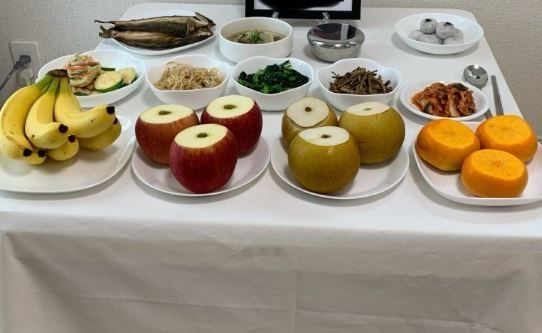
Mr. A said, "I asked her how she did it since she can't speak Korean, and she said she searched online and looked at pictures," adding, "I was very touched and promised myself to do well too."
Netizens who read the story praised it, saying, "You can feel the sincerity," "All the necessary items are there," and "It must be an unfamiliar culture in Japan, so it's amazing."
Although the trend is toward modernization and simplification, many households in Korea still hold ancestral rites. Then, what about neighboring Japan?
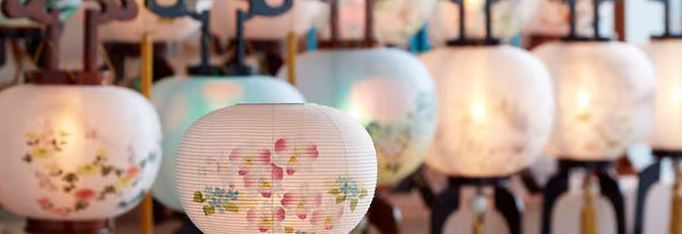 Lanterns used during Obon. Although fruits or alcohol are sometimes placed at graves during the Obon period, there is no fixed format like that of ancestral rites or memorial services. [Image source=Online community capture]
In Japan, where Confucian culture has not deeply taken root, there is no ancestral ritual culture like Korea's. There is a culture called "Ohigan," where people visit their ancestors' graves twice a year in spring and autumn, but this culture is derived from Buddhism and strictly speaking, it cannot be considered an ancestral rite.
However, Japan also has "Obon," a concept of inviting the spirits of ancestors into the home. It is an event held every August (in some regions July), where candles are placed on an altar in front of the grave and lit, then the candlelight is placed inside a lantern and brought home to enshrine. When the Obon period ends, the candlelight is taken back to the grave and extinguished.
This ritual also originates from Buddhism. In the past, Japanese people believed that during Obon, the distance between the afterlife and this world was the closest. The lit lanterns served as guides, symbolizing the ancestors' spirits visiting the home.
© The Asia Business Daily(www.asiae.co.kr). All rights reserved.
![Clutching a Stolen Dior Bag, Saying "I Hate Being Poor but Real"... The Grotesque Con of a "Human Knockoff" [Slate]](https://cwcontent.asiae.co.kr/asiaresize/183/2026021902243444107_1771435474.jpg)
















