Constitutional Review Petition Filed by Korea Federation of SMEs and Others
"Major Accidents Cannot Be Prevented by Emphasizing Only Responsibility and Punishment"
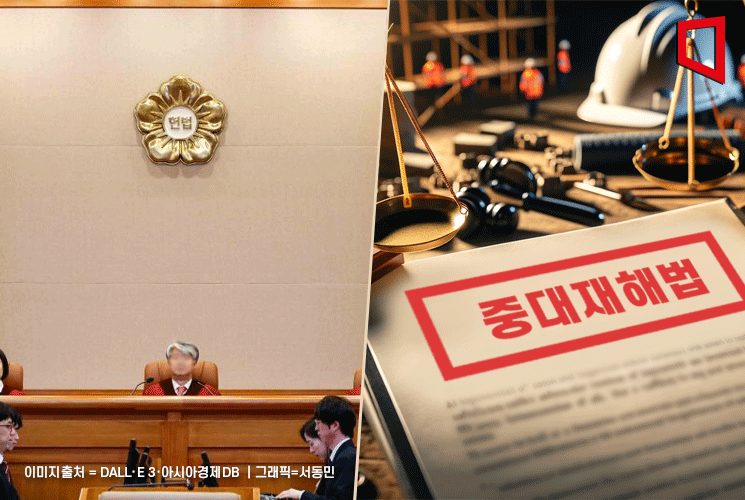
The Constitutional Court is set to determine the constitutionality of the Serious Accidents Punishment Act (SAP Act), which is currently enforced on small businesses with fewer than 50 employees.
On the 1st, the Korea Federation of Small and Medium Business (Kbiz) and other small business organizations filed a constitutional complaint with the Constitutional Court regarding the SAP Act. The petitioners include nine small business organizations and 305 small and medium enterprises (SMEs) and small business owners with 5 to 50 regular employees who have been subject to the SAP Act since January 27.
Jung Yun-mo, the full-time vice chairman of Kbiz, held a press conference on the same day and stated, “The SAP Act imposes excessively broad and vague obligations that are difficult for small SMEs and small business owners to comply with, while prescribing punishments that are disproportionate to the responsibilities, placing an extremely heavy burden on small businesses already struggling in a difficult business environment.” He explained the reasons for filing the constitutional complaint.
He added, “We hope that the excessive punishment of imprisonment for more than one year will be ruled unconstitutional. Setting a minimum prison sentence as a statutory penalty is disproportionate to the responsibility, and it is unfair that management officials receive harsher punishments than the direct perpetrators of accidents simply because they are in charge of management.”
Vice Chairman Jung further said, “Many workplaces are unprepared due to unclear and complex provisions, and many small SMEs and small business owners do not even know whether they are subject to the law. Emphasizing only the responsibility and punishment of business owners will not reduce serious accidents.”
The small business community argues that the SAP Act violates the principles of clarity and prohibition of excess. However, there was a case last year where a company prosecuted for a serious accident requested a constitutional review on similar grounds, but the request was dismissed.
At that time, the court ruled that the SAP Act did not violate the constitutional principles of clarity, prohibition of excess, or equality. The court stated, “Management officials are better positioned than anyone else to know what measures are necessary to prevent risks and can seek advice from legal and safety and health experts, enabling them to sufficiently understand and anticipate the obligations imposed on them.”
However, Kbiz explained that the previous case was dismissed by a district court, and since the current matter is being directly reviewed by the Constitutional Court, the conclusion could differ.
Regarding this, Kim Ki-moon, chairman of Kbiz, said at a press briefing held in February, “Many small businesses and small business organizations suggested filing a constitutional complaint. After consulting labor law specialists and law firms, we received opinions that there is a strong possibility of unconstitutionality, so we decided to file the constitutional complaint in consultation with small business organizations.”
Meanwhile, the SAP Act for workplaces with fewer than 50 employees began to be enforced on January 27. Before its enforcement, the small business community urged the National Assembly and government to grant an additional two-year grace period, but the postponement was not approved during the February extraordinary session of the National Assembly. The SAP Act stipulates that when a serious accident occurs and it is confirmed that the business owner or management official neglected their duty to ensure safety and health, they may be punished with imprisonment for more than one year or a fine of up to 1 billion KRW.
© The Asia Business Daily(www.asiae.co.kr). All rights reserved.
![Clutching a Stolen Dior Bag, Saying "I Hate Being Poor but Real"... The Grotesque Con of a "Human Knockoff" [Slate]](https://cwcontent.asiae.co.kr/asiaresize/183/2026021902243444107_1771435474.jpg)
















