Successful Launch of Miniature Satellite 'Kapasat' from US Mainland
Starting This Month, Communication Connection Twice Daily When Passing Over the Korean Peninsula
The former Soviet Union launched the artificial satellite Sputnik in 1967. It was the world's first. The United States fell into panic. Fear spread that the balance of power between the two countries, which were in conflict during the Cold War, might be tipping in favor of the Soviet Union. At that time, U.S. President Dwight Eisenhower ordered the establishment of the National Aeronautics and Space Administration (NASA) the following year. The launch of NASA led to the 'Apollo Project.' Apollo sent humans to the moon six times from 1969 to 1972. Since then, more than 50 countries have launched observation satellites, communication satellites, exploration satellites, military satellites, and scientific satellites. Thus, the space age began. Our Air Force also added a new curriculum this year for cadets at the Korea Air Force Academy (KAFA) to respond to space. Theoretical education and practical training are combined so that cadets can be immediately deployed in the aerospace field upon commissioning after graduation. On the 18th of last month, I met cadets who are deeply immersed in space studies.
 When the ground station sends commands including orbital information, KapaSat receives the commands and updates the orbital information, enabling two-way communication. (Photo by Air Force Academy)
Although it was early in the semester, the school was very quiet. I entered the Danjaegwan building where students were attending classes. Some buildings within KAFA are named after independence activists. Danjaegwan is the pen name of Shin Chae-ho. It seemed to be break time as cadets were murmuring in the hallway. The reason was a short-range ballistic missile launched by North Korea that morning. The conversation was different from that of ordinary university students. The students were discussing the differences between ballistic missiles and satellite launch vehicles.
Space-related learning from the time of academy admission
I observed second-year cadets during class. It was a creative engineering design practice session. The students, dressed in cadet uniforms, focused intently on the professor’s words, not wanting to miss anything. The professor explained the elements necessary for fighter jet design and engineering. This year, they must form teams to design, build, and fly unmanned aerial vehicles (UAVs) themselves. All of this counts toward their grades. On one side of the classroom, UAVs being built by students caught my eye. There was even a UAV that looked exactly like the B-52 stealth strategic bomber operated by the U.S. Air Force. Since ideas varied, the models were all different. After completing the design, parts are made directly using their own 3D printers.
Using the medium-sized subsonic wind tunnel laboratory installed at KAFA (ROKAFA Subsonic Wind Tunnel Laboratory), they also conduct research, development, and design practice for 6th-generation fighter jets and unmanned aerial vehicles. Aerospace engineering majors conduct their aerospace experiments in this laboratory as well. The wind tunnel lab is a place to directly observe and experiment with shock wave phenomena that occur during supersonic flight. The American company Sverdrup was responsible for its design and construction. It allows for testing fighter jet aerodynamic characteristics, propeller thrust, and weapon separation experiments. The facility is large enough to test a 1/5 scale model of an F-16 fighter jet, measuring 65 meters in length, 23 meters in width, and 12 meters in height.
Second-year students not only build UAVs but also make can-sized satellites. These satellites, about the size of a can, are dropped from a UAV at an altitude of 200 meters using a parachute and communicate with the ground. This is to help students understand the concept of satellites. In the hallway, there were also works displayed that had won the annual 'Can Satellite Competition' held by KAIST.
A KAFA official said, “With an outdated curriculum repeated for decades, there are limits to cultivating excellent talent needed by the military. We judged that we could not nurture capable commanders to respond to the changing nature of future warfare, so we rolled up our sleeves to improve the education system.”
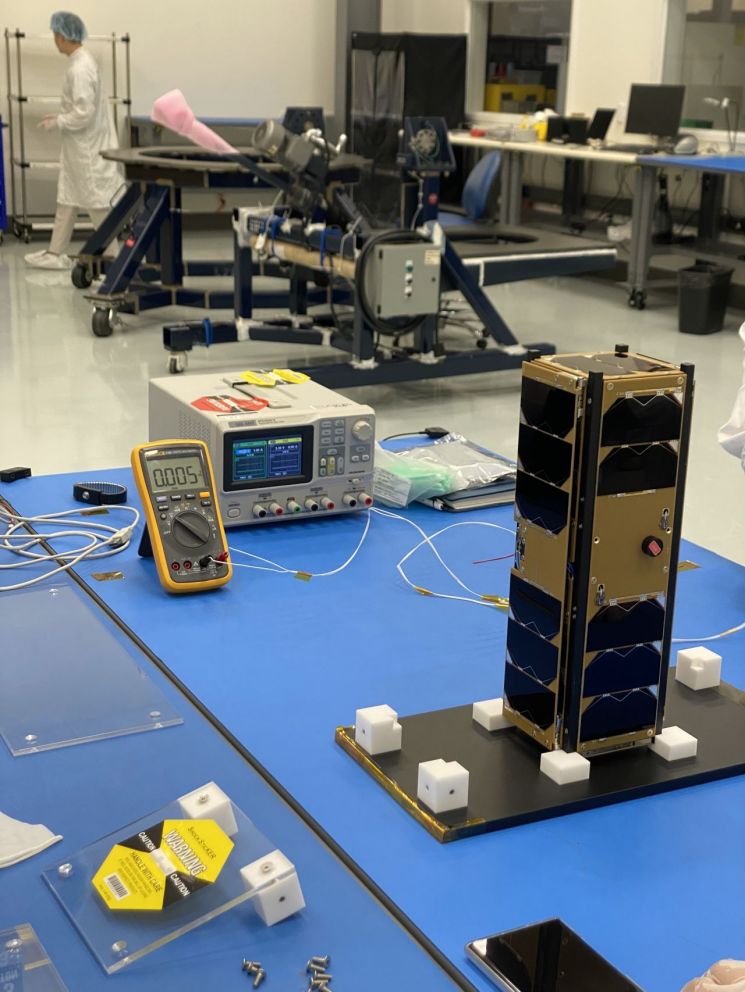 KAPASAT was launched on November 12 last year from Vandenberg Space Force Base in California, USA, aboard SpaceX's Falcon 9 rocket. (Photo by Air Force Academy)
Since 2013, KAFA and KAIST have challenged themselves for five years to develop a microsatellite called ‘K2SAT.’ In December 2018, it was launched by SpaceX’s Falcon 9 rocket from Vandenberg Air Force Base in the U.S. The result was a failure. The launch delay caused a loss of power, and communication was not established. KAFA tried again. They created ‘KAFASAT,’ a microsatellite capable of capturing images of the Earth and communicating with the ground station. KAFASAT is a portmanteau of Korea Air Force Academy and Satellite. It is the name of the educational microsatellite project. The design of KAFASAT was started in 2020 by the 69th class cadets who were seniors at the time, and the 70th class produced a test evaluation model the following year. The 71st class made the actual spaceflight model, and the 72nd class assembled the final model. KAFASAT was launched on November 12 last year from Vandenberg Space Force Base in California aboard SpaceX’s Falcon 9 rocket.
A KAFA official said, “I will show you the KAFASAT satellite,” and guided me to the fourth-floor ground station. Inside the ground station, I saw a monitor receiving real-time video transmissions. Thick lines were marked vertically on the world map. These represented the satellite’s orbit. The satellite moved slightly at latitude 60 degrees and longitude 30 degrees, heading toward South America. KAFASAT, orbiting at about 550 km altitude, takes approximately 95 minutes to circle the Earth once. It passes over the Korean Peninsula twice a day, allowing normal communication with the KAFA ground station.
Establishment of advanced departments such as aerospace, cyber, and AI
When the ground station sends commands including orbital information, KAFASAT receives the commands and updates its orbital data, enabling two-way communication. Starting in April, all cadets will directly operate the satellite and perform satellite communications using this satellite. KAFA plans to begin conceptual design of ‘KAFASAT-2’ aiming for launch in 2027. From this month, 30 senior aerospace engineering cadets specializing in space will be involved in the project.
Colonel Kim Jong-beom, head of the Department of Aerospace Engineering, said, “We conduct hands-on education involving the entire process of designing and manufacturing UAVs and satellite systems,” adding, “Cadets may also participate as researchers in professors’ research projects for UAV research.”
KAFA plans to establish a ‘Smart Factory’ for aerospace science education support by June to utilize it in cadet training. This facility will consolidate 3D printers, precision machining workshops, and clean rooms for satellite assembly and testing in one place. It will be an educational facility used for developing advanced UAVs and satellites. It is expected to serve as a cutting-edge space where cadets’ creative and convergent ideas can be realized. A mandatory course called ‘Defense Weapon Systems Research’ has been newly established, and the Department of Computer Science has been renamed the ‘Department of Computer and Cyber Science.’ An ‘Artificial Intelligence Department’ has also been established to strengthen specialized AI education. Through this, KAFA explained, “Cadets will study other military branches, allied countries, adversaries, and future weapon systems, and develop expertise in the AI field.”

© The Asia Business Daily(www.asiae.co.kr). All rights reserved.
![Clutching a Stolen Dior Bag, Saying "I Hate Being Poor but Real"... The Grotesque Con of a "Human Knockoff" [Slate]](https://cwcontent.asiae.co.kr/asiaresize/183/2026021902243444107_1771435474.jpg)


















