CEO Leijun "Secured 24 Trillion Won in Competitive Funding"
Chinese Expert "Unlikely to Conduct Costly R&D"
China's Xiaomi has ignited a price war in the Chinese electric vehicle market with its first electric car, the SU7 (Chinese name 'Suchi').
According to Chinese economic media Caixin on the 31st, the SU7 was launched at two price points: 215,900 yuan (approximately 40 million KRW) and 299,900 yuan (approximately 56 million KRW). Both are lower than market expectations.
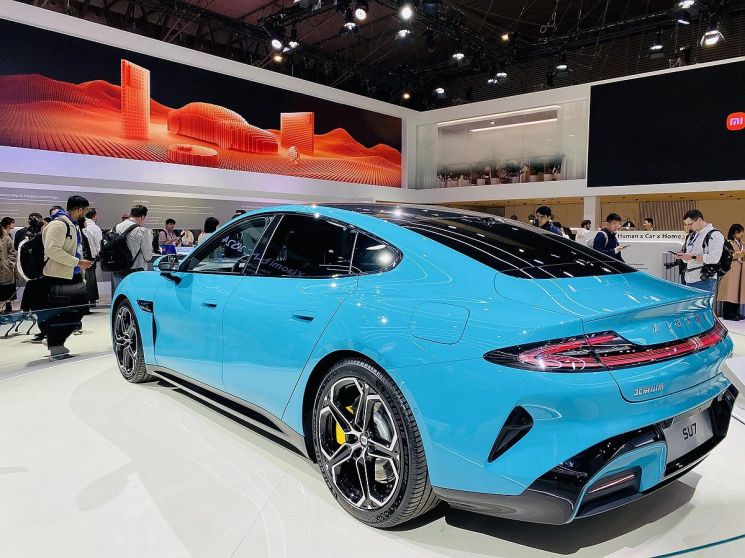
Xiaomi CEO Lei Jun compared the performance of the SU7 to the Tesla Model S at the new car launch event, but the general market perception is that Xiaomi and Tesla currently target different potential customer groups.
It is analyzed that the majority of early users of Xiaomi electric vehicles are likely other Xiaomi hardware users who are widespread due to the affordable price.
The actual competitors are primarily Chinese brands. Ahead of its first technology launch event in December last year, Xiaomi drew attention by displaying advertisements on the exterior walls of buildings in major cities such as Beijing, Shanghai, Guangzhou, and Shenzhen, paying tribute to competitors like BYD (比亞迪), NIO, XPeng, Li Xiang, and Huawei.
NIO, in which CEO Lei Jun has personally invested, lowered the starting price of its premium sport utility vehicle (SUV) model, which was over 350,000 yuan (approximately 65 million KRW), to 258,000 yuan (approximately 48 million KRW) through a battery rental program in response to the SU7 launch.
In the case of XPeng, the Model P7 overlaps in price range with the Xiaomi SU7. The P7 was XPeng's initial model launched in 2019 when the company entered the electric vehicle sector, and it was also the first vehicle to adopt the Porsche style, which the Xiaomi SU7 has been evaluated to resemble in design.
XPeng Motors reduced the price of the top version of the P7i model from 289,900 yuan (approximately 54 million KRW) to 249,900 yuan (approximately 46 million KRW) four days before the SU7 release.
A Chinese automotive industry analyst explained, "In the short term, Xiaomi's intelligent driving still has to follow XPeng, but in the current environment, 'cost-effectiveness' may be more important than intelligent driving capabilities."
CEO Lei Jun has expressed his intention to target the automotive market with secured "ammunition." Upon launching the SU7, he said, "Is the price war in the automotive industry more intense than in the mobile phone industry? Xiaomi is the 'king of competition (卷王)' whether big or small," adding, "We knew from day one that this was a battlefield, and we are looking not at the current 300 to 400 new energy vehicle companies, but at the 5 to 8 that will survive until the end."
He also emphasized, "We have been cornered from day one and will accomplish everything with ten times the input (investment or effort)." He noted that Xiaomi spent 24 billion yuan (approximately 4.5 trillion KRW) on research and development (R&D) in 2023 and has prepared over 130 billion yuan (approximately 24 trillion KRW) in cash to cope with competition over the next five years.
Within the Chinese automotive industry, there is a forecast that Xiaomi will not become the "highest-spending" manufacturer. This implies that Xiaomi is more likely to focus on the "less costly" price war rather than research and development (R&D), which involves huge initial costs and risks of failure.
An industry insider said, "Xiaomi hopes to become an 'honor student' with relatively low costs rather than necessarily becoming 'number one.' To become number one, an enormous investment in R&D is required, but if it only aims to be an honor student, it can rely on brand and user advantages."
© The Asia Business Daily(www.asiae.co.kr). All rights reserved.
![Clutching a Stolen Dior Bag, Saying "I Hate Being Poor but Real"... The Grotesque Con of a "Human Knockoff" [Slate]](https://cwcontent.asiae.co.kr/asiaresize/183/2026021902243444107_1771435474.jpg)















