Highest Medical School Admission Quotas for Elementary, Middle, and High School Students
"Expected Impact on Regional Talent Selection" Analysis
As the number of medical school admissions quotas increases mainly in non-metropolitan areas, interest in so-called 'local studying' is rising. In this context, the region where it is easiest to enter medical school nationwide has been identified as the Gangwon area.
According to Jongno Academy on the 31st, across all grades from elementary to high school, the region most advantageous for entering medical schools within the area was Gangwon.
This year, the ratio of medical school admission quotas to the number of high school seniors in Gangwon is the highest nationwide at 3.68%. For high school juniors and sophomores, the ratios are also the highest in the country at 3.23% and 3.52%, respectively.
The second place, the Chungcheong area, has a ratio of 2.01% for high school seniors, 1.77% for juniors, and 1.85% for sophomores. For third place, the ratios for seniors and juniors are Jeju (1.64% and 1.48%, respectively), and for sophomores, it is Daegu·Gyeongbuk (1.54%).
In middle school as well, entering medical schools within the region was found to be most advantageous in the Gangwon area. The ratio of medical school admission quotas to the number of 9th graders in Gangwon is 3.58%, 3.45% for 8th graders, and 3.44% for 7th graders. The second place is Chungcheong (9th grade 1.92%, 8th grade 1.82%, 7th grade 1.80%).
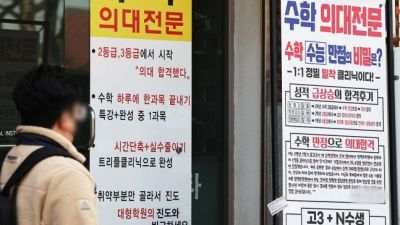 Posters related to medical school entrance exams are posted in the Daechi-dong academy district.
 [Image source=Yonhap News]
In elementary schools, Gangwon also had the highest ratio of medical school admission quotas to the number of students nationwide. Excluding 1st graders whose student numbers were not disclosed, from 2nd to 6th grade, Gangwon ranked first in the ratio of medical school admission quotas to student numbers. Chungcheong was second, followed by Honam in third place.
Jongno Academy explained, "Among students currently enrolled in science and engineering departments at top universities, those who graduated from high schools in local areas may be significantly affected in their reapplication depending on how universities organize regional talent selection in the future."
They further predicted that in non-metropolitan areas where it is relatively advantageous for local students to enter medical schools, the proportion of regional talent selection is expected to be lower than in other regions. Conversely, in non-metropolitan areas where it is difficult to enter medical schools, such as Busan, Ulsan, and Gyeongnam, the proportion of regional talent selection is expected to be relatively high.
Additionally, they analyzed, "Currently, elementary students residing in the metropolitan area are likely to first enroll in middle schools in non-metropolitan areas to aim for medical school regional talent selection later, and then advance to nationwide autonomous private high schools (Jasago) located in non-metropolitan areas."
Regional talent selection requires applicants to have attended high school in the region where the local medical school is located for three years to qualify. However, according to the law revised in 2021, starting from the 2028 college entrance exam, which current 9th graders will take, students must have resided in the region for six years covering middle and high school.
Meanwhile, according to the government announcement on the 20th, 1,639 of the 2,000 additional medical school quotas, accounting for 82%, were allocated to non-metropolitan areas. 361 quotas, or 18%, were assigned to the Gyeongin area, and none to the Seoul area. Non-metropolitan medical schools decided to select more than 60% of their quotas through regional talent selection.
© The Asia Business Daily(www.asiae.co.kr). All rights reserved.
![Clutching a Stolen Dior Bag, Saying "I Hate Being Poor but Real"... The Grotesque Con of a "Human Knockoff" [Slate]](https://cwcontent.asiae.co.kr/asiaresize/183/2026021902243444107_1771435474.jpg)















