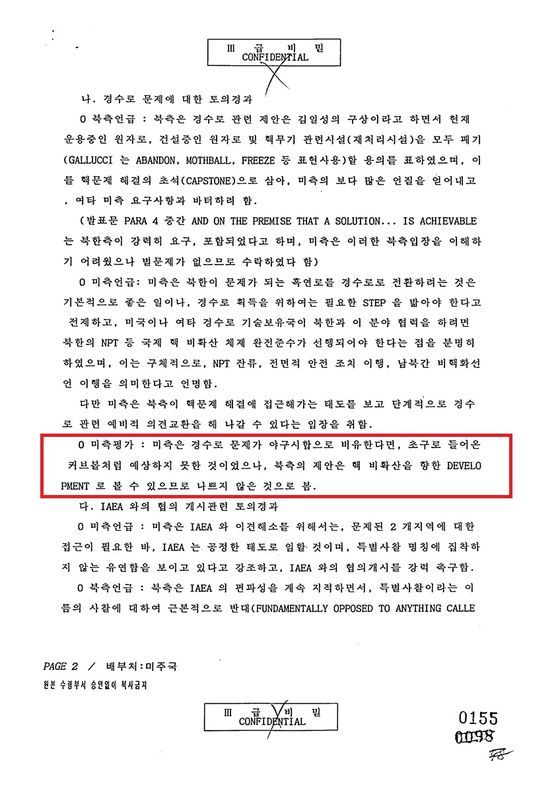
Diplomatic documents from 1993, when North Korea declared its withdrawal from the Nuclear Non-Proliferation Treaty (NPT) in protest against special inspections by the International Atomic Energy Agency (IAEA), have been released. The documents include diplomatic efforts by South Korea and the United States to prevent North Korea's withdrawal from the NPT, as well as previously undisclosed diplomatic backstories.
On the 29th, the Ministry of Foreign Affairs disclosed these diplomatic documents, which were declassified after 30 years. The collection consists of 2,306 volumes and 370,000 pages. The Ministry releases confidential diplomatic documents older than 30 years to the public annually.
Notably, the newly released documents focus on the first North Korean nuclear crisis triggered by North Korea's NPT withdrawal declaration. North Korea announced its withdrawal from the NPT on March 12, 1993, in response to IAEA's pressure for special inspections of two nuclear facilities in Yongbyon and the joint U.S.-South Korea Team Spirit military exercises.
Subsequently, the United States held a series of high-level talks with North Korea, striving to keep North Korea bound to the NPT. At the first high-level North Korea-U.S. talks held in New York from June 2 to 11, North Korea demanded a joint statement including U.S. support for Korean Peninsula unification and non-interference in internal affairs, and a joint statement reflecting these points was adopted a few days later.
During high-level contacts held in Geneva from July 14 to 19 of the same year, North Korea added a request for U.S. cooperation in converting its current graphite-moderated reactors to light-water reactors. Robert Gallucci, then U.S. Deputy Assistant Secretary of State leading the negotiations, described this as "an unexpected curveball thrown as the first pitch in a baseball game," but also regarded North Korea's (light-water reactor) proposal as progress toward nuclear non-proliferation.
Following these negotiations, North Korea and the United States agreed to freeze North Korea's nuclear program by signing the Geneva Agreed Framework in October 1994. However, peace did not last long. With the inauguration of the Bush administration in the U.S. in 2001 and renewed suspicions about North Korea's highly enriched uranium program, the Geneva Agreed Framework collapsed, and North Korea declared its withdrawal from the NPT again in January 2003.
Additionally, diplomatic documents related to negotiations between South Korea and Russia in 1992 over the black box to investigate the truth behind the 1983 Korean Air (KAL) passenger plane shootdown incident were also released. At that time, South Korea sought to obtain the original black box during Russian President Boris Yeltsin's visit to South Korea in November 1992.
President Yeltsin sent a letter to President Roh Tae-woo on October 29, just before his visit, stating, "We have the recorded documents from the flight operation, and if South Korea is interested in these recording tapes, we are prepared to deliver them." However, what Russia delivered to South Korea on November 19 did not include the Flight Data Recorder (FDR) tape, which was key to uncovering the truth, and the Cockpit Voice Recorder (CVR) tape was a copy, not the original. After realizing this, the Ministry of Foreign Affairs was taken aback and requested an explanation from the Russian side.
Eventually, South Korea, Russia, the United States, and Japan met in Moscow on December 8?9 and requested the International Civil Aviation Organization (ICAO) to reinvestigate the KAL plane shootdown incident. The original black box was handed over to ICAO. ICAO adopted the final report of the reinvestigation on June 14, 1993, and only then was the original black box delivered to South Korea on July 8.
The original diplomatic documents released on this day can be viewed by visiting the diplomatic document reading room at the Diplomatic Archives in Seocho-dong or by applying online through the Public Diplomatic Document Viewing and Request System. However, documents released this year will only be available through the viewing and request system after June.
© The Asia Business Daily(www.asiae.co.kr). All rights reserved.
![Clutching a Stolen Dior Bag, Saying "I Hate Being Poor but Real"... The Grotesque Con of a "Human Knockoff" [Slate]](https://cwcontent.asiae.co.kr/asiaresize/183/2026021902243444107_1771435474.jpg)















