Local media including Nihon Keizai Shimbun (Nikkei) reported on the 27th that the Japanese government is once again challenging the development of a domestically produced passenger aircraft.
According to the reports, the Ministry of Economy, Trade and Industry of Japan announced on the same day that it will promote the development of the next-generation domestic passenger aircraft based on public-private cooperation. It plans to invest about 5 trillion yen (approximately 44 trillion won) by around 2035 to provide extensive support including research costs, establishment of technical standards, and parts procurement.
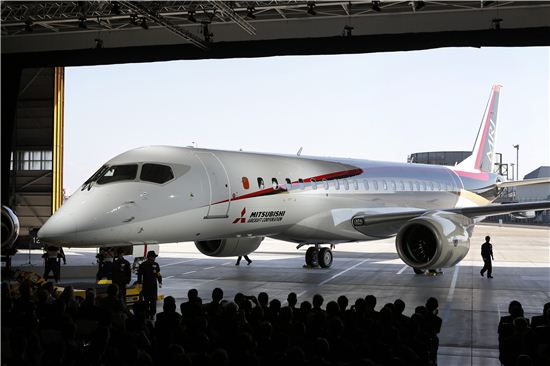 Passenger aircraft MRJ developed by Japan's Mitsubishi Heavy Industries [Photo by Bloomberg]
This is not the first time the Japanese government has attempted to develop a passenger aircraft. Backed by subsidies of up to 50 billion yen (about 440 billion won) from the Ministry of Economy, Trade and Industry, Mitsubishi Heavy Industries began developing the small jet passenger aircraft "Space Jet" (MSJ, formerly MRJ) in 2008. At that time, it secured orders for about 300 units from All Nippon Airways (ANA) and Japan Airlines (JAL), but frequent design changes and production issues eventually led to its withdrawal last year.
The Japanese government analyzed that the failure was due to a lack of understanding of the market and industry, with a single company pushing the project alone. Therefore, it plans to promote partnerships with multiple companies such as large manufacturers like Mitsubishi Heavy Industries, parts suppliers, and leading companies in hydrogen engine development. It also intends to cooperate with overseas companies like Boeing to learn know-how.
In the early stages of the project, jet aircraft will be the main focus of manufacturing, but in the future, production of hydrogen engine passenger aircraft is anticipated. Japan has set a goal in its "Aviation Industry Strategy" to virtually eliminate greenhouse gas emissions by 2050. Accordingly, Nikkei predicted that demand for decarbonized materials will increase.
Kazuchika Iwata, Vice Minister of Economy, Trade and Industry, emphasized, "Japan's mission is to actively utilize the lessons and knowledge gained through the MSJ," and added, "The Japanese aviation industry will transform so that it does not remain satisfied as a parts supplier but actively creates added value."
Yomiuri analyzed, "The aircraft industry is important from the perspectives of economic security and national defense," and stated, "The Japanese government aims to strengthen the security system through the maintenance of production infrastructure and expand the domestic aircraft industry."
© The Asia Business Daily(www.asiae.co.kr). All rights reserved.
![Clutching a Stolen Dior Bag, Saying "I Hate Being Poor but Real"... The Grotesque Con of a "Human Knockoff" [Slate]](https://cwcontent.asiae.co.kr/asiaresize/183/2026021902243444107_1771435474.jpg)














