18 Out of 91 Abolished, 14 Reduced
First Revision in 63 Years... Annual Scale of 2 Trillion Won
The government will abolish or reduce 32 out of the 91 statutory charges it currently manages. The aim is to restructure unnecessary charges to ease the burden on citizens and businesses. The charge system, which has grown to a scale of 24.6 trillion won this year and is often called a ‘quasi-tax’ because it is virtually indistinguishable from taxes, will undergo a comprehensive reform for the first time in 63 years.
On the 27th, the Ministry of Economy and Finance announced this at the 23rd Emergency Economic and Livelihood Meeting chaired by President Yoon Suk-yeol, through the ‘Plan to Organize Charges and Strengthen the Management System.’ Of the current 91 charges, 55 that need to be retained and 4 that have already been reorganized will remain, while the remaining 32 charges will be restructured. This is the first major reform since the charge system was introduced in 1961, aiming to eliminate unreasonable charges and revitalize people’s livelihoods.
Choi Sang-mok, Deputy Prime Minister and Minister of Economy and Finance, said at the meeting, "Among the current 91 charges, we have reorganized all 32 charges except for the 55 that need to be retained and the 4 that have already been reorganized," adding, "By reorganizing charges directly related to citizens’ daily lives, such as airline fees and electricity charges, we will reduce the burden on citizens and businesses by about 2 trillion won annually."
Charges are amounts imposed under the pretext of being used for specific public interest projects, but they have been called ‘quasi-taxes’ or ‘shadow taxes’ because they are virtually indistinguishable from taxes. The expected collection amount of charges this year is 24.6 trillion won, more than three times the 7.4 trillion won collected in 2002 when the Basic Act on Charge Management was introduced. This is also a 12.7% increase compared to the previous year. The number of charges, which was about seven in the early days, increased to 102 in 2005 and then slowed down, maintaining the current level.
Elimination or Reduction of 8 'Citizen-Perceived Charges' Applied When Watching Movies or Departing the Country
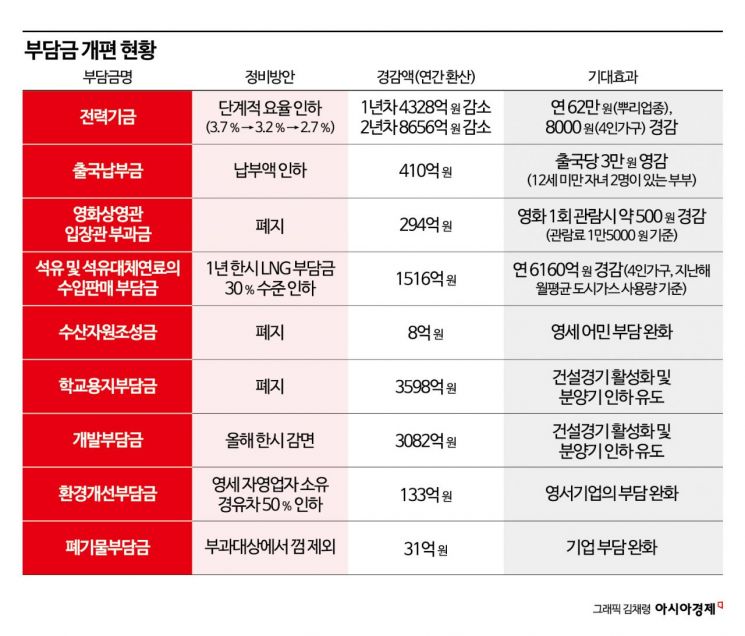
First, the largest charge among the 91, the ‘Electric Power Industry Infrastructure Fund (Electric Power Fund) charge,’ will be gradually reduced over two years. Korea Electric Power Corporation collects this charge, which adds 3.7% to the electricity bill paid by all citizens. The government plans to lower the current 3.7% rate to 3.2% in July this year and further reduce it to 2.7% in July next year. The expected reduction amount is 432.8 billion won in the first year and 865.6 billion won in the second year.
The ‘International Exchange Contribution’ and ‘Departure Payment,’ introduced when overseas travel was not widespread, will also be reduced. The international exchange contribution paid when issuing passports will be reduced by 3,000 won for multiple-entry passports, and single-entry passports or travel certificates will be exempted. The departure payment of 11,000 won charged at airport departure will be reduced by 4,000 won to 7,000 won, and the exemption target will be expanded from under 2 years old to under 12 years old.
The ‘Movie Theater Admission Ticket Charge,’ which imposes 3% of the ticket price on moviegoers, will be abolished. This charge, introduced to raise the Movie Development Fund, has been criticized for shifting the burden to the audience rather than producers or distributors who profit from movie success. Additionally, the LNG import charge will be reduced by 30%, and the ‘Automobile Accident Victim Support Contribution’ included in automobile insurance premiums will be reduced by 50% over three years.
Outdated and Misaligned Charges to Be Phased Out
Eleven charges that hinder corporate economic activities will also be restructured. The ‘School Site Charge,’ which imposes 0.8% of the sale price on housing developers (based on apartment complexes), will be abolished, and the ‘Development Charge,’ which imposes a certain percentage of development profits on developers, will be temporarily reduced this year. The Ministry of Economy and Finance stated, "For projects approved this year, a 50% reduction will be applied in the metropolitan area and exemption in non-metropolitan areas to revitalize the construction market and induce lower sale prices."
Charges introduced decades ago, such as the ‘Environmental Improvement Charge,’ will also be eased. The environmental improvement charge imposed on diesel vehicle owners to cover environmental improvement costs will be reduced by 50% for small self-employed businesses. The exemption criteria for the ‘Waste Disposal Charge,’ imposed on waste incineration or landfill, will be raised from annual sales of 60 billion won to 100 billion won for small and medium-sized enterprises to reduce their burden. Also, gum, which contains no harmful substances and can be incinerated but has been uniformly charged 1.8% of the sales price, will be excluded from the waste charge target. The ‘Farmland Conservation Charge’ imposed when converting farmland to other uses and the ‘Fisheries Resource Development Fund’ imposed on fishery aquaculture operators will also be eased.
Thirteen charges that have become ineffective or have been executed contrary to their purpose will be completely abolished. These include the ‘Road Act Cause-Based Charge,’ which imposes costs on those responsible for road damage; the ‘Tourist Site Resource Facility User and Cause-Based Charge,’ which imposes costs on users or those responsible for the construction or maintenance of resource facilities such as tourist sites; the ‘Water Quality Improvement Charge,’ imposed on bottled water manufacturers and importers; and the ‘District Energy Supply Facility Construction Cost Charge,’ imposed as installation costs on district heating users.
2 Trillion Won Annual Charge Reduction... "Introducing Feasibility Assessment for New Charges" for Continuous Management
The government plans to start legal amendments immediately to accelerate the effect of charge reductions. The Ministry of Economy and Finance explained, "The revision of the enforcement decree will take effect from July this year, and the bill to amend laws regarding abolished charges will be submitted to the National Assembly in the second half of this year." Although not included in this reform, the government also plans to identify and significantly abolish or reduce charges that are outdated or have low enforcement effectiveness.
A feasibility assessment will be introduced to make it difficult to establish new charges. A Ministry of Economy and Finance official explained, "Even for charges retained after this reorganization, we will continuously review their feasibility and appropriateness, and strengthen the charge management system by introducing feasibility assessments for new charges, mandating expiration periods for charges, and providing prompt remedies for rights violations."
© The Asia Business Daily(www.asiae.co.kr). All rights reserved.
![Clutching a Stolen Dior Bag, Saying "I Hate Being Poor but Real"... The Grotesque Con of a "Human Knockoff" [Slate]](https://cwcontent.asiae.co.kr/asiaresize/183/2026021902243444107_1771435474.jpg)
















