Joint Climate Stress Test with Domestic Financial Companies
The Bank of Korea and the Financial Supervisory Service are preparing policies for managing climate risks to ensure financial stability.
On the 27th, the Bank of Korea announced that, together with the Financial Supervisory Service, it will conduct a climate stress test jointly with 15 domestic financial companies and plans to establish climate risk management policies based on the results. The Bank of Korea and the Financial Supervisory Service held the first meeting of the task force (TF) on the same day and plan to carry out climate scenario development, measurement of the impact on financial companies by scenario, and analysis of the measurement results by December.
The participating domestic financial companies include seven banks (KB, Shinhan, Hana, Woori, NH, Daegu, Busan), four life insurance companies (Samsung, Kyobo, Hanwha, Shinhan), and four non-life insurance companies (Samsung, Hyundai, KB, Korean Re).
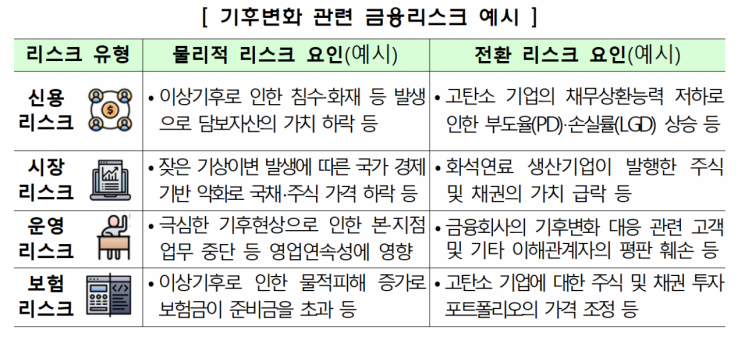
The climate stress test involves setting scenarios for shocks caused by climate change and analyzing the impact on the financial industry according to those scenarios. It is conducted by generating customized domestic climate scenarios that include low-carbon transition pathways and real economy ripple effects, and then measuring the financial risks accordingly.
Regarding this stress test, the Bank of Korea stated, "This is the first domestic case where the Bank of Korea, the Financial Supervisory Service, and financial institutions collaborate to early identify the impact of climate risks on financial stability and to strengthen the financial sector’s climate risk management capabilities." They added, "The combination of the Bank of Korea’s expertise in analyzing the macroeconomic effects of climate risks and the Financial Supervisory Service’s experience in managing and supervising financial companies’ climate risks is expected to create significant synergy."
Both institutions plan to disclose the TF results externally in the future and continuously strengthen mutual cooperation related to climate risk management. A Bank of Korea official said, "By encouraging the green transition of financial companies, we will support the expansion of low-carbon transition fund supply to achieve carbon neutrality, while also strengthening climate risk management supervision through the 'Climate Risk Management Guidelines.'"
© The Asia Business Daily(www.asiae.co.kr). All rights reserved.
![Clutching a Stolen Dior Bag, Saying "I Hate Being Poor but Real"... The Grotesque Con of a "Human Knockoff" [Slate]](https://cwcontent.asiae.co.kr/asiaresize/183/2026021902243444107_1771435474.jpg)
















