Doctors' Collective Action Central Disaster and Safety Countermeasures Headquarters Meeting
"Medical Reform Is for Healthcare Professionals"
"Plan to Improve Medical School Education Conditions by April"
New KMA President: "If Residents Are Harmed, Total Strike"
The government reiterated its commitment to expanding medical school quotas, calling it a "necessary condition to initiate the normalization of healthcare" for the first time in 27 years. Amid the launch of a demand survey to improve educational conditions at each university for the quota increase, the government also urged dialogue, stating that "healthcare reform is for all citizens as well as for medical professionals."
On the 27th, Lee Sang-min, Minister of the Ministry of the Interior and Safety and the 2nd Deputy Head of the Central Disaster and Safety Countermeasures Headquarters (CDSCH) for the doctors' collective action, said before the meeting, "The government will prioritize the lives and health of the people and mobilize all available resources across the government to ensure that there are no gaps in the emergency medical system focused on critically ill and emergency patients," emphasizing this point.
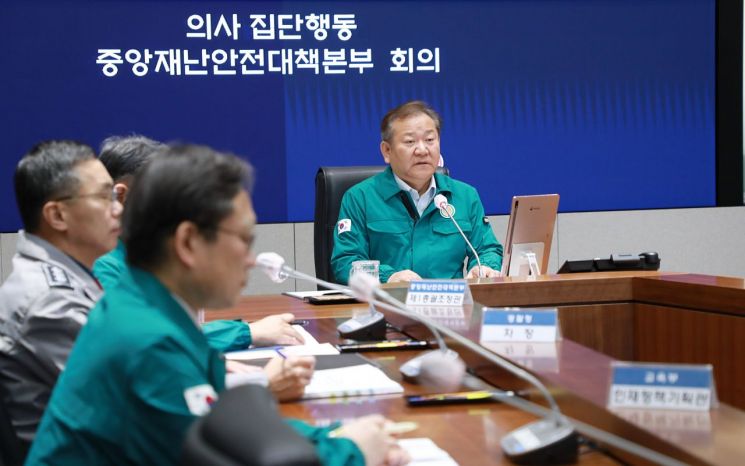
Minister Lee emphasized the government's expansion of medical school quotas as a 'necessary condition,' pointing out, "The number of doctors per 1,000 people in OECD countries averages 3.7, but in 16 out of 17 metropolitan cities and provinces in Korea, excluding Seoul, the number is only 1.93 per 1,000 people." He added, "In response to aging populations, countries worldwide have steadily increased medical school admissions. The United States increased admissions by 7,000 over the past 20 years, France by 6,150, and Japan by 1,759."
He also promised to implement detailed measures for healthcare reform. Minister Lee stated, "We will introduce a contract-based regional essential doctor system, support scholarships and training costs, and improve living conditions to expand competitive regional medical personnel," adding, "We will also steadily increase the number of medical school professors at national universities by 1,000 by 2027."
He explained that a demand survey by university was launched to prepare the necessary educational conditions for the medical school quota increase, including faculty expansion and the enhancement of education and training facilities. Minister Lee said, "Through the second meeting of the Medical Education Support TF yesterday, we began a demand survey by university covering eight areas, including faculty expansion," and added, "We plan to prepare measures to improve medical school educational conditions by April, actively reflecting each university's demands."
The minister also called for dialogue with the government. He urged, "We ask healthcare stakeholders to stop futile conflicts and come to the table for constructive dialogue to jointly resolve the pressing challenges in the medical field and to concretize and develop plans for healthcare normalization," adding, "We also ask medical school professors to persuade residents to return as soon as possible and actively engage in dialogue with the government."
The day before, the government met with key figures in the medical community to discuss forming a 'medical-government consultative body' to address the current situation, but no progress was made. Prime Minister Han Duck-soo visited Seoul National University College of Medicine in Jongno, Seoul, and conveyed, "I believe the public wants those involved and capable of resolving the issues to form a constructive dialogue body to foster mutual understanding and empathy," but it is reported that the scale of the medical school quota increase itself was not discussed.
In response, the government began actively deploying 200 additional public health doctors and military medical officers from that day to mitigate medical service gaps. They received training over two days, from the 25th to the 26th, at their respective deployment medical institutions. Including the 166 personnel dispatched in the first round on the 11th of this month, more than 400 military medical officers and public health doctors are now working. Support for them will also be strengthened. The government decided to provide special activity support fees and overtime pay when they work weekends or night shifts. Plans are also underway to allow military medical officers nearing discharge to return early to tertiary hospitals as part of additional staffing measures.
The problem is that the situation is unlikely to change drastically as a hardliner was elected as the new president of the Korean Medical Association (KMA). Im Hyun-taek, president of the Korean Pediatric Society, who was elected as the new KMA president, will begin his term in May but is already leading the KMA's Emergency Response Committee, making immediate further protests possible. Above all, there is a strong determination not to be swayed by the government's calls for 'dialogue.' He has set the dismissal of Minister Cho Kyu-hong and Vice Minister Park Min-soo of the Ministry of Health and Welfare as preconditions and declared, "If even one resident, medical student, or medical school professor is harmed by license suspension or civil/criminal lawsuits, a general strike will begin."
© The Asia Business Daily(www.asiae.co.kr). All rights reserved.
![Clutching a Stolen Dior Bag, Saying "I Hate Being Poor but Real"... The Grotesque Con of a "Human Knockoff" [Slate]](https://cwcontent.asiae.co.kr/asiaresize/183/2026021902243444107_1771435474.jpg)
















