Most Are Mountainous Areas... The Most Underdeveloped Among Yongin's 3 Districts
President Yoon Emphasizes Semiconductor, Transportation, and Housing Infrastructure
The area of Cheoin-gu, Yongin City, is 467.55㎢, which is three-quarters the size of Seoul. It is the second largest among general districts (gu) in South Korea. It accounts for 80% of Yongin City's total area of 591.22㎢. However, its population is only 261,000, which is just a quarter of the city's total population of 1.07 million. This is mainly because most of the area is steep mountainous terrain, limiting large-scale development potential, and unlike Giheung and Suji districts, it has relatively weak railway and road networks.
Cheoin-gu, which has been neglected in development until now, is on the verge of a dramatic transformation. Following SK Hynix's 'Yongin Semiconductor Cluster General Industrial Complex' in Wonsam-myeon, plans have emerged for Samsung Electronics' 'Advanced System Semiconductor National Industrial Complex' and the semiconductor-backed new town 'Idong Public Housing District.' Additionally, the government has expressed its commitment to building large-scale transportation infrastructure to support these projects.
In particular, on the 25th, President Yoon Suk-yeol, while presiding over a public discussion at Yongin City Hall, emphasized this vision by proposing a railway network connecting the semiconductor belt and the construction of a semiconductor expressway, signaling a large-scale development wave across Cheoin-gu.
We review the current status of major railway network expansion projects underway around Yongin, centered on the semiconductor belt in the Cheoin-gu area.
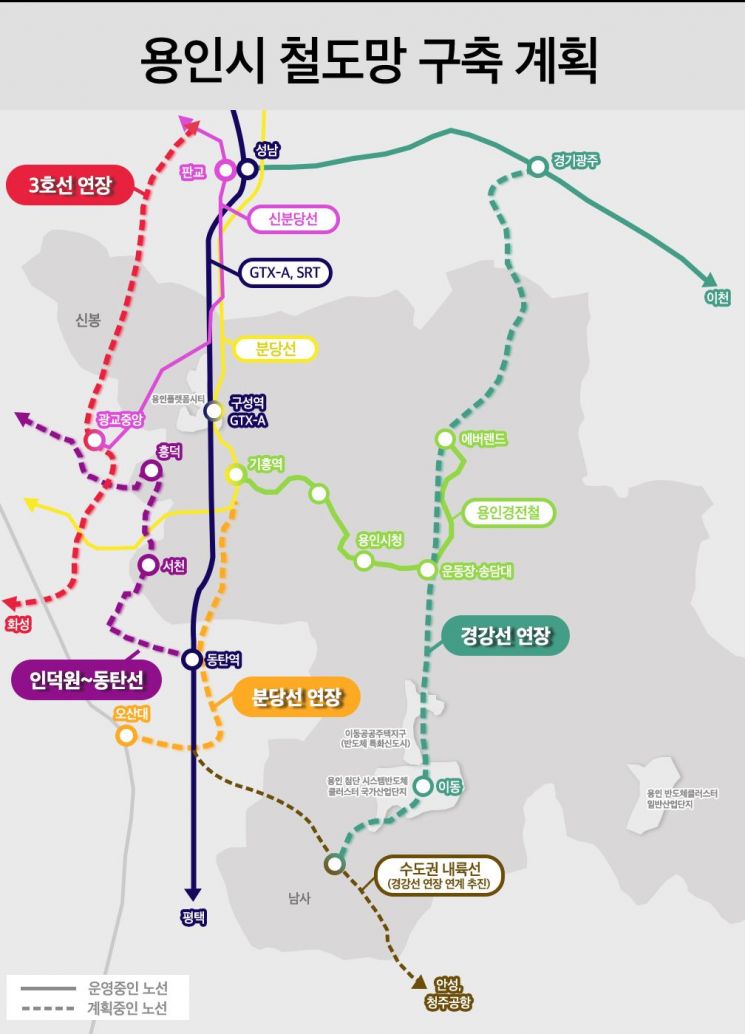
Extension of Gyeonggang Line from Gwangju to Idong and Namsa
The extension of the Gyeonggang Line is a project to branch off the existing Gyeonggang Line between Seongnam Pangyo Station and Yeoju Station to connect to the semiconductor belt. The plan is to branch off at Gyeonggi Gwangju Station, pass through Yongin Everland, and connect to Idong and Namsa-eup, where the Advanced System National Industrial Complex and Idong Public Housing District are located. Yongin City plans to promote this as a double-track railway with a total length of 37.97 km.
The city expects a total project cost of 2.3154 trillion KRW for the Gyeonggang Line extension. A self-feasibility study jointly conducted by Yongin City and Gwangju City showed a benefit-cost ratio (B/C) of 0.92, confirming its feasibility. Based on the study results, the city has officially requested the Ministry of Land, Infrastructure and Transport to include this as a new project in the '5th National Railway Network Construction Plan.'
The Ministry of Land, Infrastructure and Transport's 5th National Railway Network Construction Plan is expected to be established around June to July next year. Mayor Lee Sang-il of Yongin said, "Since the government has expressed its intention to expand Yongin's railway network, including the Gyeonggang Line, the city will work with the government to expedite the implementation schedule as much as possible."
Mayor Lee also emphasized that the Gyeonggang Line extension project will significantly complement the metropolitan railway network in the southeastern metropolitan area, including the GTX A~F lines, which are national policies.
He said, "Through the Gyeonggang Line extension, the Idong and Namsa areas will be connected to the Metropolitan Inland Line, Suseo-Gwangju Line, Metropolitan Express Railway (GTX) Line A, Shinbundang Line, and Wolgot-Pangyo Line, enabling the establishment of a southeastern metropolitan railway belt."
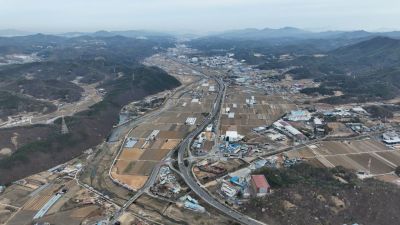 A panoramic view of Idong and Namsa-eup areas in Cheoin-gu, Yongin-si, where the advanced system semiconductor national industrial complex is planned to be established.
 [Photo by Yongin-si]
Extension of Seoul Subway Line 3
The extension of Seoul Subway Line 3 is a project to relocate the Suseo train depot in Gangnam-gu, Seoul, to the southern Gyeonggi region and extend Line 3 southward through Seongnam, Yongin, Suwon, and Hwaseong. Although Yongin City, Suwon City, and Seongnam City have cooperated since 2019 to conduct a preliminary feasibility study aiming for inclusion in the 5th National Railway Network Construction Plan, the project was effectively halted due to unresolved issues securing the train depot site.
However, momentum has revived under the 8th local government administration. Following a joint agreement among Mayor Lee Sang-il of Yongin, Mayor Shin Sang-jin of Seongnam, Mayor Lee Jae-jun of Suwon, and Mayor Jeong Myeong-geun of Hwaseong to realize the project, a five-party agreement including Gyeonggi Governor Kim Dong-yeon was signed in February last year.
In May last year, facilitated by Mayor Lee Sang-il, the four city mayors held a meeting with Seoul Mayor Oh Se-hoon and agreed to proceed with related consultations once the feasibility study results for the jointly commissioned Line 3 extension project were available.
Yongin City is currently conducting a feasibility study jointly with the three other cities to confirm the project's viability. The city plans to hold a mid-term report meeting next month to review the optimal route plan and then request the Ministry of Land, Infrastructure and Transport to include it as a new metropolitan railway project in the 5th National Railway Network Construction Plan scheduled for May.
Extension of Bundang Line from Giheung Station to Osan University Station
Aside from existing projects, the extension of the Bundang Line from Giheung Station to Osan University Station is attracting attention. At the public discussion on the 25th, Mayor Lee said, "I hope the government will actively support the prompt realization of the Bundang Line extension from Giheung Station to Osan University Station, which is included in the 4th National Railway Network Construction Plan."
The Bundang Line extension was confirmed as a new project in the 4th National Railway Network Construction Plan in 2021. It is a metropolitan railway stretching 16.8 km from Giheung Station through Hwaseong Dongtan to Osan University Station.
According to the city's own feasibility analysis, the total project cost is estimated at 1.0243 trillion KRW, with a B/C ratio of 0.71. The Korea Rail Network Authority is currently reviewing ways to improve the project's economic feasibility.
The city views the Bundang Line extension as a key axis connecting major economic hubs such as the Advanced System Semiconductor National Industrial Complex and the Platform City being developed in Bojeong and Mabuk-dong areas, and is working with Hwaseong and Osan cities to enhance the project's economic viability.
Mayor Lee said, "Since the Bundang Line extension is expected to serve as a core transportation network for IT talents commuting from Seoul and Pangyo to the semiconductor national industrial complex, I hope the government will expedite the project."
Indeokwon-Dongtan Double-Track Railway
The Indeokwon-Dongtan Line is a double-track railway connecting Indeokwon in Anyang City through Uiwang, Suwon, and Yongin to Dongtan in Hwaseong City. It covers a total distance of 39 km with 18 stations. Construction began in 2021 to resolve traffic congestion in the southwestern Gyeonggi region.
Although the opening was targeted for 2026, the project cost increased following the detailed design, leading the Ministry of Economy and Finance to decide last year to re-examine the appropriateness of the project plan for the uncontracted sections. As a result, construction was halted on all sections except the turnkey sections 1 and 9, and resumed only at the end of last year.
Mayor Lee said, "Once the Indeokwon-Dongtan Line opens, it will significantly alleviate traffic difficulties for residents in the southwestern Gyeonggi region. Since the government has promised to expedite construction, we will do our best to provide administrative support to accelerate the delayed work."
© The Asia Business Daily(www.asiae.co.kr). All rights reserved.
![Clutching a Stolen Dior Bag, Saying "I Hate Being Poor but Real"... The Grotesque Con of a "Human Knockoff" [Slate]](https://cwcontent.asiae.co.kr/asiaresize/183/2026021902243444107_1771435474.jpg)
















