"Thinking Residents Will Return Like 4 Years Ago Is a Government Misconception"
"Further Reduction in Essential Medical Staff Makes Catastrophe Inevitable"
Ahn Cheol-soo, co-chairman of the People Power Party's joint election countermeasures committee, called on June 26 for a reconsideration of the government's plan to increase medical school quotas by 2,000. Chairman Ahn also proposed establishing a review period of about 3 to 6 months regarding the expansion of medical school quotas and forming a broad social medical reform consultative body.
In the afternoon, Chairman Ahn held an emergency press conference at the Seongnam City Council and disclosed a mediation plan discussed with the emergency committee of Seoul National University College of Medicine and Seoul National University Hospital, as well as resident doctors. He stated, "The current plan to increase medical school quotas by 2,000 should be re-examined and verified through scientific evidence and data to calculate the necessary expansion number." He added, "The application of the increased medical school quotas will be implemented after scientific estimation (expected to take 3 to 6 months) and subsequent agreement."
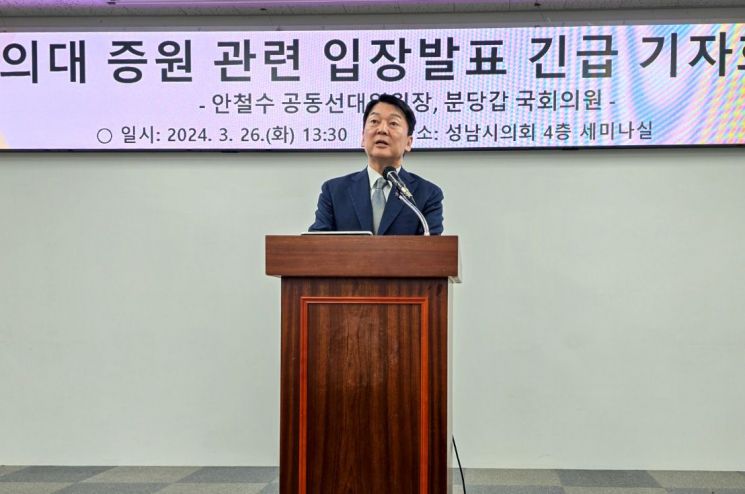
Furthermore, he proposed the formation of a broad social medical reform consultative body acceptable to both the government and medical organizations, rather than a medical-government agreement body. He added that credible domestic institutions and civic groups should be included.
Chairman Ahn urged the government to take direct action to ensure the return of resident doctors. He said, "The government should actively respond so that doctors return to patients. If the medical strike continues for more than a month in the current situation, there is a concern about an irreparable collapse of the medical system. Therefore, the government should directly intervene to facilitate the return of resident doctors."
He also introduced discussions on medical reform measures beyond the mediation plan, including improvements to the essential medical system, fostering medical scientists, and preparing support measures for local medical systems.
Regarding the background for proposing the emergency mediation plan, Chairman Ahn said, "It is a misunderstanding by the government to think that resident doctors will return as they did during the medical crisis four years ago." He warned, "If this continues, they will never return. Currently, even professors cannot persuade their resident doctor students. As a result, it is obvious that the number of essential medical personnel will further decrease." He pointed out the issue of medical personnel shortages caused by medical students' military enlistment and leaves of absence, warning, "South Korea's medical community will face a total catastrophe of exhaustion, with no students, no interns, no resident doctors, and only specialist doctors remaining."
© The Asia Business Daily(www.asiae.co.kr). All rights reserved.
![Clutching a Stolen Dior Bag, Saying "I Hate Being Poor but Real"... The Grotesque Con of a "Human Knockoff" [Slate]](https://cwcontent.asiae.co.kr/asiaresize/183/2026021902243444107_1771435474.jpg)















