30 Billion Investment in Solid Ionics, a Sulfide-Based Electrolyte Manufacturer
Samyang Corporation has initiated its entry into the core materials business for all-solid-state batteries.
On the 25th, Samyang announced on the 26th that it signed a 3 billion KRW investment contract with 'Solid Ionics,' a company developing and manufacturing solid electrolytes, at the Samyang Group headquarters in Jongno-gu, Seoul. Samyang had previously invested 2.9 billion KRW in Solid Ionics in 2020, bringing the total investment to 5.9 billion KRW.
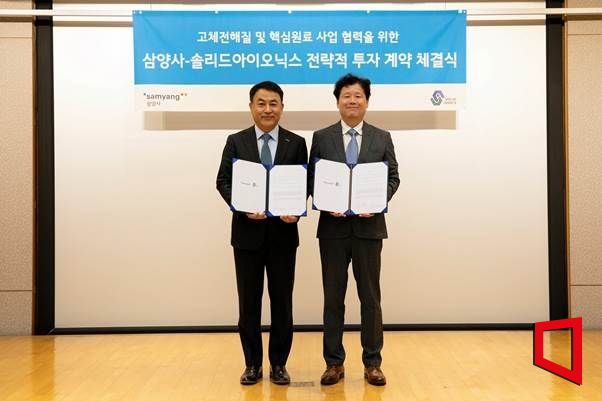 Kang Hoseong, CEO of Samyang Corporation (left), is taking a commemorative photo with Shin Dongsuk, CEO of Solidionics, at the investment contract ceremony held on the 25th at the Samyang Group headquarters in Jongno-gu, Seoul. (Photo by Samyang Corporation)
With this investment, Samyang secured solid electrolytes, the core material of all-solid-state batteries, and lithium sulfide (Li2S), the main raw material, as part of its business portfolio, while Solid Ionics can accelerate the commercialization of its products under development.
All-solid-state batteries are next-generation secondary batteries that replace the electrolyte, which transfers ions between the cathode and anode, from liquid to solid. Compared to conventional batteries, they have lower risks of explosion and fire and offer significantly higher energy density, earning them the nickname "dream battery." Depending on the constituent materials, they are classified into sulfide-based, oxide-based, and polymer-based types. Market attention is focused on sulfide-based all-solid-state batteries, which have the highest ion conductivity and can achieve excellent energy density.
The material that Solid Ionics is about to mass-produce is a solid electrolyte used in sulfide-based all-solid-state batteries. It holds patented technology for manufacturing lithium sulfide, the main raw material, enabling stable supply of raw materials and securing a competitive position in terms of price.
Solid Ionics has established a semi-continuous production process where raw material input and production occur simultaneously. Compared to batch production processes that produce a fixed amount at a time, this method allows faster production speed and mass production of products with uniform quality. It also has its own process capable of producing both electrolyte membrane-sized particles and smaller cathode material particles, with a monthly production capacity of 1 ton.
Currently, it is preparing for final tests for commercialization with all-solid-state battery developers and plans to complete a sulfide-based solid electrolyte production plant in Ulsan with an annual capacity of 1,200 tons by 2027.
Kang Ho-sung, CEO of Samyang Corporation, said, "The most important core material in all-solid-state batteries is the solid electrolyte, and domestic and international companies are competing to develop it to secure market leadership." He added, "We will use this investment as an opportunity to fully enter the all-solid-state battery materials business and plan to further expand our portfolio in the battery materials sector."
© The Asia Business Daily(www.asiae.co.kr). All rights reserved.
![Clutching a Stolen Dior Bag, Saying "I Hate Being Poor but Real"... The Grotesque Con of a "Human Knockoff" [Slate]](https://cwcontent.asiae.co.kr/asiaresize/183/2026021902243444107_1771435474.jpg)















