On the 23rd, the three major carriers raise switching subsidies and expand eligible models
However, benefits decrease for new models and low-cost plans
"Subsidies not high... Preference for Seongji likely to continue"
After the Korea Communications Commission's request for cooperation on the transition subsidy policy, the three major mobile carriers simultaneously increased their transition subsidies. However, since the benefits for new devices such as the Galaxy S24 and iPhone 15, as well as low-cost plans, remain limited, the controversy over the policy's effectiveness is unlikely to be completely resolved.
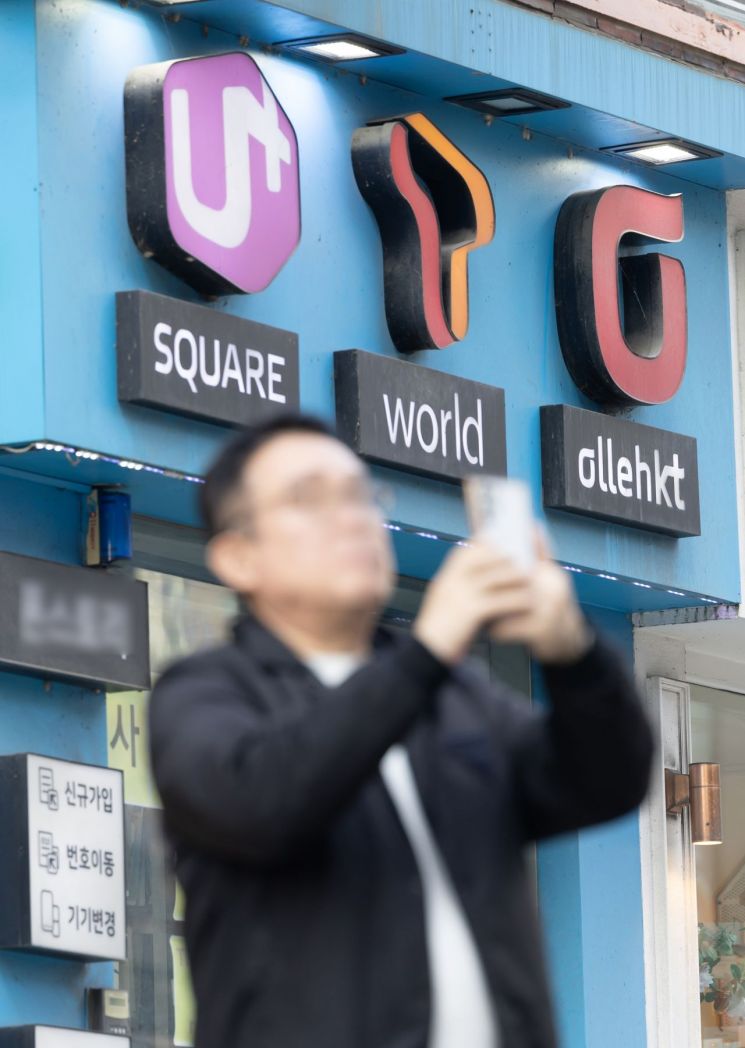
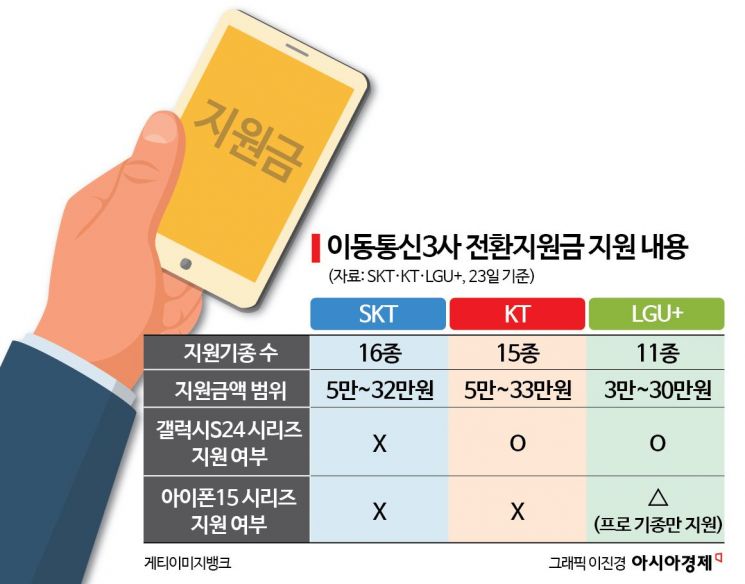
According to the industry on the 27th, SK Telecom, KT, and LG Uplus raised transition subsidies and expanded the types of eligible devices on the 23rd. For customers switching their numbers, the three carriers provide transition subsidies ranging from a minimum of 30,000 KRW to a maximum of 330,000 KRW. SKT supports 16 device models, KT supports 15, and LG Uplus supports 11 models.
However, the subsidies for new models preferred by consumers who want to purchase new phones, such as the Galaxy S24 and iPhone 15, remain low. LG Uplus offers up to 90,000 KRW for the Galaxy S24 series and up to 100,000 KRW only for the iPhone 15 Pro models, making it the carrier with the highest subsidy among the three. KT provides up to 80,000 KRW only for the Galaxy S24 series and does not offer transition subsidies for the iPhone 15 series. SKT does not provide transition subsidies for either series.
This is because users tend to switch even without subsidies for the latest phones. An industry insider said, "The latest phones have a launch effect, so even with low subsidies, many users switch," adding, "They focused their marketing efforts by carefully considering where subsidies would maximize marketing effectiveness."
The fact that support is centered on high-priced plans also makes it difficult to quell the controversy over the effectiveness of the transition subsidy policy. All three carriers require customers to choose the highest-priced plans to receive the maximum subsidy. SKT requires customers to select plans costing at least 55,000 KRW to receive subsidies for all models except the mid-range Galaxy Wide6, Galaxy A15, and Galaxy A24. KT also requires plans costing at least 55,000 KRW except for the Galaxy Jump3 and Galaxy A15. LG Uplus similarly requires customers to use plans in the 50,000 KRW range or higher for models other than the mid-range Galaxy A24 and Galaxy A15.
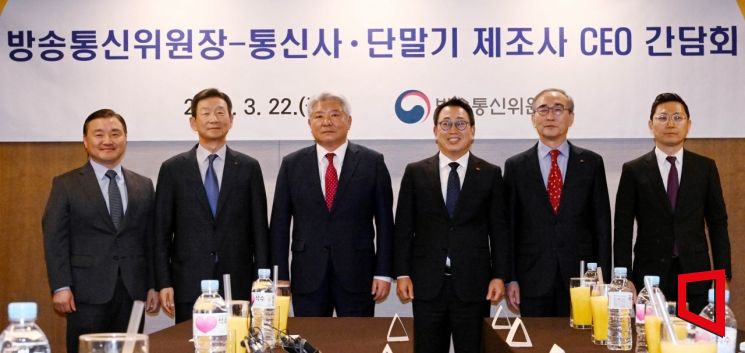 On the 22nd, at the Press Center in Jung-gu, Seoul, Kim Hong-il, Chairman of the Korea Communications Commission, and related officials are taking a commemorative photo during a meeting between the Chairman of the Korea Communications Commission and CEOs of telecommunications companies and device manufacturers. From the left: No Tae-moon, President of Samsung Electronics; Hwang Hyun-sik, CEO of LG U+; Kim Hong-il, Chairman of the Korea Communications Commission; Yoo Sang-young, CEO of SK Telecom; Kim Young-seop, CEO of KT; Ahn Cheol-hyun, Vice President of Apple Korea. Photo by Joint Press Corps
The Korea Communications Commission stated that it is natural for transition subsidies to be concentrated on high-priced plans. Park Dong-joo, Director of the Broadcasting and Communications User Policy Bureau, said during a back briefing after a meeting with the three carriers and manufacturers on the 23rd, "Competition will start with high-end models initially, but then it is expected to expand like dominoes," adding, "Past subsidy competitions also followed that pattern."
Mobile phone dealers also find it difficult to feel an increase in customers due to the transition subsidies. Mr. A, who works at a dealership in Jongno-gu, said, "For the Galaxy S24 and iPhone 15 series, device upgrades are more common than number portability," adding, "Although inquiries have increased due to the raised transition subsidies, actual contracts are only about one-tenth of that." Mr. B, working at a dealership in Eunpyeong-gu, said, "Demand would increase if there were large discounts, but since the subsidies are not substantial, no one uses a 100,000 KRW plan for six months just to get a few tens of thousands of won discount," adding, "The phenomenon of customers visiting specific stores will continue."
Experts criticized this as a predictable outcome. Han Seok-hyun, Director of the Seoul YMCA Citizen Mediation Office, said, "There should have been guidelines from the start not to discriminate based on plans or subsidy amounts, but the government was probably in a situation where enforcement was difficult," pointing out, "Since only the upper limit of the transition subsidy was set, carriers focused on areas where they could make profits." He added, "They should have anticipated and prepared for these predictable vulnerabilities in the policy before implementation, but there was no such preparation."
© The Asia Business Daily(www.asiae.co.kr). All rights reserved.
![Clutching a Stolen Dior Bag, Saying "I Hate Being Poor but Real"... The Grotesque Con of a "Human Knockoff" [Slate]](https://cwcontent.asiae.co.kr/asiaresize/183/2026021902243444107_1771435474.jpg)


















