Controversy Sparked by Ansan Player
"Colonial Residue" vs "Respect for Traditional Culture"
Tense Opposition to Some Concerns Raised
A sculptural installation symbolizing a Japanese shrine (神社) has been set up on Siridan-gil in the High-tech area of Gwangju Metropolitan City, sparking controversy.
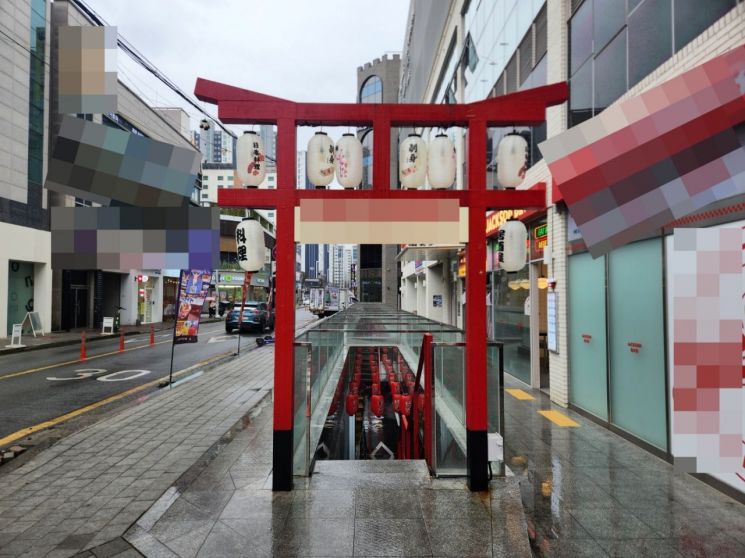 At the entrance of the stairs leading to an underground food court in Ssangam-dong, Gwangsan-gu, Gwangju Metropolitan City, there is a sculpture reminiscent of a 'torii,' the pillar gate found at the entrance of a shrine.
 [Photo by Jin-Hyung Park]
On the afternoon of the 25th, at the entrance to the stairs leading to an underground food court in Ssangam-dong, Gwangsan-gu, Gwangju Metropolitan City, there is a sculpture reminiscent of a 'torii,' the pillar gate found at the entrance of a shrine. This location is a shopping center housing Japanese-style stores operated under the Trip to Japan concept.
However, since shrine visits were promoted by Imperial Japan as part of its policy to erase Korean identity, negative opinions such as "colonial remnants" have emerged.
Ko Wook, head of the Gwangju branch of the Liberation Association, said in a phone interview, "Considering the painful history our country experienced during the Japanese colonial period, this may not align with the national sentiment," adding, "It is quite concerning that remnants of Japanese colonial civilian governance are openly installed in a busy downtown area."
A citizen named Lee, met on the street, said, "We must not forget that our ancestors were brutally suppressed for refusing to visit shrines in the past," and added, "I agree that depending on one's perspective, such sculptures that evoke the era of Japanese imperialism can cause feelings of disgust."
Opposing views also exist. There are many voices saying that it should be understood and accepted within the context of Japanese traditional culture. Consuming various content related to Japanese culture is seen as a natural phenomenon.
Mr. Kim said, "I understand that this is not a facility installed by a government office nor does it display the Rising Sun Flag symbolizing Japanese militarism," and added, "It is simply a Japanese-style shopping center created at the private level. The harsh criticism should stop."
Ms. Park pointed out, "Just as self-employed people doing business in Chinatown are not labeled as pro-China or sycophants, the exchange and contact of diverse cultures from different countries is a natural phenomenon," and warned, "We should not escalate conflicts with an excessive pro-Japan frame."
Nearby merchants have expressed concerns that the recent controversy might affect their business operations. A restaurant official said, "Statements that demonize all Japanese culture and provoke futile debates could harm innocent self-employed business owners," adding, "A store right next door even suffered from point-deduction attacks. We are very worried that our sales might be impacted as well."
Meanwhile, An San, the triple gold medalist in archery at the Tokyo Olympics, used the term "traitor" on her social media on the 16th referring to a Japanese-style pub in the underground food court but apologized three days later, stating, "I had no intention to disparage any specific store or individual."
© The Asia Business Daily(www.asiae.co.kr). All rights reserved.
![Clutching a Stolen Dior Bag, Saying "I Hate Being Poor but Real"... The Grotesque Con of a "Human Knockoff" [Slate]](https://cwcontent.asiae.co.kr/asiaresize/183/2026021902243444107_1771435474.jpg)
















