The Most Used OTT Platforms Are YouTube 1st and Netflix 2nd
Annual Economic Benefits of 6.156 Trillion Won, 88% for Broadcasting
It has been found that South Korean citizens are willing to pay about 17,000 KRW per month for online video streaming services (OTT).
According to the article "Motivations for Using OTT Services and Analysis of Welfare and Benefits" contributed by Associate Professor Imina from Sookmyung Women’s University and Professor Byun Sang-gyu from Hoseo University to the Korean Broadcasting Society’s academic journal "Broadcasting and Communication" on the 23rd, the willingness to pay for OTT subscriptions among South Korean citizens was surveyed at 16,974 KRW per month.
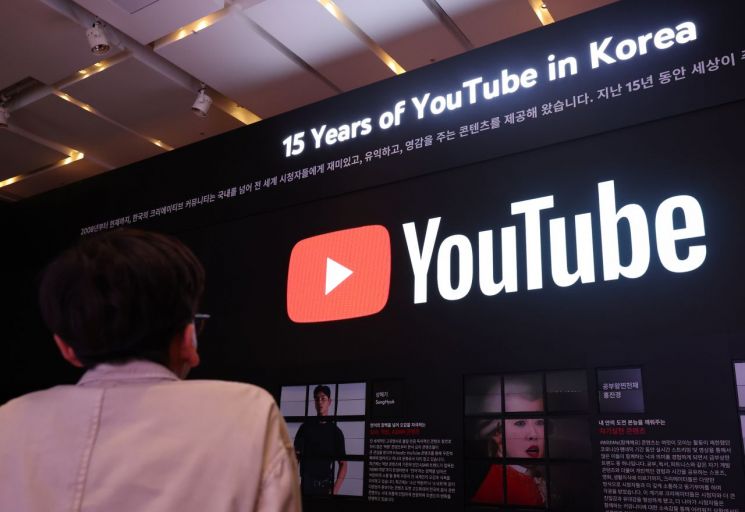 At the 'Google for Korea 2023' event held by Google Korea on the afternoon of September 21 last year at the Shilla Hotel in Jung-gu, Seoul, visitors are viewing the pre-exhibition commemorating the 15th anniversary of YouTube.
 [Photo by Yonhap News]
According to responses from 500 paid and free OTT users aged 20 to 80 nationwide, surveyed online by the research team, the average daily OTT usage time was 160.77 minutes, with YouTube being the most used OTT service at 453 respondents (90.6%).
Among paid subscription OTT services, Netflix was the most popular with 329 respondents (65.8%), followed by TVING (125), YouTube Premium and Naver Now (96), Wavve (87), Disney Plus (77), KakaoTV (61), U+ Mobile TV (54), Watcha (47), Season (24), and Amazon Prime (9).
The average number of OTT services used, both paid and free, was 3.17.
The research team analyzed that OTT services generated an annual benefit of 6.156 trillion KRW to the national economy. This figure estimates individual utility at the overall economic level.
When indirectly compared to revenue, this amount reaches 88% of the total 2021 broadcasting business revenue of paid broadcasting platform operators (SO, IPTV, satellite), which was 7.012 trillion KRW, and is 1.68 times the total revenue of general PP (excluding home shopping PP) at 3.6684 trillion KRW.
The researchers stated, "It is necessary to implement various support policies such as tax credits for content production costs, support for overseas expansion, and other content production funding," adding, "Ultimately, it is also necessary to ease regulations on existing media to enable healthy competition with traditional broadcasting media."
They also explained that policies are needed to ensure OTT provides more benefits to users while minimizing negative effects that hinder these benefits.
There is a need for policy decisions on how to impose minimum measures to secure public interest in OTT services, similar to broadcasting.
The research team emphasized, "In particular, post-content review should be pursued for OTT operators or content providers with significant influence, or for the content itself."
© The Asia Business Daily(www.asiae.co.kr). All rights reserved.
![Clutching a Stolen Dior Bag, Saying "I Hate Being Poor but Real"... The Grotesque Con of a "Human Knockoff" [Slate]](https://cwcontent.asiae.co.kr/asiaresize/183/2026021902243444107_1771435474.jpg)
















