"Impact Not Expected to Be Significant" Amid Observations
Concerns Over Equipment Repair and Parts Replacement
Accelerating Chinese Localization Also a Challenge
As the United States announced plans to control not only semiconductor manufacturing equipment exports to China but also the services and parts sales already exported, companies including Samsung Electronics, SK Hynix, as well as material, parts, and equipment suppliers are closely monitoring the situation. There is a growing sense of crisis that new administrative regulations on parts control may continue to increase in the future.
Alan Estevez, U.S. Deputy Under Secretary for Industry and Security at the Department of Commerce, explained at a House Foreign Affairs Committee hearing on the 21st (local time) that the U.S. is trying to persuade allies to introduce semiconductor export controls to China similar to those of the U.S. in order to achieve "parity" between U.S. companies and allied companies. He said, "Before implementing semiconductor equipment export controls, we are also looking into service issues for equipment already exported to China," adding, "We are also dealing with components. We are trying to get allies to join us."
The semiconductor industry expects the immediate impact to be limited but expressed mid- to long-term concerns about the plan to expand the scope of regulations to include services and parts, separate from the system responding to equipment regulation strengthening.
Industry insiders are paying attention to the part of Deputy Under Secretary Estevez's remarks referring to "equipment sold or planned to be sold to China." Major domestic material, parts, and equipment companies such as Exicon and Dongjin Semichem operate businesses in China, but their main customers are Samsung Electronics and SK Hynix, which operate factories locally. The proportion of direct supply to Chinese semiconductor companies is minimal.
Samsung Electronics and SK Hynix were recognized as "Verified End Users (VEU)" by the U.S. government last year, so they expect no major issues in their processes within their Chinese operations. VEU is a comprehensive licensing system that allows export and import of designated items to pre-approved companies. This means advanced U.S.-made semiconductor equipment can be brought into Chinese factories without U.S. government approval. An Ki-hyun Ahn, Executive Director of the Korea Semiconductor Industry Association, said on the 22nd, "Samsung Electronics and SK Hynix have been designated as VEUs, so even if these regulations are enforced, there will be no problems in the Chinese supply chain."
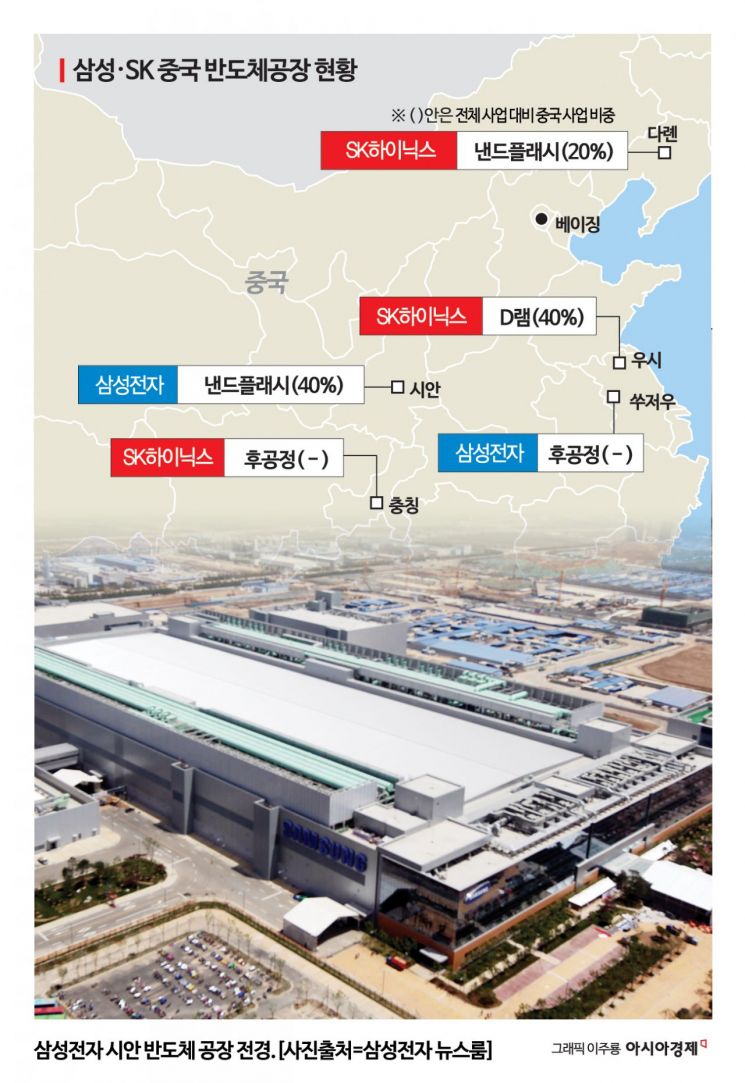
However, since both Samsung and SK have a significant portion of their business in China, they cannot ignore long-term risks related to China. Samsung Electronics has a NAND flash production plant in Xi'an, China, which produces 40% of Samsung's total NAND. SK Hynix produces 40% of its total DRAM at its Wuxi plant in China and 20% of its total NAND at its Dalian NAND (Solidigm) plant.
Additionally, future equipment repairs and parts replacements may face some obstacles. In particular, if there is any disruption in the supply of "consumable parts," which are essential for semiconductor front-end etching equipment, it could cause difficulties in equipment operation and process maintenance. Consumable parts include quartz, ceramics, and lamps. Executive Director Ahn said, "If the supply of consumable parts is not received, the equipment cannot be operated properly." An industry insider said, "If equipment and parts at Chinese sites become outdated, repairs and replacements may be hindered, and Samsung and SK are no exceptions."
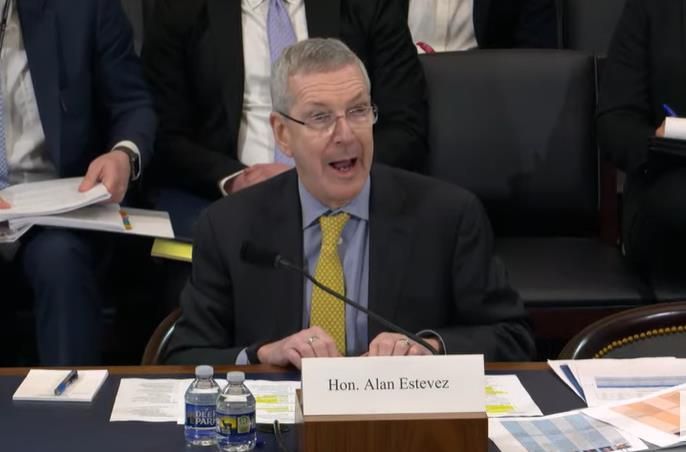 Allen Estevez, Deputy Assistant Secretary for Industry and Security at the U.S. Department of Commerce, is testifying at the House Foreign Affairs Committee hearing held in Washington DC on the 21st (local time).
 [Photo by Yonhap News]
According to senior officials from Samsung and SK partner companies, the degree to which material, parts, and equipment companies accept Deputy Under Secretary Estevez's remarks varies. Material companies see no major issues but are monitoring the situation as there may be risks related to importing some materials used in equipment. Parts and equipment companies, although overwhelmingly trading with Samsung and SK and not directly dealing with Chinese companies, view the situation seriously. A senior official from a partner company said, "Our company is committed to strictly complying with U.S. Department of Commerce regulations and managing risks within the scope of U.S. administrative regulations," adding, "Companies supplying 'consumable parts' used in advanced equipment could be directly hit."
In the mid- to long-term, there are concerns that as the pace of China’s localization accelerates, the business of small parts and equipment companies as well as Samsung and SK partners in China may shrink, potentially reducing production capacity at business sites. An industry insider said, "The problem is not the intensity of the regulations mentioned by Deputy Under Secretary Estevez itself, but that the contraction of partner companies' business in China could cause setbacks in yield improvement, capacity increase, and process innovation."
Samsung Electronics and SK Hynix have refrained from making official statements. An industry insider said, "Important business sites like Samsung Xi'an and SK Wuxi and Dalian will not be significantly affected by these regulations," but added, "It is necessary to closely monitor the trend of regulations."
© The Asia Business Daily(www.asiae.co.kr). All rights reserved.
![Clutching a Stolen Dior Bag, Saying "I Hate Being Poor but Real"... The Grotesque Con of a "Human Knockoff" [Slate]](https://cwcontent.asiae.co.kr/asiaresize/183/2026021902243444107_1771435474.jpg)
















