Korea's Producer Price Index in February Rises 0.3% Month-on-Month
Agricultural Products and Oil Prices Drive Price Increase
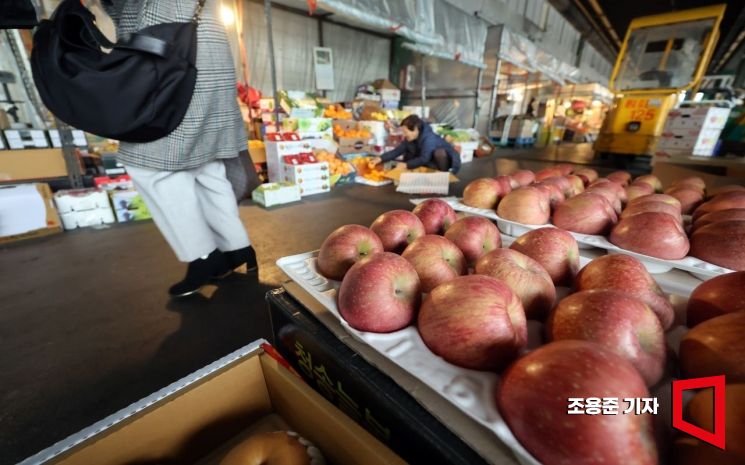 The prices of fruits, including apples, have skyrocketed, causing an emergency in the cost of food on dining tables. Not only consumers trying to buy fruits but also small business owners running fruit shops in the produce market are deeply sighing over their livelihoods. Garak Agricultural Market, Songpa-gu, Seoul. Photo by Jo Yongjun jun21@
Prices of agricultural and marine products such as tangerines, apples, napa cabbage, and rockfish have risen sharply, causing the producer price index to increase for the third consecutive month.
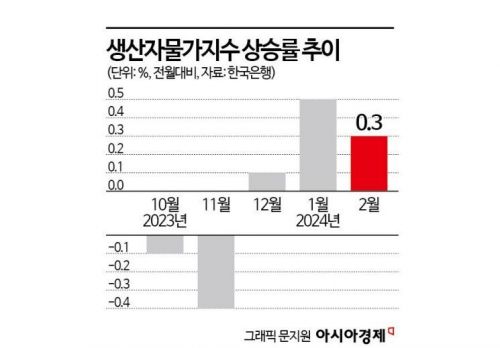
According to the "February 2024 Producer Price Index (Provisional)" released by the Bank of Korea on the 22nd, the producer price index in February rose by 0.3% compared to the previous month.
The producer price index growth rate decreased in October (-0.1%) and November (-0.4%) last year but has been rising for three consecutive months since December (0.1%), January this year (0.5%), and February (0.3%).
Specifically, agricultural, forestry, and fishery products (0.8%) and manufactured goods (0.5%) saw significant increases. Among agricultural, forestry, and fishery products, agricultural products (2.6%) and marine products (2.1%) rose substantially, while livestock products fell (-2.4%).
By item, agricultural products increased compared to the previous month, with tangerines (31.9%) and napa cabbage (26.3%) rising. In particular, tangerines surged 154.9% and apples 121.9% compared to the same month last year.
Marine products rose compared to the previous month, centered on rockfish (57.9%) and frozen squid (6.1%). On the other hand, livestock products declined, mainly pork (-9.4%) and eggs (-5.4%).
Yoo Sung-wook, head of the Price Statistics Team at the Bank of Korea’s Economic Statistics Bureau, said, "Apple prices rose due to reduced shipment volumes," adding, "We need to monitor the prices of substitute fruits and imported fruits going forward."
Manufactured goods rose 0.5% compared to the previous month, driven by a significant increase in coal and petroleum products (3.3%) due to rising international oil prices, along with chemical products (0.9%) and primary metal products (0.6%).
Electricity, gas, water, and waste services fell 0.9% compared to the previous month, as industrial city gas prices dropped (-9.2%).
Yoo said, "Industrial city gas prices are linked to international liquefied natural gas (LNG) prices, which fell 9.2% this month," and forecasted, "Prices are expected to rise next month."
In the service sector, financial and insurance services (0.6%) and real estate services (0.4%) increased, resulting in a 0.2% rise compared to the previous month.
By special classification, food prices rose 0.3%, fresh food increased 2.6%, energy rose 0.4%, and IT increased 0.1% compared to the previous month.
The domestic supply price index in February rose 0.5% compared to the previous month, with raw materials (1.7%), intermediate goods (0.3%), and final goods (0.5%) all increasing.
The total output price index rose 0.5% compared to the previous month, with manufactured goods (0.8%), services (0.2%), and agricultural, forestry, and fishery products (0.8%) all increasing.
© The Asia Business Daily(www.asiae.co.kr). All rights reserved.
![Clutching a Stolen Dior Bag, Saying "I Hate Being Poor but Real"... The Grotesque Con of a "Human Knockoff" [Slate]](https://cwcontent.asiae.co.kr/asiaresize/183/2026021902243444107_1771435474.jpg)
















