Severe Patient Groups Issue Statement on Government Medical School Quota
Confirmed Increase Is Not a Resolution of the Standoff
Forced to Return to Long-Term Care Hospitals for Secondary Treatment
"Once again, there were no measures for patients in the government's plan. Moreover, the government showed an absurd perception that there is not much harm to patients in this situation that started with the resignation of residents."
The government announced the distribution of increased medical school quotas by school, but severely ill patients expressed that they cannot simply welcome this. There are concerns that the intensified standoff between the government and the medical community will worsen the medical crisis.
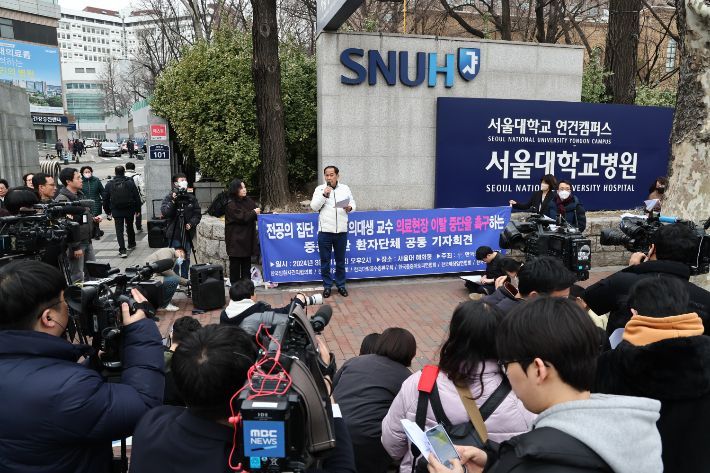 On the afternoon of the 11th, a press conference urging the cessation of resident doctors' resignations and medical school professors' withdrawal from medical sites was held in front of Seoul National University Yeongeon Campus in Jongno-gu, Seoul, hosted by the Korea Severe Disease Alliance.
 [Photo by Yonhap News]
The Korea Severe Disease Alliance, consisting of seven organizations including the Korea Cancer Patient Rights Council and the Korea Lou Gehrig's Disease Federation, stated in an appeal on the 21st, "The government's announcement made in a situation where even medical school professors have announced their resignation on the 25th is not resolving but rather confirming the standoff between the Korean Medical Association (KMA) and the government."
Earlier, the Ministry of Health and Welfare explained that among the total 408 emergency medical institutions, 396 (97%) are operating without reducing beds, and public medical institutions and military hospital emergency rooms are also operating without significant changes.
The alliance pointed out that the number of consultations received at the 'Physician Collective Action Damage Report and Support Center,' which has been operating since the 19th of last month, has exceeded 1,600 cases, saying, "From the perspective of severely ill patients, it is impossible to understand what the government is looking at."
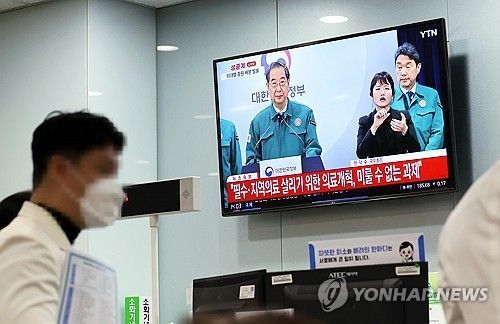
As of the previous day, the Ministry of Health and Welfare announced that the total number of consultations at the Damage Report Support Center was 1,643, of which 548 were damage reports. The most common types of damage cases were 'surgery delays' (379 cases) and 'cancellation and refusal of treatment' (144 cases).
The alliance emphasized, "Since the medical strike began, patients who were urged to be discharged from tertiary hospitals have been holding on at secondary hospitals, but now they have to move to nursing hospitals," and added, "The government must present practical measures, not measures without any plan."
They continued, "The sacrifices of patients will now become visible and occur explosively," expressing concern that "only then will the fight between these two organizations (the medical community and the government), each with their own objectives, stop." They also reported that after most residents left the field, patients who were refused treatment or urged to be discharged at tertiary hospitals barely endured by moving between secondary hospitals, but now are moving to nursing hospitals and facilities.
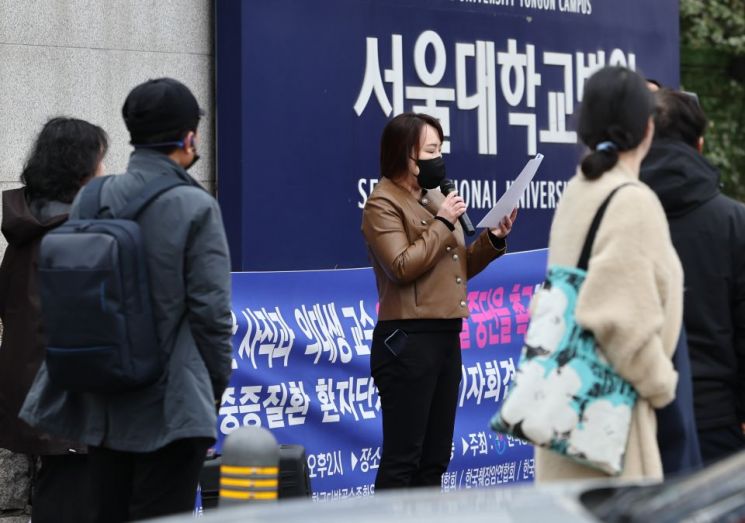 On the afternoon of March 11, a press conference urging the resignation of residents and the cessation of medical school professors leaving the medical field was held in front of Seoul National University Yeongeon Campus in Jongno-gu, Seoul, hosted by the Korea Severe Disease Association.
 [Photo by Yonhap News]
The alliance stated, "Did the government not truly learn from the Korean Medical Association's tough response during the 2020 strike and intend to drive medical staff into this chaotic situation?" and asked, "What perception do they have about the patients who are dying and will die, and how are they creating this situation?"
They urged, "The government should not force sacrifices on patients but must present effective measures. Patients are exhausted by hospitals saying 'please wait' or 'you need to find another hospital,'" and added, "They must present practical measures that allow patients to feel secure as members of this country, not 'measures without any plan' from those responsible."
Earlier, on the 20th, Lee Ju-ho, Deputy Prime Minister for Social Affairs and Minister of Education, announced the '2025 Academic Year Medical School Student Quota Allocation by University' plan, stating that of the 2,000 increased quotas, 1,639 (82%) will be allocated to non-metropolitan areas, and the remaining 361 to the Gyeonggi and Incheon regions. Medical schools in the Seoul area were not included in the increase.
The Deputy Prime Minister emphasized, "This expansion of medical school quotas is the beginning of medical reform and an opportunity to resolve the medical gap between metropolitan and non-metropolitan areas," adding, "The Ministry of Education, as a partner of universities, will listen to voices from the field and work together to solve the difficulties universities face due to the increase in medical school quotas."
© The Asia Business Daily(www.asiae.co.kr). All rights reserved.
![Clutching a Stolen Dior Bag, Saying "I Hate Being Poor but Real"... The Grotesque Con of a "Human Knockoff" [Slate]](https://cwcontent.asiae.co.kr/asiaresize/183/2026021902243444107_1771435474.jpg)


















