Multiple Posts Report Bedbugs Found on Subway Seats
Last Year, Bedbug Consultations in Japan Highest Since 1987
As bedbugs spread in Japan, a bug map to avoid them is being shared online. On the 12th (local time), Hong Kong media HK01 reported that bedbug incidents are occurring one after another in Japan, sharing a story from a Japanese netizen. Mr. A recently posted on his X (formerly Twitter) account that he discovered an insect suspected to be a bedbug on a seat while returning home on the Tokyo subway with his wife, drawing attention.
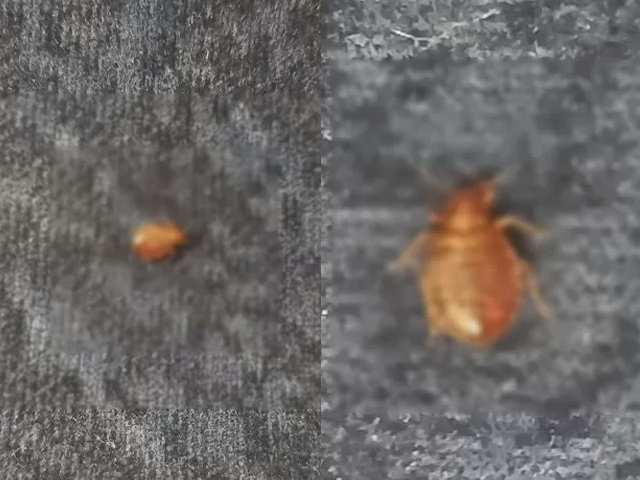 A Japanese netizen, Mr. A, recently posted on his X (formerly Twitter) account that he discovered an insect suspected to be a bedbug on a seat while returning home on the Tokyo subway with his wife, attracting attention.
 [Photo by X (formerly Twitter)]
Mr. A said, "I was traveling from Ueno Station to Utsunomiya Station when I saw a bug that looked like a bedbug on the seat." He continued, "The bug suspected to be a bedbug was about 5mm long. We were all startled and scared, so we immediately got up from the seat." Mr. A and his wife reported this to the station staff, handed over the captured bedbug, and after returning home, they disinfected their clothes and disposed of their luggage immediately.
The photo shared by Mr. A shows an insect suspected to be a bedbug. Recently, on social media, posts from others reporting bedbugs found on seats of other Tokyo subway lines have been appearing one after another, increasing citizens' fears. HK01 explained that bedbugs have been found not only on the JR Utsunomiya Line but also on the Ueno-Tokyo Line, Sh?nan-Shinjuku Line, Takasaki Line, and Tokaido Main Line.
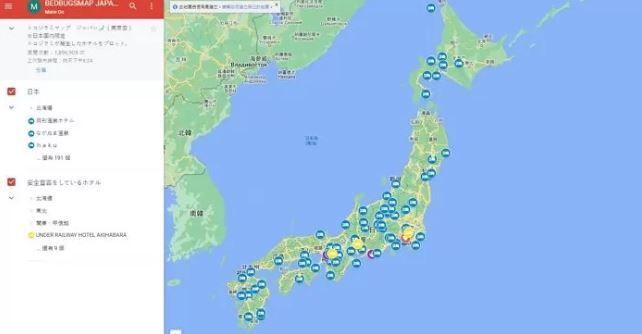 As bedbugs became rampant, Japanese netizens created and shared the 'Bedbug Map (BEDBUGSMAP JAPAN).'
 [Photo by X (formerly Twitter)]
The lines where bedbugs have been found are frequently used not only by citizens but also by travelers. As bedbugs have become rampant, Japanese netizens have created and shared a "BEDBUGS MAP JAPAN." This map marks locations suspected of bedbug infestations. It includes popular tourist spots as well as many popular hotels frequented by travelers, such as hotels in Kabukicho, Shinjuku, Tokyo, and hotels in Tenmabashi, Osaka.
The hotels mentioned on the map have hurriedly explained that they have thoroughly cleaned their premises.
Serious Bedbug Problem in Japan... Caution Needed When Traveling
Earlier, around December last year, NHK reported that the number of bedbug consultations received by the "Tokyo Pest Control Association," composed of pest control professionals in Tokyo, from January to November last year reached 306 cases, far exceeding the total 246 cases for the entire previous year. This is nearly three times the 120 cases recorded in 2017 and is the highest number since records began in 1987. Earth Chemical, a pesticide manufacturer, also announced that bedbug consultations increased eightfold from January to November last year compared to the same period the previous year.
In Osaka, bedbug consultations in 2023 also reached 307 cases, about a 50% increase compared to 2022. In November last year, bedbugs appeared on the subway, prompting the subway company to disinfect all 1,380 train cars. The bedbug problem in Japan is emerging as a serious social issue.
Bedbugs are nocturnal creatures about 5mm in size that hide between furniture during the day and come out at night to bite people. They have a strong reproductive ability, laying hundreds of eggs throughout the house, making eradication difficult. Being bitten by bedbugs can cause itching, allergic reactions, and skin swelling, so caution is necessary. If bitten by bedbugs, it is recommended to apply a cold compress with an ice pack wrapped in a thin towel. If itching is severe, applying topical steroids or taking antihistamines as advised by a doctor may help. If bedbugs are found on clothes, they should be washed in water hotter than 70 degrees Celsius or exposed to the hot air of a dryer for more than two hours.
© The Asia Business Daily(www.asiae.co.kr). All rights reserved.
![Clutching a Stolen Dior Bag, Saying "I Hate Being Poor but Real"... The Grotesque Con of a "Human Knockoff" [Slate]](https://cwcontent.asiae.co.kr/asiaresize/183/2026021902243444107_1771435474.jpg)

















