Government: "If a position opens, it will be filled in schools"
Bang Jae-seung: "How can 1,000 people fail?"
Jung Jae-hoon: "Some fellows do not want to become teachers"
As the government has declared that it will secure faculty members to handle the 2,000 additional medical students, medical school professors point out that realistically, recruiting faculty is impossible. This directly contradicts the government's stance that securing faculty personnel is not an issue, suggesting that it will be difficult to find new professor candidates with the necessary educational and research experience in reality.
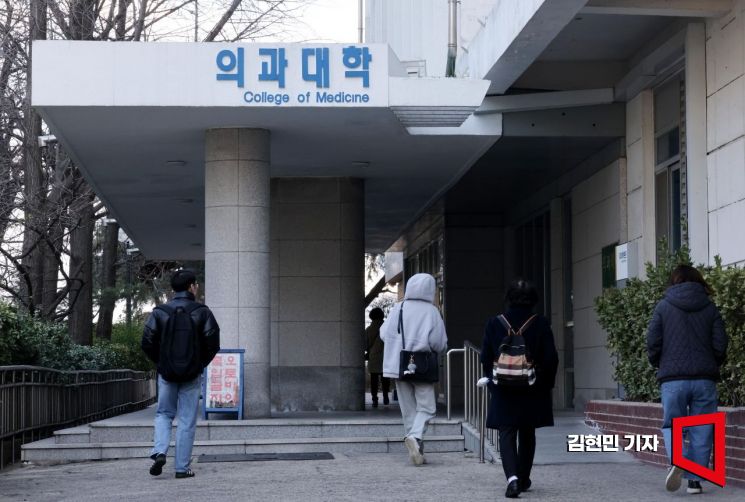 Students are entering a medical school in Seoul on the 20th, the day the results of the increased medical school admission quota distribution, which sparked conflict between the medical community and the government, are being announced. Photo by Hyunmin Kim kimhyun81@
Bang Jae-seung, Chairman of the Emergency Response Committee of Medical School Professors Nationwide (Professor at Seoul National University College of Medicine), said on MBC Radio on the 21st, "One regional national university has a quota of 49 students, but it was announced as 200," adding, "Anyone who is a professor responsible for practical medical field work knows well that it is impossible to educate when about four times the number of medical students are assigned."
He also explained that due to the nature of medical school professors, it is necessary to accumulate experience as well as degrees, and it is difficult to find qualified faculty members within just one year. Chairman Bang said, "You have to work so hard that you might die, and only by around age 45 can you be called a competent professor. How could 1,000 such professors suddenly fall from the sky?" and stated, "(Faculty expansion) is not possible."
The government claims that when recruiting full-time medical school professors, existing funded professors can fill the positions. Medical school professors progress through stages of 'clinical professor → funded professor → full-time professor,' and the increasing full-time professor positions will be supported by funded professors, while clinical professors will fill the vacancies left by funded professors. Park Min-su, Vice Minister of Health and Welfare, said at the briefing on medical school expansion allocation the day before, "Clinical professor positions can be filled again by fellows (residents)," adding, "Currently, many fellows finish their training at hospitals and go into private practice, but if university positions become available, many of them are expected to settle in academia, so there is no problem securing faculty personnel."
However, medical school professors argue that relying solely on this structure will not secure medical school faculty. Jeong Jae-hoon, Professor of Preventive Medicine at Gachon University College of Medicine, emphasized, "Currently, the number of funded professors is not that abundant, and while some funded professors may consider moving to full-time positions, many fellows do not want to become faculty members." He added, "I believe the likelihood of smooth faculty recruitment under the current circumstances is low," and further explained, "In basic medical sciences, it is even more difficult as they are currently operated by full-time professors and doctoral students who are not medical school graduates."
© The Asia Business Daily(www.asiae.co.kr). All rights reserved.
![Clutching a Stolen Dior Bag, Saying "I Hate Being Poor but Real"... The Grotesque Con of a "Human Knockoff" [Slate]](https://cwcontent.asiae.co.kr/asiaresize/183/2026021902243444107_1771435474.jpg)















