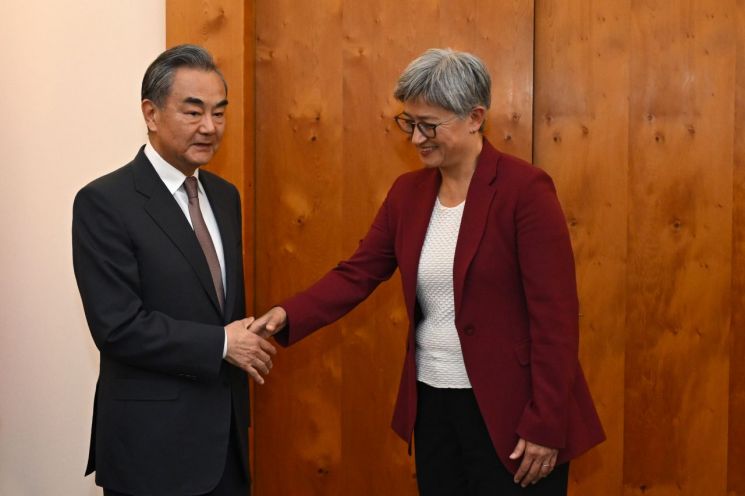
 The king visiting Australia is shaking hands with Wang Yi, China's Foreign Minister (left), who met with Penny Wong, Australia's Foreign Minister, at the Australian House of Representatives in Canberra on the 20th.
 [Image source=EPA Yonhap News]
Wang Yi, Director of the Central Foreign Affairs Office of the Chinese Communist Party and Minister of Foreign Affairs, who visited Australia, urged Australia to conduct an "independent diplomacy" while checking the United States. This was interpreted as a message that Australia should break free from the influence of the U.S. (a third party), given that Australia has participated in China containment centered on its ally, the United States.
According to the Chinese Ministry of Foreign Affairs and Australian AAP news on the 20th, Director Wang mentioned the conflicts between China and Australia during his opening remarks at the 7th China-Australia Foreign Strategic Dialogue held in Canberra with Penny Wong, Australia's Foreign Minister, saying, "The ups and downs over the past decade have left us lessons to learn and valuable experiences."
Director Wang said, "The most essential thing is to uphold mutual respect," adding, "China has never interfered in Australia's internal affairs and has respected the system and path chosen by Australia." He also said, "Likewise, we hope Australia will continue to keep the promises made under diplomatic relations regarding China's sovereignty, dignity, and legitimate concerns, and handle them with respect and proper treatment."
He argued, "Independence should be an important principle in Australia's foreign policy," and "The China-Australia relationship should neither target a third party nor be influenced or interfered with by a third party." "Since the bilateral relationship has already returned to the right track, we should neither hesitate, deviate, nor look back," he added.
Australian Minister Wong said, "Australia is always Australia, and China is always China," emphasizing, "It is in all our interests to commit to a preventive structure to reduce the risk of conflict, and it is important that communication does not stop." However, she also said, "We expect to speak frankly about issues such as Australians detained in China, human rights, maritime security and safety, the Pacific, Russia's invasion of Ukraine, and regional and international conflicts in the Middle East," adding, "We know that differences between the two countries will not disappear, but through dialogue, we can manage our differences."
Previously, China was Australia's largest export market, but the two countries experienced serious conflicts during the conservative government of former Australian Prime Minister Scott Morrison (August 2018?May 2022). In 2018, Australia excluded Huawei, China's largest telecommunications equipment company, from participating in the 5G mobile network project, and in 2020, it demanded an international investigation into the origins of COVID-19. China retaliated by imposing high tariffs on more than ten Australian products, including wine, beef, barley, and coal.
However, after the Australian Labor Party government took office in 2022, a reconciliation atmosphere was created. Last year, Prime Minister Albanese visited China for the first time in seven years as an Australian prime minister, improving bilateral relations. This visit by Director Wang was also the first by a Chinese foreign minister to Australia in seven years.
Currently, China’s high tariff barriers on Australian wine, lobster, beef, and other products remain. Recently, tensions persist as China applied espionage charges against Yang Hengjun, a Chinese-Australian writer, sentencing him to death with a reprieve.
© The Asia Business Daily(www.asiae.co.kr). All rights reserved.
![Clutching a Stolen Dior Bag, Saying "I Hate Being Poor but Real"... The Grotesque Con of a "Human Knockoff" [Slate]](https://cwcontent.asiae.co.kr/asiaresize/183/2026021902243444107_1771435474.jpg)















