Response of Flour Companies to Raw Material Price Reduction Demands
Price Reduction Demands Also for Sugar and Cooking Oil
Additional Pressure Expected on Manufacturers Using These Ingredients
As the government launches an all-out 'price control' campaign ahead of the April 10 National Assembly general election next month, the food industry is on edge. CJ CheilJedang, the top player in the food industry, has lowered flour prices reflecting the global decline in wheat prices, and retail stores have started large-scale fruit discount events in response to the recent controversy over 'applelation' (apple inflation). As calls for price reductions on raw materials such as sugar and cooking oil grow louder, food manufacturers using these ingredients are also facing pressure to lower prices.
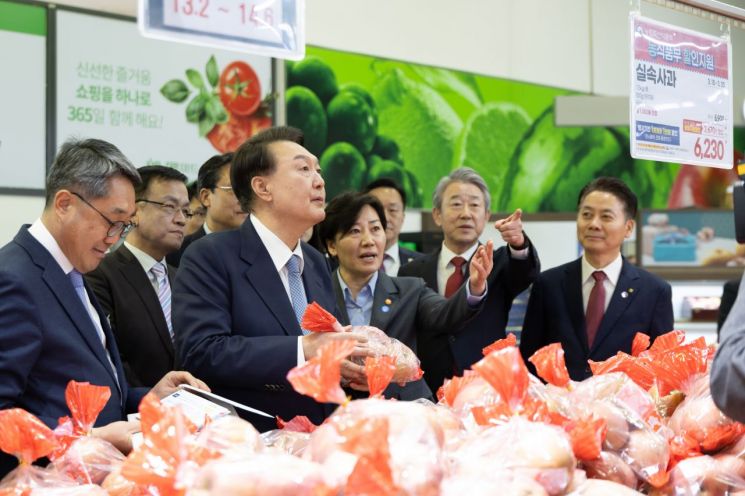 President Yoon Suk-yeol is inspecting fruit prices while checking discounted apples supported by the Ministry of Agriculture, Food and Rural Affairs at the Nonghyup Hanaro Mart Yangjae branch fruit section in Seocho-gu, Seoul on the 18th.
 [Photo by the Office of the President]
According to the industry on the 20th, the Fair Trade Commission sent investigators to three domestic sugar companies?CJ CheilJedang, Samyangsa, and Daehan Sugar?to conduct on-site investigations and secure sales data related to sugar. This is reportedly to verify suspicions that these sugar manufacturers and sellers colluded to raise prices.
This action came just one day after President Yoon Suk-yeol visited the Nonghyup Hanaro Mart Yangjae branch on the 18th to check the price situation, stating, "The government will immediately implement special measures to lower grocery prices," and warning, "We will respond strictly if excessive price hikes or unfair practices such as collusion lead to profiteering."
The government has been pressuring price reductions based on the fact that raw material prices for items such as sugar, flour, and cooking oil have fallen. On the 6th, Choi Sang-mok, Deputy Prime Minister and Minister of Economy and Finance, pointed out at the 'Price-Related Ministers' Meeting' that "recent international grain prices have dropped by about half compared to the 2022 peak, but this has not been properly reflected in food prices such as flour and cooking oil, causing high inflation."
The flour industry was the first to respond. The day before, CJ CheilJedang announced that it would lower prices for three consumer products?1kg and 2.5kg all-purpose flour and 3kg frying flour?starting from the 1st of next month. The reduction rate ranges from 3.2% to 10% based on regular prices at large supermarkets, with an average reduction of 6.6%. Frying flour and all-purpose flour are products commonly used in households and account for more than half of total B2C (business-to-consumer) sales volume. Other companies such as Samyangsa and Daehanjeobun are also reviewing details such as timing and reduction rates to lower prices for consumer products.
Going forward, the government may use price reductions in flour and sugar as a pretext to further induce price cuts from manufacturers producing products like ramen, confectionery, and bakery items that use these raw materials. A food industry insider said, "Last year, the government and consumer groups strongly demanded price cuts for finished products like ramen, snacks, and bread, but manufacturers often responded that it was difficult because raw material prices remained unchanged. Considering this, this year, the government seems to be targeting raw material suppliers first before focusing on manufacturers."
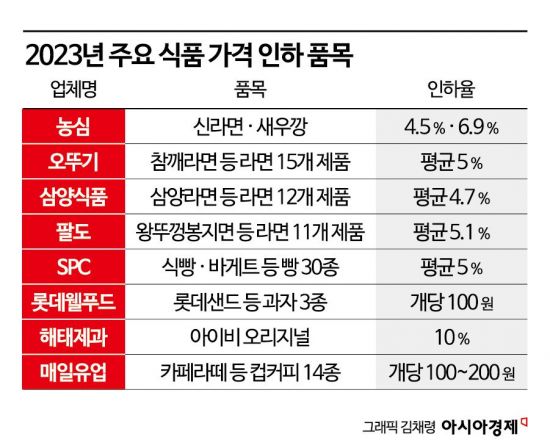
Food companies also lowered prices for major products last year as consumer inflation surged to the 6% range in the first half, unable to withstand the government's strong pressure. Because of this, they are reluctant to accept further price cuts. However, the government and civic groups are increasing pressure based on the fact that some food companies achieved their highest-ever profits since their founding last year.
In response, the distribution industry has rolled up its sleeves to stabilize sharply rising fruit prices. Homeplus is offering major items with soaring prices, including apples, under the 'Only Price Explosion Products Cider Special' promotion. Emart sold spring strawberries and new oriental melons at discounted prices from the 8th to the 14th and, together with the Ministry of Agriculture, Food and Rural Affairs, sold apples and pears at affordable prices through the 'Agricultural Product Discount (Nonghal) Coupon.' Coupang purchased 900 tons of fruit and is discounting seven types of fruit, including apples, strawberries, and tomatoes, through Rocket Fresh until the 24th.
Earlier, on the 15th, the government announced an additional investment of 150 billion won to stabilize prices of agricultural and livestock products, including 75.5 billion won for delivery price support and 45 billion won for discount support. Additionally, the government is considering including apples, whose prices have recently surged, in the government stockpile items. The plan is to secure large quantities and release stockpiled products into the market when needed to help stabilize prices.
As the government continues its daily price control efforts, retail prices of apples and pears have temporarily turned downward. According to the Korea Agro-Fisheries & Food Trade Corporation (aT) Agricultural Product Distribution Information, as of the 19th, the retail price for 10 pears (Shingo, standard grade) was 41,486 won, down 0.2% from the previous day. The retail price for 10 apples (Fuji, standard grade) also fell 1.8% to 23,725 won compared to the previous day.
© The Asia Business Daily(www.asiae.co.kr). All rights reserved.
![Clutching a Stolen Dior Bag, Saying "I Hate Being Poor but Real"... The Grotesque Con of a "Human Knockoff" [Slate]](https://cwcontent.asiae.co.kr/asiaresize/183/2026021902243444107_1771435474.jpg)
















