Purpose of Expanding Electric Vehicle Adoption... Fuel Efficiency Calculations Set Lower
Industry and Environmental Groups Generally Praise
The U.S. government has decided to gradually lower the fuel efficiency ratings for electric vehicles. This move aims to encourage companies to increase the proportion of electric vehicle sales by considering fuel efficiency regulations.
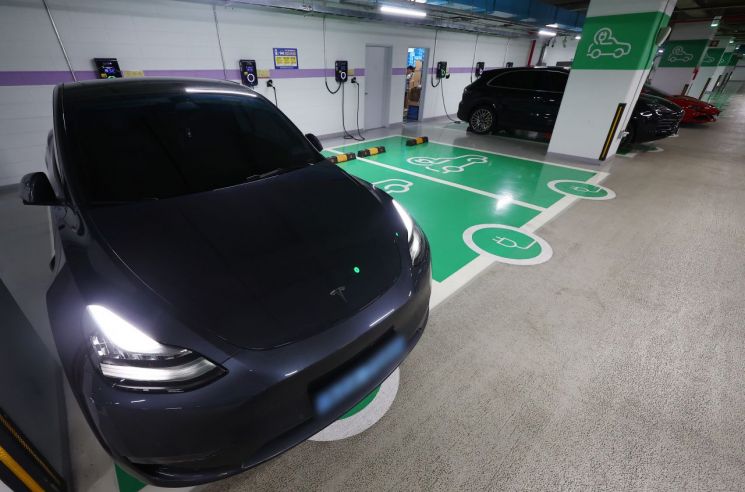
According to major foreign media including Bloomberg on the 19th (local time), the U.S. Department of Energy announced a final rule on the same day to calculate electric vehicle fuel efficiency lower than before. Accordingly, the conversion factor used as the standard when converting electric vehicle energy consumption to internal combustion engine fuel efficiency will be gradually adjusted from the current 82 kilowatt-hours per gallon to 29 kilowatt-hours per gallon by 2030.
For example, for model years 2024 to 2026, the existing regulations will apply, but in 2027, the factor will change from 80 kilowatt-hours per gallon → in 2028, 50.4 kilowatt-hours per gallon → in 2029, 36.8 kilowatt-hours per gallon → and after 2030, it will be eased to 29 kilowatt-hours per gallon. However, this is more lenient than the Department of Energy’s proposal last year to apply 23.2 kilowatt-hours per gallon starting in 2027.
The United States has implemented the Corporate Average Fuel Economy (CAFE) standards for the automotive industry since 2012. Regardless of vehicle type, including internal combustion engine vehicles and electric vehicles, if a manufacturer’s average fuel efficiency for all vehicles produced in a year falls below this standard, they must pay substantial fines. To avoid fines, companies must expand their electric vehicle sales ratio. It is known that the three major U.S. automakers (General Motors, Stellantis, and Ford) face fines exceeding $10 billion to be paid by 2032 for failing to meet CAFE standards.
The U.S. government expects that this regulation will lead the automotive industry to expand incentives for electric vehicle sales. Michael Berube, Deputy Assistant Secretary for Sustainable Transportation and Fuels at the Department of Energy, said, “The new regulation will help encourage electric vehicles in the early stages of implementation” and added, “It is also expected to contribute to energy savings.”
The industry appears relieved as the regulation is more lenient than initially discussed. John Bozzella, president of the Alliance for Automotive Innovation (AAI), described this phased adjustment as a “positive development.”
Environmental groups advocating for stricter fuel efficiency regulations have also generally expressed satisfaction. They have pointed out that the government’s conversion factor has been generous in calculating electric vehicle fuel efficiency, allowing manufacturers to offset CAFE standards by selling a small number of electric vehicles even if they sell many high carbon-emission pickup trucks. Pete Hoffman, senior attorney at the Natural Resources Defense Council, said, “Now the industry must step on the accelerator for selling more fuel-efficient vehicles to save consumers’ fuel costs.”
Meanwhile, the Biden administration is expected to unveil the key points of its plan to strengthen greenhouse gas and vehicle emission standards to promote electric vehicle sales on the 20th. The Environmental Protection Agency (EPA) is set to announce emission standards for vehicle models released between 2027 and 2032, but foreign media report that the plan is likely to be more lenient than originally planned due to industry opposition.
© The Asia Business Daily(www.asiae.co.kr). All rights reserved.
![Clutching a Stolen Dior Bag, Saying "I Hate Being Poor but Real"... The Grotesque Con of a "Human Knockoff" [Slate]](https://cwcontent.asiae.co.kr/asiaresize/183/2026021902243444107_1771435474.jpg)















