The government's efforts to prevent the spread of livestock infectious diseases have been shown to contribute to stabilizing the supply and demand of livestock products and alleviating the burden on consumer prices.
According to the Ministry of Agriculture, Food and Rural Affairs, in mid-March, the consumer price of eggs was 6,167 won (30 special eggs), chicken was 6,016 won (1 kg of fresh chicken), and pork was 2,251 won (100g of pork belly), maintaining the same level as the previous year. In January 2024, sales and sales volume of eggs at large supermarkets increased by 7.1% and 12.9%, respectively, compared to the previous year.
An official from the Ministry of Agriculture, Food and Rural Affairs stated, "According to Statistics Korea, the consumer price index for livestock products fell by 1.5% compared to the previous month in February and rose by only 1.1% compared to the same month last year, showing relative stability. This trend of stable livestock product prices is evaluated as the effect of proactive livestock infectious disease prevention measures strongly promoted since last winter with active cooperation from local governments, related organizations, farms, and affiliates."
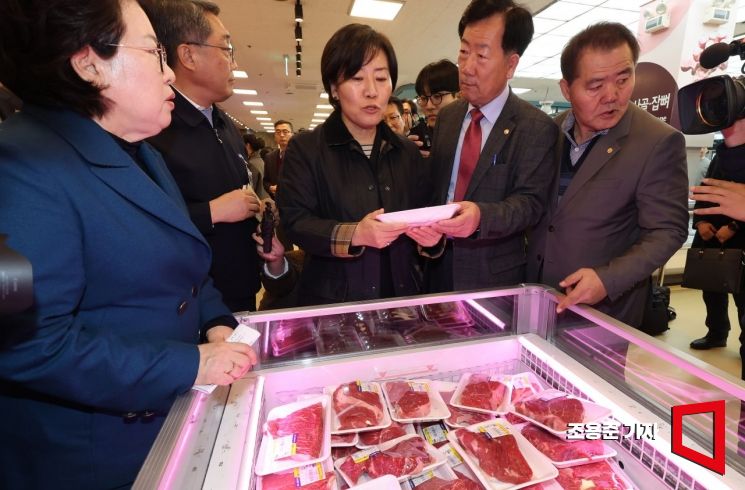 Song Mi-ryeong, Minister of Agriculture, Food and Rural Affairs, visited Hanaro Mart Yangjae branch in Seocho-gu, Seoul on the 7th to conduct an on-site inspection ahead of promoting the Soprise 2024 Korea Hanwoo Sale. Photo by Jo Yong-jun jun21@
In the past, the prices of livestock products such as eggs frequently surged due to the spread of highly pathogenic avian influenza during winter. The price of eggs (30 special eggs) during 2016-2017 and 2020-2021, when laying hen damage was severe, rose by 31% (5,590 → 7,326 won) and 34% (5,666 → 7,612 won) respectively in March compared to the average in September before the special quarantine period. However, this year, damage was minimized by culling 3.61 million birds, the smallest scale in the past 15 years (since 2008).
The Ministry of Agriculture, Food and Rural Affairs designated the period from October last year to February this year as a special quarantine period and prepared and implemented a strategic map by risk for 68 cities and counties to prepare for the outbreak of highly pathogenic avian influenza. In addition, affiliates established systematic voluntary quarantine programs and regularly conducted self-education, inspections, and improvements for contracted farms as part of the special quarantine measures.
Especially unlike previous winters, concerns about large-scale outbreaks were high due to the simultaneous detection of two serotypes at poultry farms, multiple outbreaks in the early stages in Jeonnam region, and the characteristics of the virus circulating this season. However, the Ministry evaluated that damage was minimized and contributed to stabilizing egg prices closely related to people's lives through focused quarantine management in high-risk areas and dense laying hen complexes (10 locations) and expanded installation of disinfection facilities in laying hen farms with more than 100,000 birds as proactive quarantine measures targeting laying hens.
Furthermore, the Ministry proactively responded to supply and demand instability following the outbreak of highly pathogenic avian influenza in December last year by importing and supplying 1.12 million fresh eggs in January this year. It also collaborated with producer organizations to lower farm gate prices (500 won per 30-egg carton) and used egg self-support funds to reduce the delivery price of eggs supplied by NongHyup to large supermarkets by 1,300 won per 30-egg carton, thereby inducing a decrease in consumer prices.
For Hanwoo beef and Korean pork, discount events using self-support funds were held during the high-consumption Lunar New Year season, and occasional discount events continue after the holiday to ease consumer burden. In the case of Hanwoo beef, due to a large number of livestock and slaughtered heads, wholesale prices have fallen, causing management difficulties for farms. To expand consumption and reduce consumer price burdens, nationwide agricultural cooperatives' Hanaro marts are conducting large-scale discount events with discounts of up to 30-50%.
Minister Song Miryeong said, "Despite difficult conditions during this winter's special quarantine period, local governments, related organizations, and farms worked together, minimizing damage to livestock farms caused by infectious diseases and stabilizing livestock product prices. We are able to repay consumers who cooperated and supported quarantine efforts with stable livestock product prices. We will continue to listen to various opinions from the field and do our best to stabilize prices going forward."
© The Asia Business Daily(www.asiae.co.kr). All rights reserved.
![Clutching a Stolen Dior Bag, Saying "I Hate Being Poor but Real"... The Grotesque Con of a "Human Knockoff" [Slate]](https://cwcontent.asiae.co.kr/asiaresize/183/2026021902243444107_1771435474.jpg)
















