"Need for Investment Diversification to Prepare for a Bear Market"
As the U.S. stock market continues its historic rally, the Chief Investment Officer (CIO) of global investment bank Morgan Stanley has issued a warning to investors. There are concerns that structural pressures on the dollar could spread to cause a decline in the U.S. stock market.
On the 18th (local time), according to Bloomberg News, Lisa Shalett, Morgan Stanley CIO, stated, "Investors need to prepare for the possibility that the dollar may turn weak."
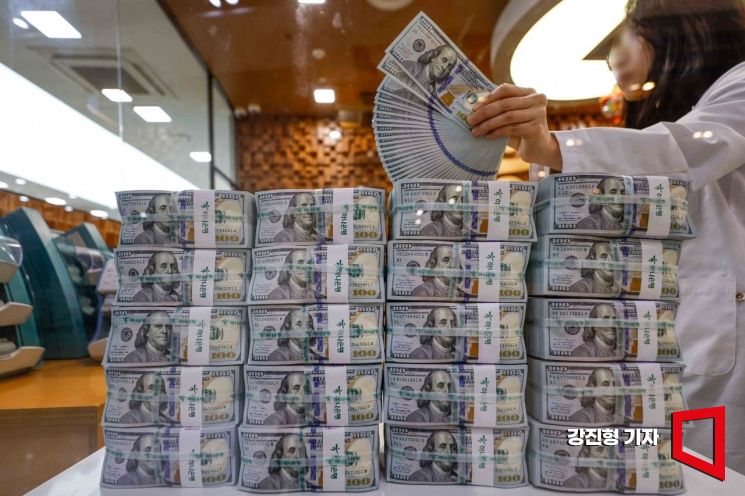 As the USD-KRW exchange rate surpassed 1,340 won early in the trading session, an employee is organizing dollars at the Counterfeit Response Center of Hana Bank in Jung-gu, Seoul on the 17th. Photo by Jinhyung Kang aymsdream@
CIO Shalett said, "Deteriorating relations with China, the end of Japan's Yield Curve Control (YCC), and rising prices of Bitcoin and commodities suggest that the currency's appreciation may have reached its limit. Now that the dollar bull market has entered a mature phase, it is necessary to closely monitor the correlation between dollar strength and price-to-earnings (P/E) ratios."
Shalett analyzed that the recent dollar strength has functioned as a core element of U.S. monetary easing policies. It suppressed import-related inflation and exerted downward pressure on energy prices, thereby driving stock price increases.
While the dollar fell about 3% last year, it showed strength this year as expectations for Federal Reserve (Fed) monetary easing diminished. However, despite waning expectations for rate cuts, the dollar's upward momentum has stalled. The Bloomberg Dollar Index fell 0.5% this month, while Bitcoin and gold prices reached record highs.
CIO Shalett recently advised investors to look toward overseas markets in preparation for a potential correction in the U.S. stock market. While the U.S. market enjoys a boom, she has previously warned about the bull market. Morgan Stanley's Michael Wilson, CIO, also set the S&P 500 target at 4500 this year.
Shalett analyzed that the dollar is under pressure as the Bank of Japan (BOJ) is expected to end its negative interest rate policy. The yen and Japanese interest rates are rising, and funds are flowing out of U.S. stocks. In particular, during the U.S. presidential election period, fractures in U.S.-China relations are expected to accelerate dollar weakness, a movement that has been reflected in gold prices.
She said, "If global policies begin to realign into mixed trends as before the global financial crisis, or if excessive optimism causes the market to collapse and dollar weakness continues, investors could benefit from asset diversification and geographic diversification."
© The Asia Business Daily(www.asiae.co.kr). All rights reserved.

















