Last year, among 804 smokers who visited the smoking cessation clinic in Jung-gu, Seoul (District Mayor Kim Gil-seong), 339 succeeded in quitting smoking for more than six months. According to the government joint evaluation, Jung-gu's smoking cessation success rate is 42.2%, far exceeding the average of 30.4% for smoking cessation clinics in Seoul's autonomous districts.
The secret to the high smoking cessation success rate lies in Jung-gu's smoking cessation program, which closely manages and encourages smokers to ensure their determination to quit does not waver.
The Jung-gu smoking cessation clinic runs a six-month program. Based on the nicotine dependence assessment results, nine customized professional counseling sessions are conducted. The carbon monoxide concentration in exhaled breath is measured, and smoking cessation aids such as nicotine patches are distributed to manage the quitting process. Various therapies that can replace smoking are also introduced to help maintain cessation.
For those with high nicotine dependence, participation in the national smoking cessation support center's smoking cessation camp is encouraged. For severe smokers who cannot use nicotine aids, connections are made to receive drug treatment. Those who maintain smoking cessation for six months receive commemorative gifts to share the joy of success.
In addition, the district operates a "mobile smoking cessation clinic" program that visits workplaces with high smoking rates. Over the past year, the clinic consistently visited 15 workplaces once a week for more than three months, confirming the "determination to quit smoking" of 299 office workers and encouraging them to maintain cessation.
It is even more important not to get close to cigarettes in the first place. Last year, the district visited a total of 29 places from daycare centers to high schools, providing smoking cessation education tailored to the level of 597 infants and toddlers and 1,708 elementary, middle, and high school students. Professional smoking cessation counselors used videos, teaching aids, and writing exercises to explain △ the harms of smoking △ the harmful components of cigarettes on youth health △ tobacco companies' marketing strategies targeting youth.
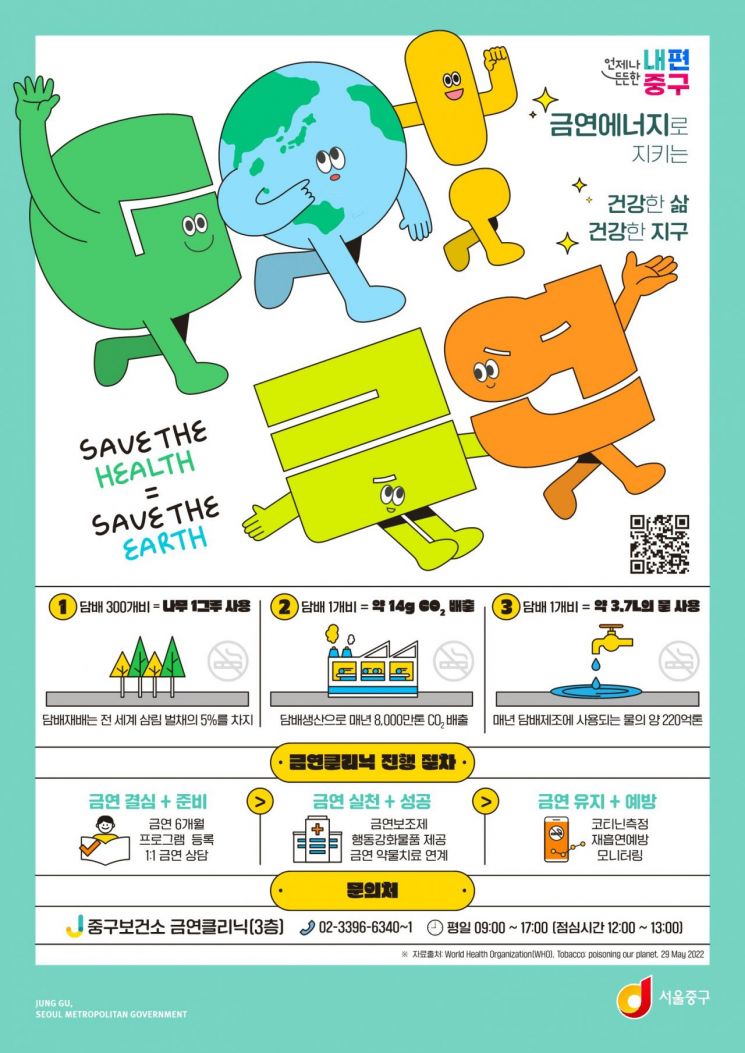
Starting this year, Jung-gu emphasizes "environmentally conscious smoking cessation."
This approach differs from traditional smoking cessation education that instills guilt in smokers, as it helps them realize that quitting smoking protects not only their own and their family's health but also the planet, naturally encouraging participation in smoking cessation.
Jung-gu also includes the environmental damage caused by cigarettes in its smoking cessation promotional materials.
"Cigarettes destroy the environment throughout their entire lifecycle. One tree is cut down for every 300 cigarettes produced. Producing one cigarette emits 14g of CO2 and uses 3.7 liters of water. Burning cigarettes releases carcinogens and fine dust. Cigarette butts are lumps of microplastics that take more than 10 years to decompose. Butts flow through sewage pipes into the sea and rivers."
Residents of Jung-gu who want to protect not only their own and their family's health but also the global environment can contact the Jung-gu Public Health Center smoking cessation clinic for inquiries.
© The Asia Business Daily(www.asiae.co.kr). All rights reserved.

![User Who Sold Erroneously Deposited Bitcoins to Repay Debt and Fund Entertainment... What Did the Supreme Court Decide in 2021? [Legal Issue Check]](https://cwcontent.asiae.co.kr/asiaresize/183/2026020910431234020_1770601391.png)