The Supreme Court overturned the second-instance ruling that acquitted former Shinhan Financial Group President Shin Sang-hoon and former Shinhan Bank President Lee Baek-soon, who were jointly indicted in connection with the 'Namsan 300 Million Won Incident,' on charges of perjury after each appeared as a witness in the other's trial and allegedly gave false testimony.
The ruling holds that if a co-defendant, who is a joint offender, appears as a witness in another co-defendant's trial, is informed of the right to refuse testimony, but does not exercise this right and gives false testimony, the crime of perjury can be established.
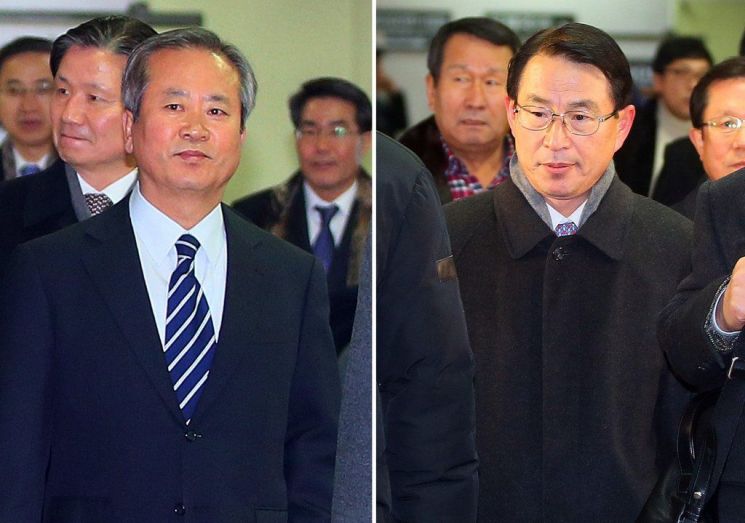 Former Shin Sang-hoon, ex-president of Shinhan Financial Group (left), and former Shin Baek-soon, ex-president of Shinhan Bank, who were indicted on charges including embezzlement related to the internal corruption scandal at Shinhan Financial Group, are entering the Seoul Central District Court in Seocho-dong, Seoul, on January 16, 2013.
According to the legal community on the 18th, the Supreme Court's Second Division (Presiding Justice Lee Dong-won) overturned the original ruling that acquitted former President Shin and former President Lee on perjury charges and remanded the case to the Seoul Central District Court.
The court stated, "If the defendants, who were informed of their right to refuse testimony while the litigation procedures were separated, did not exercise this right and gave false statements, even if they were questioned as witnesses about their own criminal acts, it cannot be said that their right to refuse testimony or privilege against self-incrimination as defendants was violated, and it is reasonable to find that the crime of perjury is established."
It added, "Nevertheless, the lower court maintained the first-instance ruling that acquitted the defendants without making any judgment on whether their testimony was false. This misinterpretation of the legal principles regarding the establishment of perjury affected the judgment, which is why the case is being overturned and remanded."
The two were jointly indicted and tried for the 'Namsan 300 Million Won Incident' and were charged in November 2012 with perjury after each appeared as a witness in the other's trial.
At that time, the two were co-defendants and accomplices accused of embezzling 261 million won from the 2008 management consulting fees, which were corporate funds (embezzlement under the Specific Economic Crimes Act). When each requested the other as a witness, the court separated their trials and accepted the other as a witness in each trial.
The 'Namsan 300 Million Won Incident' involves allegations that former President Lee, under the direction of former Shinhan Financial Group Chairman Ra Eung-chan, created illegal slush funds and, shortly after the 17th presidential election in February 2008, handed over 300 million won as a congratulatory gift for the election of former President Lee Myung-bak to the camp of his older brother, former lawmaker Lee Sang-deuk.
Although it was established that the money was delivered at the Namsan Freedom Center parking lot, the identities of the deliverer and recipient were never revealed despite a prosecutorial reinvestigation.
Previously, both the first and second-instance courts acquitted the two.
The first-instance court ruled, "Co-defendants who are accomplices cannot be witnesses for other co-defendants," denying the witness qualification of co-defendants for other co-defendants.
The court pointed out that since the testimony of co-defendant accomplices can be used as evidence to acknowledge the criminal facts of other co-defendants anyway, there is no practical benefit in examining them as witnesses. Moreover, it criticized that allowing prosecutors to later indict defendants for perjury based on such testimony could coerce defendants into unfavorable statements, stating, "The current general trial practice of examining co-defendant accomplices as witnesses for other co-defendants should be reconsidered."
The prosecution appealed, but the second-instance court also acquitted the two.
While the second-instance court found the first-instance court's denial of witness qualification for co-defendant accomplices inappropriate, it upheld the first-instance conclusion that perjury charges did not apply to the two.
The court stated, "Even if a co-defendant accomplice becomes a witness in another co-defendant's trial, the defendant's status regarding questions about their own criminal acts continues, and this status takes precedence over that of a witness. Therefore, even if the defendant gave false testimony within the scope of their defense rights, they cannot be punished for perjury."
However, the Supreme Court's judgment differed.
The court ruled, "Since the litigation procedures were separated, defendants who are co-defendant accomplices have witness qualifications regarding other co-defendants. If they were informed of the right to refuse testimony but gave false statements, the crime of perjury is established."
In other words, if the two gave false testimony contrary to their memories in court, perjury can be established. The second-instance ruling, which acquitted them without specifically examining this and on the grounds that perjury could not be established, was erroneous.
The 'Namsan 300 Million Won' allegations surfaced during the investigation of the 'Shinhan Incident,' which involved internal lawsuits and accusations within Shinhan Financial Group's management over control of the group in 2010.
After about seven years of investigation and trial, in March 2017, former President Shin was fined 20 million won for embezzling 260 million won, and former President Lee was sentenced to 1 year and 6 months in prison with a 2-year probation for violating the Financial Holding Companies Act by receiving a 500 million won deposit from a Korean-Japanese shareholder.
On the same day, two Shinhan Bank officials indicted for perjury in the embezzlement trial of former President Shin and former President Lee had their fines confirmed by the Supreme Court's Third Division (Presiding Justice Oh Seok-jun).
© The Asia Business Daily(www.asiae.co.kr). All rights reserved.

















