Likely to Announce End of Negative Interest Rates and Suspension of ETF Purchases
The international financial market's attention is focused on whether the Bank of Japan, Japan's central bank, will decide to raise interest rates. If Japan lifts its negative interest rate policy, the value of the yen is expected to rise, directly impacting financial and real markets such as the stock market, which has hit record highs, and the booming real estate sector.
On the 17th, local Japanese media and financial markets predicted that the Bank of Japan would lift the negative interest rate policy it has maintained since February 2016 at the Monetary Policy Meeting scheduled for the 18th and 19th. The biggest reason for anticipating the end of the negative interest rate is the wage increases by companies.
Rengo (連合, Japanese Trade Union Confederation), Japan's largest labor union organization, announced on the 15th that the average wage increase rate was 5.28%, which is 1.48 percentage points higher than the same period last year.
Two days earlier, on the 13th, during the so-called 'concentrated response day' when major corporations such as automobile companies responded to union wage increase demands, a significant wage increase trend was already observed.
Reflecting this, the Tokyo stock market showed a weak trend last week, closing lower on four out of five trading days.
The Nikkei 225 average stock price, the representative stock index of the Japanese stock market, closed at 38,707 on the 15th. This is about 2.5% lower than the weekend.
The Bank of Japan has stated that it will only change its negative interest rate policy once a 'virtuous cycle of rising prices and wages' is confirmed. Prices have already exceeded the Bank of Japan's inflation target.
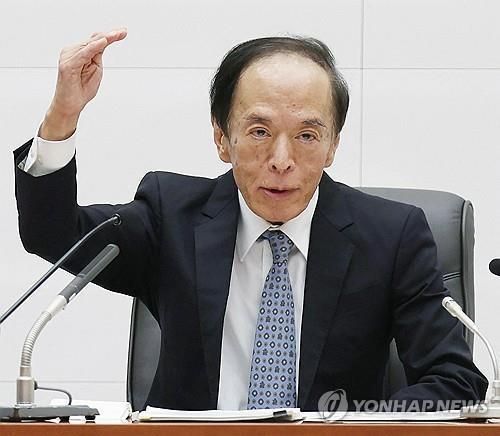
Kazuo Ueda, Governor of the Bank of Japan, has indicated that this year's wage negotiation results will be an important basis for policy decisions. Accordingly, Japanese media are flooding with forecasts that the Bank of Japan will raise interest rates at this Monetary Policy Meeting.
The Nihon Keizai Shimbun (Nikkei) reported the day before, saying, "The conditions are in place," and "The Bank of Japan is expected to lift the negative interest rate policy."
If the Bank of Japan abandons the negative interest rate policy this time, it will be the first interest rate hike in 17 years since February 2007. The Bank of Japan introduced the negative interest rate policy in February 2016, applying a short-term policy rate (current account balance policy rate) of -0.1% when banks deposit money with the central bank.
In addition to the negative interest rate, the Bank of Japan has continued unprecedented large-scale monetary easing policies worldwide, such as Yield Curve Control (YCC), which directly controls bond market interest rates by unlimited purchases of government bonds, and purchases of exchange-traded funds (ETFs) that effectively support the stock market by buying shares of domestic companies after the bubble economy collapsed.
It will not be easy to unwind these monetary easing policies all at once, but the financial market expects that along with lifting the negative interest rate, announcements such as halting ETF purchases will also be made.
In fact, Shinichi Ueda, Deputy Governor of the Bank of Japan, said in a lecture last month, "It is natural to stop ETF purchases when large-scale monetary easing is adjusted."
© The Asia Business Daily(www.asiae.co.kr). All rights reserved.
![Clutching a Stolen Dior Bag, Saying "I Hate Being Poor but Real"... The Grotesque Con of a "Human Knockoff" [Slate]](https://cwcontent.asiae.co.kr/asiaresize/183/2026021902243444107_1771435474.jpg)















