Ministry of Health and Welfare's Policy Forum on 'Medical Reform and a Cooperative Medical Delivery System'
To alleviate the concentration of patients in large hospitals, there is a call to establish the medical delivery system with a 'patient'-centered approach instead of the current 'medical supply'-centered approach.

On the afternoon of the 15th, the Ministry of Health and Welfare held a policy forum titled "Medical Reform, a Win-Win Medical Delivery System" at the Koreana Hotel in Jung-gu, Seoul.
In February, the government announced four major tasks for medical reform to save essential and regional medical care and decided to promote the establishment of a function- and demand-centered delivery system and strengthen the essential medical network to build a regionally complete medical delivery system.
This forum was organized to gather expert opinions on the medical delivery system that guarantees appropriate medical services at the right time and place and promotes rational medical use by the public, as well as to discuss specific policies for reforming the medical delivery system.
At the forum, Choi Soo-kyung, head of the Health Insurance Innovation Center at the Health Insurance Review and Assessment Service, who gave the first presentation, proposed a medical delivery system centered on the patient's disease cycle (acute-recovery-chronic).
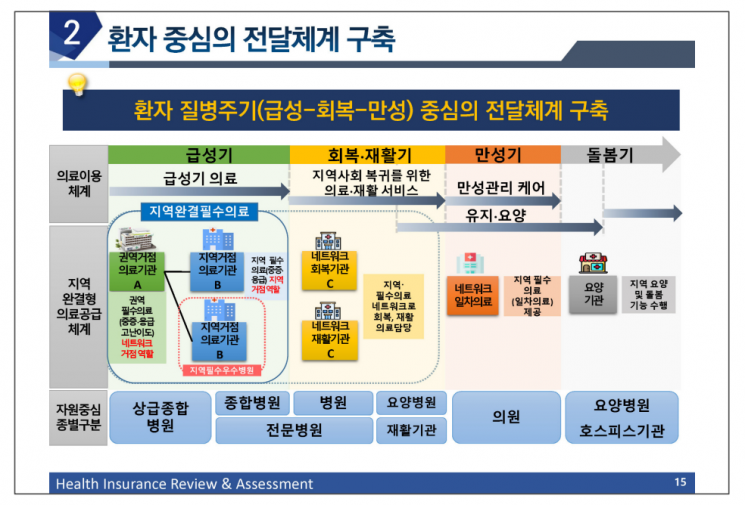
The explanation was to build a medical utilization system according to the patient's disease cycle and assign functions and roles to medical institutions within the region.
For example, during the acute phase when severe or emergency situations occur, a cooperative system is established between regional base medical institutions and local base medical institutions to enable timely treatment. During the recovery phase, patients are connected to specialized hospitals or nursing hospitals in the region for professional treatment. In the chronic phase, patients can be managed at clinics for maintenance and care, and during the care phase, nursing hospitals can be used.
There was also a proposal to build a utilization system based on regional demand.
Shin Hyun-woong, senior research fellow at the Korea Institute for Health and Social Affairs, suggested reorganizing tertiary general hospitals to focus on severe treatment, education, and research, and developing a model centered on essential medical care for secondary regional hospitals reflecting regional characteristics. He pointed out, "Currently, there is a shortage of regional essential medical personnel, and with the high workload, there is avoidance of severe and emergency care. Expanding support for regional small and medium hospitals causes the outflow of essential medical personnel from general hospitals with high on-call burdens." He added, "Support for regional hospitals needs to be selectively promoted based on cooperation among medical institutions in the region, provision of essential medical care, and quality management."
In the subsequent discussion, six experts including Professor Jung Jae-hoon of Gachon University College of Medicine, Seo In-seok, director of the Korea Hospital Association, Ahn Sang-ho, representative of the Korea Congenital Heart Disease Patients Association, Jung Ji-yeon, secretary general of the Korea Consumer Federation, Han Jeong-ho, director of Planning and Coordination at Chungbuk National University Hospital, and Yoon Soon-young, field transport team leader at the Central Emergency Medical Center, along with the Ministry of Health and Welfare’s health policy officer, participated as panelists to share issues and challenges of the domestic medical delivery system.
Minister of Health and Welfare Cho Kyu-hong attended the forum and said, "Among the four major tasks of medical reform, establishing a win-win and cooperative medical delivery system is an essential task to improve the overall efficiency and productivity of the medical system." He added, "Based on today’s discussion, we will promote innovation in the supply system by establishing functions by type of medical institution and fostering hospitals with expertise and capabilities in the region, institutionalize cooperation systems between hospitals, and review overall health and medical policies such as compensation, evaluation, and regulation under this direction."
Following the forum on the medical delivery system, the Ministry of Health and Welfare plans to continuously collect opinions through various means such as forums on major medical reform tasks including improving the treatment of residents and strengthening regional medical care.
© The Asia Business Daily(www.asiae.co.kr). All rights reserved.
![Clutching a Stolen Dior Bag, Saying "I Hate Being Poor but Real"... The Grotesque Con of a "Human Knockoff" [Slate]](https://cwcontent.asiae.co.kr/asiaresize/183/2026021902243444107_1771435474.jpg)

















