Constitutional Court Rules 'Abortion Crime' Unconstitutional
Estimated 32,063 Pregnancy Terminations in 2022
Legislative Improvements Not Made in National Assembly... Law Loses Effectiveness
Recently, France became the first country in the world to explicitly include the right to abortion in its constitution, drawing increased attention to the issue of the 'crime of abortion.' In South Korea, the Constitutional Court ruled in April 2019 that the crime of abortion was unconstitutional, but due to the lack of legislative improvements by the National Assembly, the law lost its effect in 2021. As a result, pregnancy termination is in a state that is neither legal nor illegal, causing growing confusion among the public.
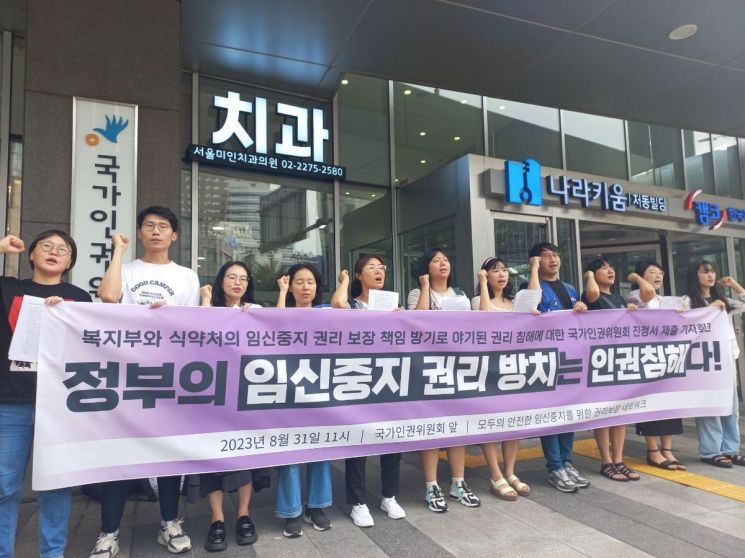 The Network for the Guarantee of Everyone's Right to Safe Abortion (Moimnet) is shouting slogans in front of the National Human Rights Commission.
 [Image source=Yonhap News]
◆Doctors Reluctant to Perform Pregnancy Termination Procedures
According to the April 18 report by the Korean Women's Development Institute titled ‘Current Status and Improvement Measures for Supporting Pregnancy Termination for Sexual Violence Victims,’ doctors either believe pregnancy termination is illegal or are uncertain about its legal status, leading them to hesitate in providing medical services. Doctor A said, “Is pregnancy termination legal now? There are no punishment provisions, but I understand it is not legal.”
In medical settings, requirements such as proof of sexual violence, guardian consent, and spouse consent still remain, and support and resources for pregnancy termination are insufficient. Doctor B stated, “The government does not seem to have clear confidence. (Maintaining existing practices) hospitals have no choice but to continue defensively,” adding, “There has been no change in hospitals before and after decriminalization.” Doctor C pointed out, “There are many supports and resources for continuing pregnancy, but none for termination,” and “Since the system is not fully established, it seems the same as before.”
In fact, even among the ‘Haebaragi Centers,’ integrated support centers for sexual violence victims, 3 out of 10 affiliated hospitals do not perform pregnancy termination procedures for sexual violence victims. Only 25 out of 35 affiliated hospitals (71.4%) were able to perform the procedures, while the remaining 10 referred patients to external hospitals. The main reasons were complicated hospital support procedures or doctors refusing. Haebaragi Centers provide integrated counseling, medical, legal, and investigative support for victims of sexual violence, domestic violence, and sex trafficking. Currently, 19 centers are established in public hospitals and 20 in private hospitals.
Women who have experienced pregnancy termination cited lack of information, accessibility to medical institutions, and medical costs as problems. The Network for Guaranteeing the Right to Safe Pregnancy Termination (Mominet) reported in last month’s ‘2021 Post-Pregnancy Termination Experience Survey Report’ that respondents found it difficult to verify reliable information online, and hospitals either did not provide proper information or gave incorrect information.
Due to the absence of official information, it was difficult to find hospitals where counseling and procedures could be received, and both women at 4 and 9 weeks of pregnancy paid between 800,000 and 1,000,000 KRW for surgical costs, showing significant disparities in medical expenses. Mominet stated, “The government and health authorities must officially guarantee pregnancy termination as a health right and provide comprehensive information on safe pregnancy termination and medical institutions,” and emphasized the need for “establishing a medical insurance system and normalizing medical fees for pregnancy termination procedures.” According to Mominet, a complaint regarding violations of pregnancy termination rights was filed with the National Human Rights Commission in August last year, but no results have been announced yet.
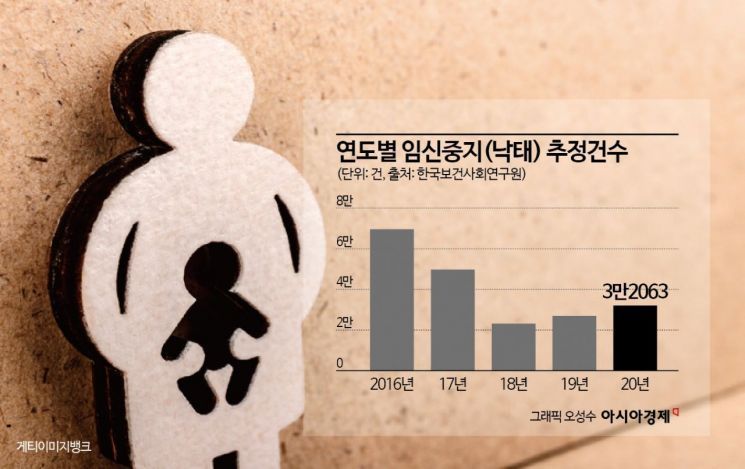
According to the Korea Institute for Health and Social Affairs’ ‘Artificial Pregnancy Termination Survey,’ the artificial pregnancy termination rate among women aged 15 to 44 in 2020 was 3.3‰ (per mille), with an estimated 32,063 terminations performed that year. By year, the rates were 6.9‰ (69,609 cases) in 2016, 4.8‰ (49,764 cases) in 2017, 2.3‰ (23,175 cases) in 2018, and 2.7‰ (26,985 cases) in 2019. These figures were calculated by applying the termination rate per 1,000 women to the population aged 15 to 44 based on the number of terminations performed that year.
◆Various Alternatives Proposed, Consensus Not Reached
In April 2019, the Constitutional Court ruled the crime of abortion unconstitutional, stating it “excessively infringes on the pregnant woman’s right to self-determination.” This came 66 years after the crime of abortion was introduced in 1953 and 7 years after a 4-4 split decision in 2012 that upheld its constitutionality. At that time, a legislative deadline of December 31, 2020, was set, but the National Assembly has yet to enact substitute legislation. Various bills regarding abortion allowance criteria have been proposed but failed to reach consensus.
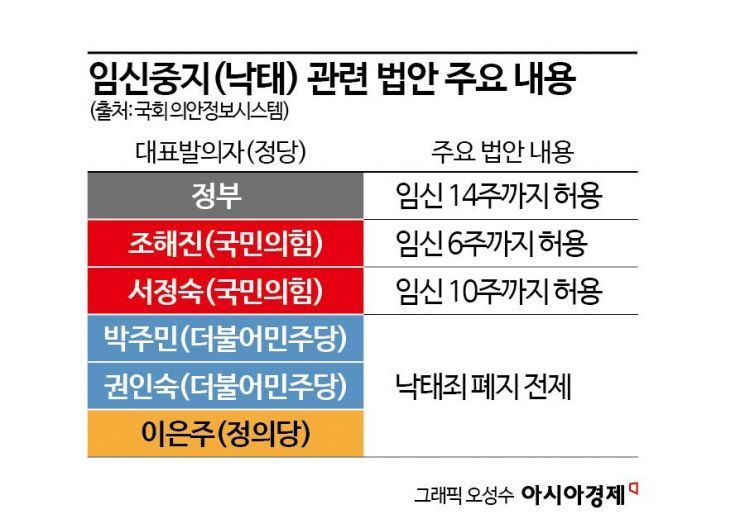
The government submitted amendments to the Criminal Act and the Maternal and Child Health Act, and lawmakers proposed a total of six bills. The government’s proposal allows abortion within 14 weeks of pregnancy based on the woman’s decision, and from 14 to 24 weeks only in cases of genetic disorders, rape or quasi-rape as defined by the Maternal and Child Health Act, and social or economic reasons.
People’s Power Party lawmaker Jo Hae-jin’s bill permits abortion up to 6 weeks before fetal heartbeat detection, allows abortion up to 10 weeks for social and economic reasons, and permits abortion up to 20 weeks only in cases of rape, quasi-rape, or health reasons of the woman. Lawmaker Seo Jeong-sook’s bill allows abortion without gestational limits if continuing the pregnancy endangers the woman’s life, and limits other cases to 10 weeks. Lawmakers Kwon In-sook, Lee Eun-joo, and Park Joo-min proposed abolishing the punishment provisions for the crime of abortion.
Professor Kim Sun-hye of Ewha Womans University’s Department of Women’s Studies said, “The provisions criminalizing abortion in the Criminal Act were deleted following the Constitutional Court’s ruling of unconstitutionality. Just as other medical procedures are not legal only if explicitly stated by law, pregnancy termination is the same,” and advised, “Pregnancy termination has long been a medical procedure performed in hospitals. What is needed now is not to create new laws regulating pregnancy termination, but to establish a healthcare system that guarantees universal health rights as a medical procedure.”
She added, “Various efforts are needed to eliminate social stigma around pregnancy termination,” and emphasized, “The urgent issue now is to include pregnancy termination in health insurance coverage. This is crucial to improving actual medical accessibility, and areas not covered by health insurance are still not considered essential issues in Korean society.”
© The Asia Business Daily(www.asiae.co.kr). All rights reserved.
![Clutching a Stolen Dior Bag, Saying "I Hate Being Poor but Real"... The Grotesque Con of a "Human Knockoff" [Slate]](https://cwcontent.asiae.co.kr/asiaresize/183/2026021902243444107_1771435474.jpg)

















