96% of Full-time Members Respond 'Policy Enforcement Push is Unfair'
The medical community urged the government to halt the policy of increasing medical school quotas, warning that if legal actions are taken against residents, the majority of employed doctors would voluntarily resign or take similar actions.
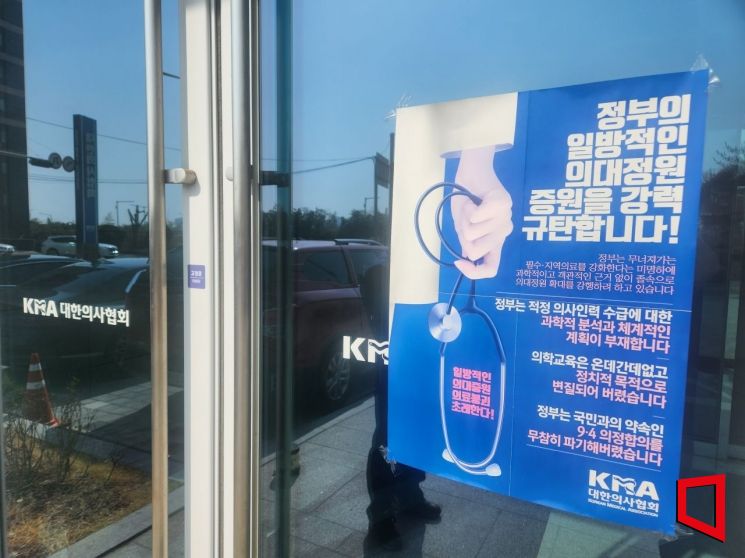 A poster opposing the increase in medical school admissions is posted on the main entrance of the Korean Medical Association building in Yongsan-gu, Seoul. Photo by Tae-won Choi peaceful1@
The Korean Medical Association (KMA) Emergency Response Committee held a regular briefing at 2 p.m. on the 15th at the KMA headquarters in Yongsan-gu, Seoul, announcing this stance. Joo Su-ho, the KMA Emergency Committee's Public Relations Officer, stated, "Following medical school professors, employed members?who constitute the largest number among medical professionals?are also expressing their anger. According to a survey by the Korean Hospital Doctors Association, 96% of employed members responded that the government's forceful policy implementation is unjust and absolutely unacceptable. Furthermore, 90% of employed members said that if KMA members, including residents, face actual legal actions, voluntary measures such as submitting resignation letters would be necessary."
He added, "The government, through repression and lack of communication, is coercing more than 60,000 employed members, along with residents, to take voluntary actions. If residents, professors, and employed doctors leave the medical field, a dreadful disaster that we dare not imagine will occur in the Republic of Korea."
He also refuted the government's claim that discussions about reducing medical school quotas in Japan are untrue. He said, "On the 2nd of last month, during a meeting with the KMA, the president and executive director of the Japan Medical Association clearly stated that the Japanese government has recently begun reducing medical school quotas, and that the medical association is participating as a member of the Ministry of Health, Labour and Welfare's committee to discuss and decide on this matter together."
He further revealed that the Japan Medical Association asked the KMA questions such as "Does the Korean government have comprehensive data on the supply and demand of medical personnel?" and "Is the shortage of doctors overall, or is there a need for specialized measures in certain areas?" In response, Commissioner Joo said, "(The Japan Medical Association) criticized the government's reckless policy push. It is obvious who understands the actual situation in Japan better?the government, which interprets Japan’s statistics arbitrarily to support its claims, or the KMA, which has heard directly from the Japanese medical field."
He also urged the government to discuss the direction of medical reform together with the medical community. He said, "The government, which has the duty to protect the lives and health of the people, should stop pushing reckless policies that ruin healthcare and take the lead in moving forward on the right path of medical reform together with the medical community."
© The Asia Business Daily(www.asiae.co.kr). All rights reserved.
![Clutching a Stolen Dior Bag, Saying "I Hate Being Poor but Real"... The Grotesque Con of a "Human Knockoff" [Slate]](https://cwcontent.asiae.co.kr/asiaresize/183/2026021902243444107_1771435474.jpg)















