University Submission Requirements and Educational Environment Inspection
The government has decided to officially launch a committee on the 15th to allocate the increased medical school quotas, which will be expanded by 2,000 students, to each university. With the increase expected to be allocated mainly to regions with many 'mini medical schools,' the Ministry of Education plans to complete the distribution by each school by next month at the latest.
At a briefing by the Central Disaster and Safety Countermeasures Headquarters on the same day, the Ministry of Education stated, "Starting today, we will fully activate the allocation committee related to the increase in medical school quotas and proceed with discussions at a rapid pace."
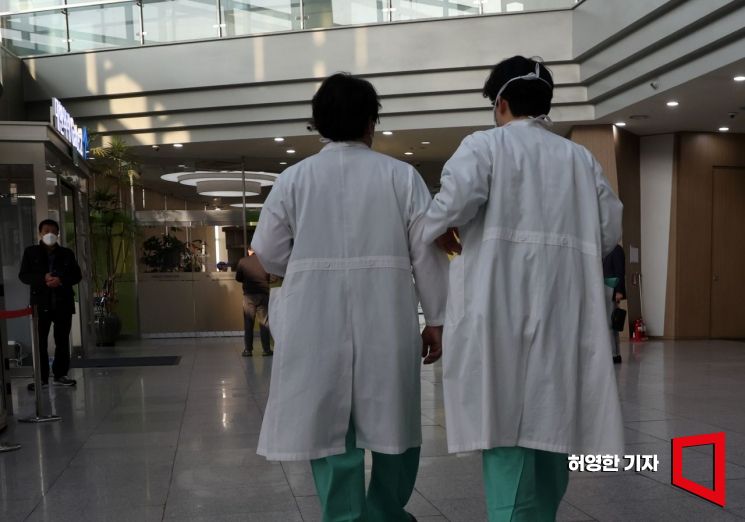 On the 15th, medical staff are entering the treatment area at a university hospital in Seoul, where the Emergency Response Committee of medical school professors from 19 universities is expected to decide on resignation. Photo by Younghan Heo younghan@
The principle of strict 'confidentiality' is being upheld regarding the composition of the allocation committee and its members. This is to prevent external influence on the medical school quota allocation review if information about the committee members becomes known.
The allocation committee, jointly formed by the Ministry of Education and the Ministry of Health and Welfare, will review the submissions from each university and assess educational conditions. In particular, the allocation will be decided in a direction that supports the establishment of a regionally self-sufficient essential medical system for non-metropolitan medical schools, enhances the central role of regional hub hospitals affiliated with regional base universities, and improves medical education conditions at small-scale medical schools.
The government is reported to have settled on allocating about 80% of the increased 2,000 medical school quotas to non-metropolitan medical schools and 20% to metropolitan areas. This means 400 quotas will be assigned to metropolitan medical schools and 1,600 to non-metropolitan medical schools. Many 'mini medical schools' with an enrollment capacity of 50 or fewer students are located in non-metropolitan areas.
Earlier, a demand survey conducted with 40 universities nationwide recorded a total demand for an increase of 3,401 medical school students. Among these, 27 non-metropolitan universities applied for an increase of 2,471 students, accounting for 72.6% of the total applications.
The authorities plan to complete the allocation of medical school quotas before the general election on April 10. Once the quota allocation by university is finalized, each university will revise its academic regulations to reflect the increased quotas. Subsequently, after approval by the Korea Council for University Education, the 2025 academic year admission plan will be amended, and the recruitment guidelines will be announced.
© The Asia Business Daily(www.asiae.co.kr). All rights reserved.
![Clutching a Stolen Dior Bag, Saying "I Hate Being Poor but Real"... The Grotesque Con of a "Human Knockoff" [Slate]](https://cwcontent.asiae.co.kr/asiaresize/183/2026021902243444107_1771435474.jpg)















