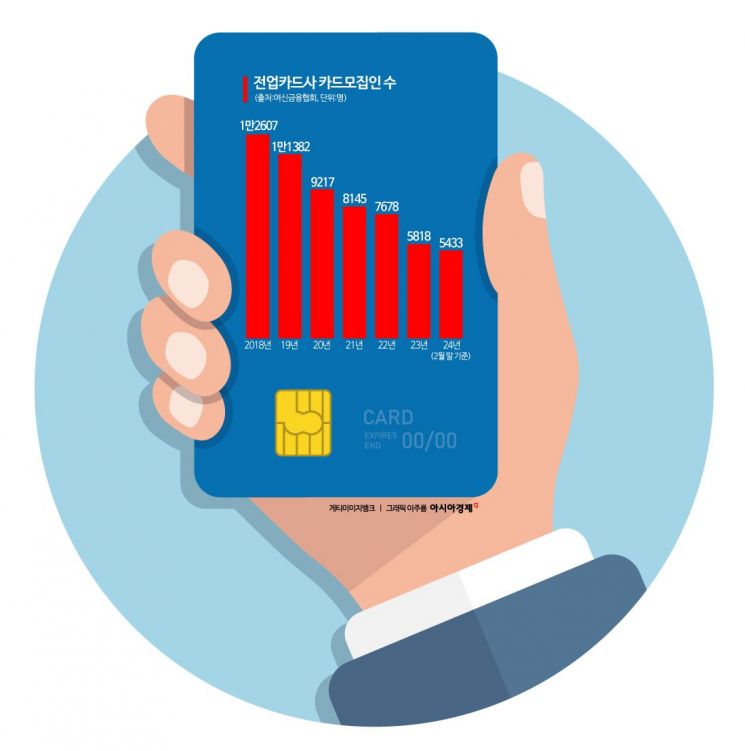
Last Month's Card Recruiters 5,433
56.9%↓ Compared to 2018
Lost Ground Due to Card Companies' Digitalization and PLCC Strategy
"Get a card. We also support the annual fee."
Card recruiters (agents) who were often seen at department stores, large marts, and subway stations are disappearing. With the digital transformation changing card companies' sales methods to non-face-to-face, and customers becoming accustomed to easily issuing cards through applications, their space is gradually shrinking.
According to the Credit Finance Association on the 15th, the number of card recruiters for the eight full-time card companies (Shinhan, Samsung, KB Kookmin, Lotte, Hana, BC, Hyundai, Woori) was counted at 5,433 at the end of last month. This is a 56.9% decrease compared to 12,607 in 2018 before COVID-19.
Card recruiters are workers employed by card companies in a contract form. When they attract customers to sign up for cards, the card company pays a commission of 100,000 to 200,000 KRW depending on the number of card issuances or usage performance. According to the Specialized Credit Finance Business Act, card recruiters can provide support funds of 100% of the annual fee if recruiting customers online, and 10% if offline, from this commission.
The decrease in card recruiters is mainly due to card companies drastically reducing branches due to the COVID-19 pandemic and other factors. According to Financial Supervisory Service statistics, as of the first half of last year, the number of branches of the eight domestic full-time card companies was 143, a 39.1% decrease compared to 235 at the end of 2018. While insurance allows cross-selling of other companies' products through General Agencies (GA), cards are regulated to operate exclusively for one company per person, so they were greatly affected by the reduction in branches.
Card recruiters, who had to conduct aggressive sales mainly online, sometimes engaged in illegal sales practices. Due to the impact of COVID-19, from February 2020, the card recruiter registration exam was changed to online video education, and some recruiters used the names of family members to obtain licenses from multiple card companies, engaging in cross-selling. They engaged in cutthroat competition by providing support funds beyond legal limits. As the side effects grew, the Credit Finance Association resumed the card recruiter registration exam in January after four years.
Card companies moving sales channels online for cost reduction and digital transformation also influenced the decrease in card recruiters. They encouraged self-issuance by partnering with other companies to offer benefits when users issued cards through apps. From the card companies' perspective, this is much cheaper than the commissions paid to card recruiters. Customers, worried about personal information leaks or so-called 'support fund fraud,' also trusted issuance through card company apps or websites.
The issuance of Private Label Credit Cards (PLCC) becoming a new trend in the card industry is another reason for the reduced role of card recruiters. PLCCs are cards that feature the partner company's brand on the front and provide benefits specialized for that company's services. Unlike traditional co-branded cards where the card company fully handles marketing, operating costs are shared with the partner company. A card company official explained, "PLCCs do not require much card recruiter cost because they can directly attract customers owned by the partner company," adding, "The simplified authentication process making card issuance easier is also likely a reason for the decrease in card recruiters."
© The Asia Business Daily(www.asiae.co.kr). All rights reserved.
![Clutching a Stolen Dior Bag, Saying "I Hate Being Poor but Real"... The Grotesque Con of a "Human Knockoff" [Slate]](https://cwcontent.asiae.co.kr/asiaresize/183/2026021902243444107_1771435474.jpg)











