Rafael Grossi, Director General of the International Atomic Energy Agency (IAEA), who visited Japan, stated that the discharge of contaminated water from the Fukushima Daiichi Nuclear Power Plant into the ocean did not have harmful effects on the environment.
On the 14th, at a press conference held in Tokyo, Grossi responded to a question about his meeting with Fukushima fishermen the previous day, saying, "Although 30,000 tons of contaminated water were discharged, the results showed that the tritium concentration was very low."
He mentioned that before the discharge last year, residents in the Fukushima area expressed anxiety and concerns due to uncertainty, but during this visit, the attitude of the residents had changed.
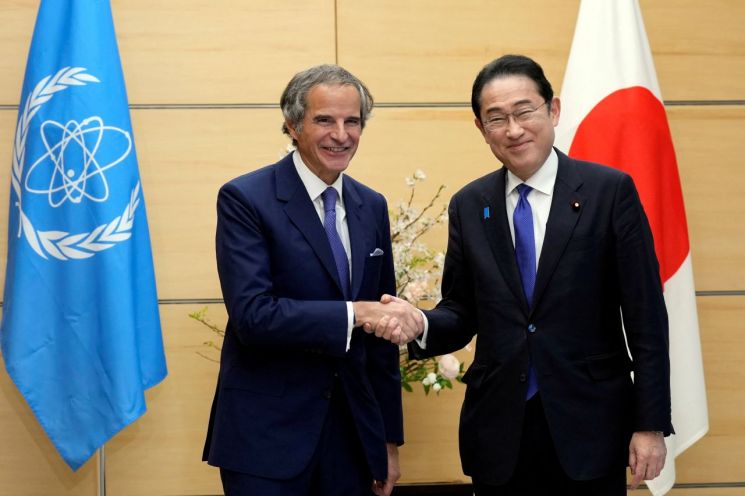 Raphael Grossi, Director General of the International Atomic Energy Agency (IAEA) (left in the photo), visited the Prime Minister's Official Residence in Tokyo on the 14th and shook hands with Prime Minister Fumio Kishida.
 [Photo by Yonhap News]
Director General Grossi visited Japan in July last year, one month before the contaminated water discharge, and this time he returned to Japan for the first time since the discharge. After talking with residents of the Fukushima area the previous day, he inspected the contaminated water discharge facilities at the Daiichi Nuclear Power Plant.
Grossi emphasized that the contaminated water discharge is proceeding without problems and that the IAEA is transparently verifying the discharge process as an independent analysis organization.
Regarding the incident last month in which 1.5 tons of contaminated water leaked due to a valve on a pipe being left open at the Fukushima Daiichi Nuclear Power Plant, Grossi dismissed it as not a major issue, stating, "I want to make it clear that (the incident) has no relation whatsoever to the contaminated water discharge."
When asked about the continued opposition from some neighboring countries and fishermen even though more than half a year has passed since the start of the contaminated water discharge, he replied that he would work to change their views through dialogue. Grossi said, "We are continuing dialogue with South Korea, China, and Pacific island countries," and added, "We will clearly explain how the discharge procedures are technically being carried out."
© The Asia Business Daily(www.asiae.co.kr). All rights reserved.
![Clutching a Stolen Dior Bag, Saying "I Hate Being Poor but Real"... The Grotesque Con of a "Human Knockoff" [Slate]](https://cwcontent.asiae.co.kr/asiaresize/183/2026021902243444107_1771435474.jpg)















