Electricity Supply Fees as Collateral for 'Accounts Receivable' Loans
Subsidiary Itech Construction's Insolvency Weakens Financing Capability
SGC Energy, the holding company of the SGC Group, secured liquidity worth 100 billion KRW by using accounts receivable from Korea Electric Power Corporation (KEPCO) as collateral. This move is interpreted as providing accounts receivable as collateral due to difficulties in raising funds through its own credit caused by the project financing (PF) failure of its subsidiary, SGC E-Tech Construction.
According to the investment banking (IB) industry on the 15th, SGC Energy recently received a loan of 100 billion KRW from a special purpose company (SPC) established under the management of DB Financial Investment. The SPC received the accounts receivable and then raised loan funds by issuing asset-backed loans (ABL) and securitized bonds to investors. The accounts receivable provided as the underlying asset serve as the repayment source for the ABL and securitized bonds.
SGC Energy supplies electricity generated at power plants to KEPCO through the Korea Power Exchange. The accounts receivable, which are to be received in the future as payment for electricity supply, were provided as the underlying asset for financing. Both confirmed accounts receivable for electricity already supplied on credit and future accounts receivable for electricity to be supplied were pledged as collateral.
SGC Energy was established in 2020 through the investment divisions of Samkwang Glass, E-Tech Construction, and the merger with Gunjang Energy. Special related parties, including Chairman Lee Bok-young of SGC Group and his son, CEO Lee Woo-sung, hold 54% of the shares. Chairman Lee is the uncle of Lee Woo-hyun, chairman of OCI Group.
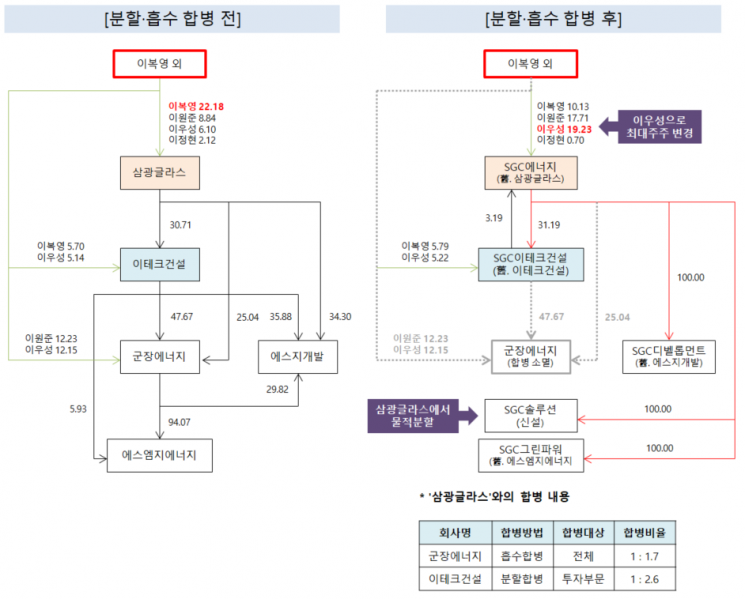
SGC Energy’s decision to raise funds using accounts receivable as collateral was due to difficulties in raising funds through credit caused by the PF failure of its subsidiary. The subsidiary, SGC E-Tech Construction, expanded its civil engineering business during the COVID-19 period with projects such as the logistics center in Wonchang-dong, Seo-gu, Incheon, but incurred massive losses.
E-Tech Construction has been refinancing the PF loans of developers by providing direct credit facilities as refinancing of PF contingent liabilities was not possible due to the Legoland incident and PF tightening. In this process, E-Tech Construction’s liquidity support commitments increased from nearly zero before 2022 to 406.6 billion KRW by the end of last year. Liquidity support commitments are credit facility contracts to support the shortfall if the developer fails to repay the PF loans.
In addition, contingent liabilities such as completion guarantees worth 566.5 billion KRW and joint guarantees worth 81 billion KRW have significantly increased. Completion guarantees are contingent liability contracts to repay debts on behalf of developers if the development project is not completed within the deadline, and joint guarantees are contracts to repay debts if the developer fails to repay loans.
The PF contingent liability failure of E-Tech Construction led to a downgrade in the credit rating of its parent company, SGC Energy. Due to the PF failure, SGC Energy’s commercial paper (CP) credit rating dropped from A2+ to A2 last year. Concerns over additional failures have made it practically difficult to raise market-based funds such as corporate bond issuance.
An IB industry official explained, "The accounts receivable held by SGC Energy are safe collateral with high payment certainty from the perspective of investors or creditors, as they are payments promised by Korea Electric Power Corporation, the largest public enterprise in Korea." He added, "Such accounts receivable securitization is widely used as an alternative financing method by companies that find it difficult to issue corporate bonds or raise funds through other market means."
© The Asia Business Daily(www.asiae.co.kr). All rights reserved.

















