Utilizing Big Data... Exploring and Analyzing Solutions for Issues in Busan
Identifying Imbalance Between Occurrence of Acute Cardiac Arrest Patients and Defibrillator Locations
Predicting Flood Risk Areas in Dong-gu, Reducing Damage... Prop
The Regional Culture Information Convergence Research Institute at Pukyong National University held a seminar titled "Busan Viewed Through Big Data" on the 6th at the Changui Hall.
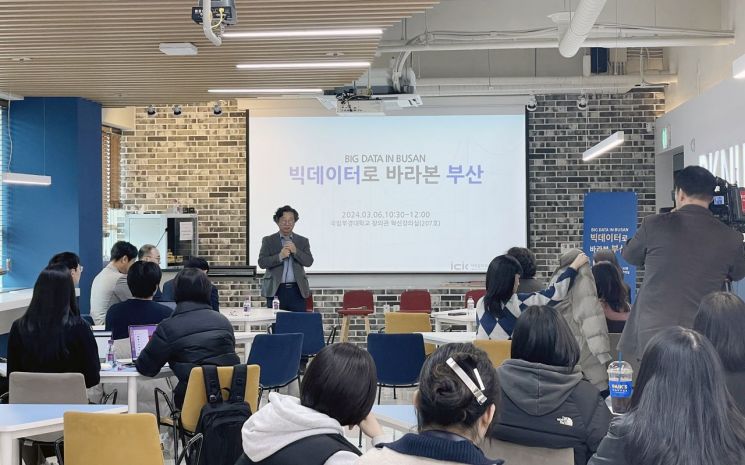
In this seminar, which examined issues in the Busan area through big data and sought solutions, presentations were given on topics such as "Analysis of the Status of Defibrillators in Busan and Policy Implementation" (Kim Dong-geun, researcher at Datory Lab) and "Leap Forward to Reduce Flooding Problems and Damage in Busan" (Shim Seo-jin, researcher at Datory Lab).
According to these presentations, while the number of acute cardiac arrest patients nationwide, including Busan, continues to increase, the distribution rate of defibrillators in Busan was found to be among the lowest in the country. In particular, data confirmed an imbalance between the locations of cardiac arrest incidents and the distribution of defibrillators, which was visualized and analyzed.
Additionally, the seminar revealed results from simulations identifying high-risk areas by analyzing flood history data and factors influencing flooding in Dong-gu, a district geographically prone to flood damage.
Following the presentations, a discussion was held moderated by Professor Kim Jeong-hwan of Pukyong National University, with panelists including Professor Noh Beop-rae of Pukyong National University, Professor Ryu Min-ho of Dong-A University, Park Se-ik, chief editor of Busan Ilbo, and Choi Hye-min, researcher at Busan Technopark. Professor Noh Beop-rae stated, "I highly appreciate that the work did not stop at defining and analyzing community issues through data but also considered various methods to solve these problems and implement solutions."
This seminar was held to commemorate the publication of the third casebook of "Busan Viewed Through Big Data," published annually by Datory Lab.
Professor Kim Jeong-hwan (Human ICT Convergence Major), who supervises Datory Lab, said, "We will continue to combine various public and private data to discover current issues and cases in the Busan area, contributing to a healthier Busan and a stronger data ecosystem."
Director Oh Chang-ho said, "This year, the institute is preparing various seminars and projects. We will look into the facets of Busan's culture, tourism, and content industries through data and create opportunities to contribute to the growth of each industry by utilizing technology and fostering discussions."
The casebook "Busan Viewed Through Big Data" can be found on the Datory Lab website.
© The Asia Business Daily(www.asiae.co.kr). All rights reserved.
![Clutching a Stolen Dior Bag, Saying "I Hate Being Poor but Real"... The Grotesque Con of a "Human Knockoff" [Slate]](https://cwcontent.asiae.co.kr/asiaresize/183/2026021902243444107_1771435474.jpg)















