16 out of 32 Semiconductor ETFs See Outflows... "Profit Taking"
Japanese Semiconductor ETFs Attract Funds... Rise of Japan's Semiconductor Industry
Recently, funds have been flowing out of semiconductor exchange-traded funds (ETFs). It appears that profit-taking occurred as the semiconductor sector, including Nvidia, experienced significant gains.
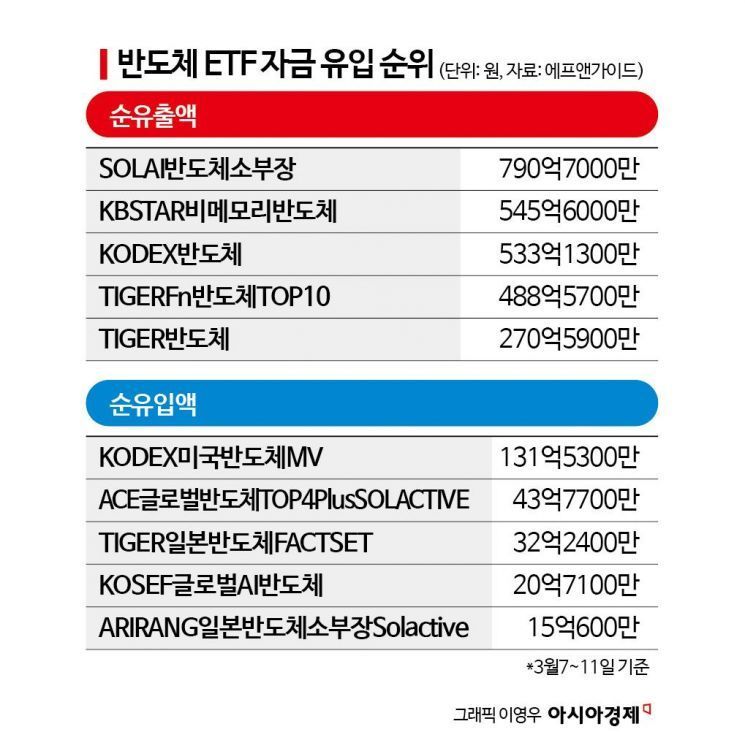
According to financial information provider FnGuide on the 13th, out of 32 semiconductor ETFs listed domestically, 16 saw fund outflows from the 4th to the 11th of this month. Meanwhile, 9 ETFs remained unchanged, and 7 ETFs experienced inflows.
The largest outflow was from the 'SOLAI Semiconductor Materials and Components ETF,' with 79.07 billion KRW withdrawn. This was followed by KBSTAR Non-memory Semiconductor (54.56 billion KRW), KODEX Semiconductor (53.313 billion KRW), TIGER Fn Semiconductor TOP10 (48.857 billion KRW), and TIGER Semiconductor (27.059 billion KRW), in that order.
The reason for the outflow from semiconductor ETFs is interpreted as the recent sharp decline in Nvidia shares combined with the burden from the sector's prior rise. Nvidia fell for two consecutive trading days on the New York Stock Exchange from the 8th to the 11th (local time). Given its rapid rise until then, profit-taking seems to have occurred. Nvidia's stock price has risen over 70% this year. Similarly, the domestic semiconductor index also rose. The KRX Semiconductor Index increased by 65.34% last year and 7.47% this year, surpassing the KOSPI's gains of 18.73% and 1.00% over the same periods.
On the other hand, funds flowed into Japan-related semiconductor ETFs. From the 4th to the 11th of this month, semiconductor-related ETFs with inflows included KODEX US Semiconductor MV (13.153 billion KRW), ACE Global Semiconductor TOP4 Plus SOLACTIVE (4.377 billion KRW), TIGER Japan Semiconductor FACTSET (2.071 billion KRW), KOSEF Global AI Semiconductor (1.56 billion KRW), and ARIRANG Japan Semiconductor Materials and Components Solactive (1.08 billion KRW). Among the top five net inflows, two were Japan-related semiconductor ETFs.
ARIRANG Japan Semiconductor Materials and Components Solactive is an ETF that leverages strengths in semiconductor materials, parts, and equipment. It includes Tokyo Electron, Advantest, Screen Holdings, and Lasertec. These stocks are also part of Goldman Sachs' 'Samurai 7 (S7)' list. TIGER Japan Semiconductor FACTSET invests in Japanese companies linked to the semiconductor industry and sales. It holds Screen Holdings, which specializes in cleaning process equipment among all semiconductor manufacturing stages, as its largest component, along with Tokyo Electron, Disco, and Advantest.
Kim Seunghyun, ETF Consulting Manager at Korea Investment Management, explained, "It appears that profit-taking occurred in domestic semiconductor investments, which had large amounts invested and good performance. Conversely, it can be seen as an expansion of investment positions into Japanese semiconductors, which had smaller investment amounts but a favorable long-term outlook."
Lee Doseon, Manager of the FICC ETF Management Team at Mirae Asset Global Investments, analyzed, "Amid the US-China conflict and the restructuring of the global semiconductor supply chain, the Japanese semiconductor industry is emerging as a core player. The Japanese stock market is also attracting attention, having surpassed 40,000 points and reaching historic highs." He added, "Among Japanese semiconductor ETFs, products exposed to the yen are attracting individual investors' funds because they can gain currency exchange profits if the yen appreciates in the future."
© The Asia Business Daily(www.asiae.co.kr). All rights reserved.
![Clutching a Stolen Dior Bag, Saying "I Hate Being Poor but Real"... The Grotesque Con of a "Human Knockoff" [Slate]](https://cwcontent.asiae.co.kr/asiaresize/183/2026021902243444107_1771435474.jpg)

















