'Import Risk Analysis Procedures for Fruits and Others' Press Conference
Import Risk Analysis Procedures Are Common Worldwide
In Case of Pest Invasion, Exports of Not Only Apples but Also Strawberries, Paprika, and Pears May Be Blocked
As calls grew louder for the government to "expedite the procedures for apple imports" to stabilize apple prices, the government stepped in to clarify the situation. There are concerns that if imports proceed without thorough preparation against foreign pests and diseases, pests related to apples could be introduced, potentially halting exports of Korea's representative agricultural products such as strawberries, paprika, pears, grapes, and citrus fruits.
The Ministry of Agriculture, Food and Rural Affairs held a press briefing on the afternoon of the 11th at the Government Complex Sejong under the theme of "Import Risk Analysis Procedures for Fruits and Others," emphasizing this point.
Based on the Plant Quarantine Act, the Ministry conducts import risk analysis procedures before importing fresh fruits like apples or fruit vegetables. Imports are only allowed after safety against pests and diseases is confirmed through the import risk analysis process.
The import risk analysis procedure is applied worldwide, and in Korea, it operates in eight stages. Upon receiving a request from an exporting country, the procedure begins with a preliminary risk assessment, followed by individual pest risk assessments, drafting risk management plans, preparing draft import allowance standards, public notice of the draft standards, and finally, promulgation and enforcement of the import allowance standards. As of the end of last month, 76 cases from 31 countries have completed the import risk analysis procedure and been approved for import, while 235 cases from 51 countries are currently underway.
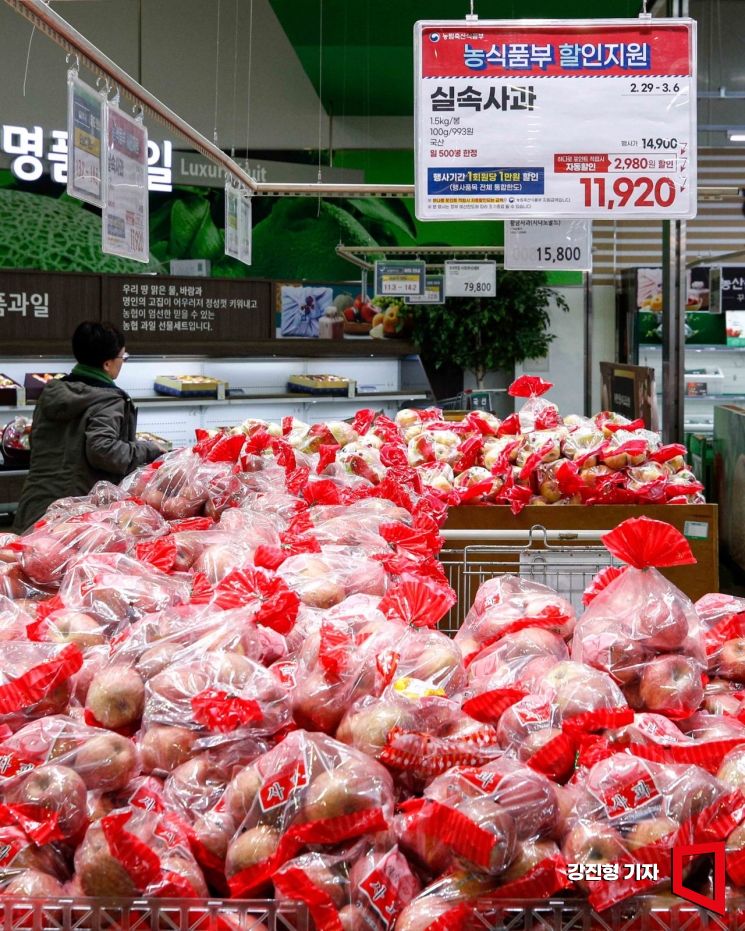 Apples are displayed at the fruit stand of Hanaro Mart Yangjae Branch in Seocho-gu, Seoul. Photo by Jinhyung Kang aymsdream@
Apple import risk analysis procedures are ongoing with four countries, including Japan. Japan is at the fifth stage, "drafting risk management plans," showing the fastest progress; however, since the Japanese government shifted the priority of analysis targets to "pear" in 2015, the apple risk analysis has been stalled. Additionally, risk analyses for apple imports are underway with New Zealand, Germany, and the United States, but these remain at stages two to three.
Jeong Hyeryeon, International Cooperation Officer at the Ministry of Agriculture, Food and Rural Affairs, explained, "The import risk analysis procedure is influenced by various variables such as the characteristics of the item, pest and disease distribution in the importing and exporting countries, and the response speed of the counterpart country, making it difficult to predict the duration. Also, since the procedure must be conducted according to the Plant Quarantine Act and its enforcement regulations, it cannot be arbitrarily omitted." In fact, the average duration for the 76 approved import cases was 8.1 years. The shortest case took 3.7 years (Chinese cherries). Conversely, the average duration for risk analysis procedures conducted by other countries for the export of Korean agricultural products was 7.8 years. However, the case of Korean citrus fruit being approved for export to New Zealand took 23 years.
The core of the import risk analysis procedure is to establish management measures against the introduction of foreign pests and diseases. Representative pests that damage apples include fruit flies, leaf-rolling moths (including Codling moth), and fire blight, all designated as prohibited pests under the Plant Quarantine Act.
Officer Jeong stated, "The introduction of foreign pests causes direct damage such as reduced agricultural production, decreased marketability, spread of damage to other crops, and increased control costs. It also leads to price increases for agricultural products, which can harm consumers. In particular, if pests related to apples are introduced, exports of Korea's representative export agricultural products such as paprika, pears, strawberries, grapes, citrus fruits, and persimmons could be halted, and resuming exports would require a long time."
He added, "Risk management plans applied to other fruits that have been approved for import cannot simply be applied to apples. Even for the same pests, the damage patterns, severity, and occurrence density vary by country and product, and within the same country, patterns can differ by region. Internationally, it is a common principle to prepare separate risk management plans when countries, regions, or products differ."
© The Asia Business Daily(www.asiae.co.kr). All rights reserved.
![Clutching a Stolen Dior Bag, Saying "I Hate Being Poor but Real"... The Grotesque Con of a "Human Knockoff" [Slate]](https://cwcontent.asiae.co.kr/asiaresize/183/2026021902243444107_1771435474.jpg)















