① Controversy over Medical School Quotas
② Price Trends
③ Verbal Blunder
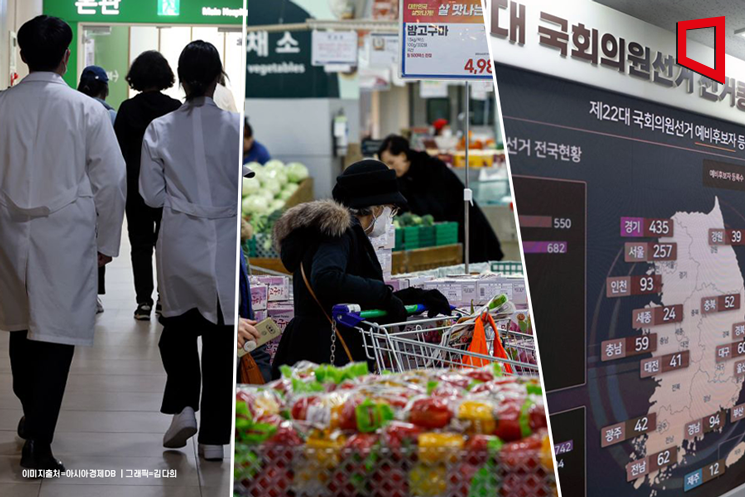
There is exactly one month left until the general election on the 11th of next month. While the opposition was predicted to have the upper hand just a few months ago, opinion polls have increasingly shown the ruling party leading since about a month ago. According to the 'Key Data from Nationwide Election Opinion Poll Results' compiled by the Central Election Survey Deliberation Commission of the National Election Commission on the 5th, the ruling party's advantage was confirmed last week regardless of telephone interviews or automated response calls (ARS).
However, in the opinion poll released by Realmeter on the 11th (commissioned by Energy Economy Newspaper, conducted on the 7th-8th targeting 1,006 voters aged 18 and over nationwide, with 97% wireless and 3% wired automated response method), the Democratic Party rebounded and was within the margin of error with the People Power Party. The Democratic Party's support rate rose by 4.0 percentage points from the previous survey to 43.1%, while the People Power Party dropped by 4.8 percentage points to 41.9%. This indicates that the general election phase has entered a volatile period. (For detailed information, refer to the Central Election Survey Deliberation Commission website.) How will the election landscape change in the remaining month? We examined the major variables that could shake the general election.
① Medical School Quota Controversy
President Yoon's low approval rating, which had been the ruling party's Achilles' heel, has risen compared to the beginning of the year and shows a stable trend. This is partly due to focusing intensively on livelihood discussions and related schedules, but also because of the positive impact of showing reformist moves such as expanding medical school quotas. The government's firm and aggressive response to doctors' opposition, including the defection of residents, positively influenced public opinion.
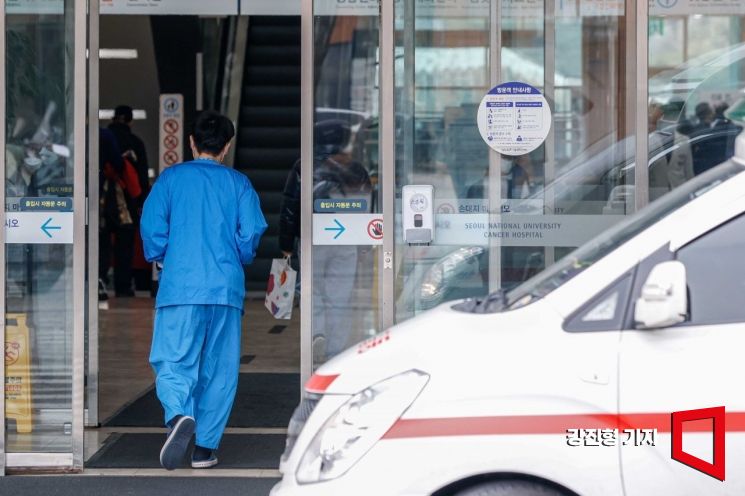 Amid the ongoing strong confrontation between the government and the medical community over the increase in medical school admissions, medical staff are moving at a large hospital in Seoul on the 29th, the government's deadline for residents who left hospitals to return. Photo by Kang Jin-hyung aymsdream@
However, as the defection of residents is followed by growing solidarity movements among medical school professors and others, the 'medical system' is truly heading toward a crisis. The key question is whether the worsening crisis will lead to consolidation around the government and ruling party or increase the responsibility attributed to them. The government is maintaining a hardline stance to the extent of expressing willingness to re-push the Nursing Act, for which it had previously exercised the right to request reconsideration.
② Inflation Trends
Recent price surges, such as the skyrocketing prices of fruits, are also variables. According to the February consumer price trends announced by Statistics Korea on the 6th, the consumer price index last month was 113.77, up 3.1% compared to the same month last year. In particular, the sharp rise in prices of fruits like apples and tangerines has caused a crisis in grocery prices.
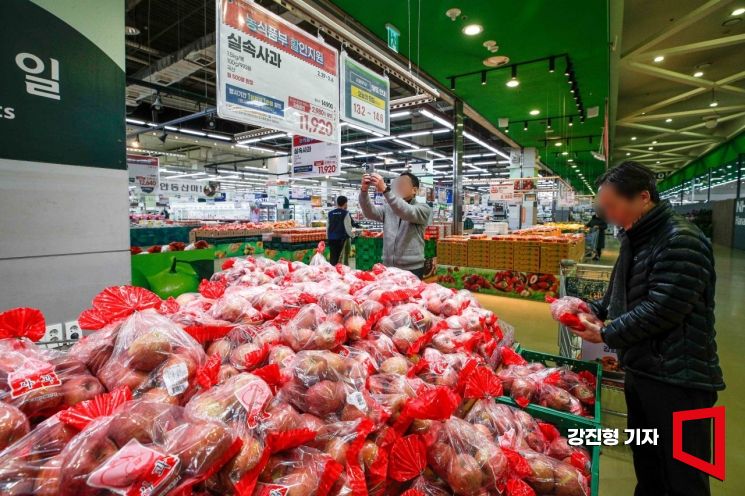 Due to the surge in prices of agricultural products, especially fruits, consumer prices, which had stabilized at 2.8% in January, returned to the 3% range within a month. On the 6th, a customer visiting the Hanaro Mart Yangjae branch in Seocho-gu, Seoul, hesitated to purchase apples. Photo by Jinhyung Kang aymsdream@
Rising prices are bad news for the government and ruling party. As the burden of inflation grows, calls for regime judgment gain strength over regime stability. Inflation directly hits the lives of ordinary people. In the U.S. presidential election, despite overall positive economic indicators, the biggest obstacle to President Joe Biden's reelection path is cited as the 'inflation burden.'
③ Verbal Blunder
As the election approaches, verbal blunders can have a destructive impact on the election. Both ruling and opposition parties engaged in intense exchanges last weekend, focusing on verbal controversies. The People Power Party pointed to Democratic Party leader Lee Jae-myung's 'second vote' remark, while the Democratic Party criticized former Supreme Council member Jang Ye-chan's past remarks, engaging in a battle of accusations.
Both parties emphasize internal discipline while launching offensives at the level of bombardment against the other's verbal slips externally. In the previous general election, remarks such as former lawmaker Cha Myung-jin's Sewol ferry disparagement and former lawmaker Chung Dong-young's derogatory comments about the elderly in 2004 caused significant upheaval in the overall election landscape.
© The Asia Business Daily(www.asiae.co.kr). All rights reserved.
![Clutching a Stolen Dior Bag, Saying "I Hate Being Poor but Real"... The Grotesque Con of a "Human Knockoff" [Slate]](https://cwcontent.asiae.co.kr/asiaresize/183/2026021902243444107_1771435474.jpg)

















