Korea Customs Service, Export and Import Status from March 1 to 10
Exports have decreased by more than 13% compared to the same period last year as of the 10th of this month. This is due to 1.5 fewer working days than the same period last year, but the government expects exports to show an overall increase in March.
The Korea Customs Service announced on the 11th that export value from March 1 to 10 was $13.5 billion, down 13.4% from the same period last year.
The number of working days up to the 10th of this month was 6 days, 1.5 days fewer than the 7.5 days during the same period last year. Considering this, the average daily export value was $2.26 billion, an increase of 8.2%.
Cho Ik-no, Trade Policy Officer at the Ministry of Trade, Industry and Energy, said, "Exports until the 10th recorded a double-digit decline due to 1.5 fewer working days, but the average daily export value increased by 8.2%, showing that our exports are clearly on a rebound."
Earlier, exports from February 1 to 10 this year decreased by 14.6% compared to the same period last year, but overall exports in February increased by 4.8%, continuing the upward trend that began in October last year for five consecutive months.
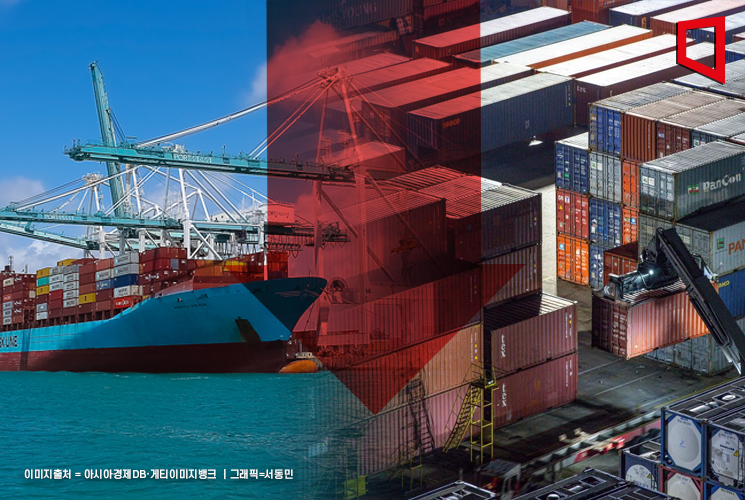
Among major export items from March 1 to 10, semiconductors (21.7%) and ships (431.4%) increased compared to the same period last year. On the other hand, passenger cars (-33.0%) and petroleum products (-29.3%) decreased.
By country, exports increased to Hong Kong (60.9%) and Singapore (14.7%), while exports to China (-8.9%), the United States (-16.3%), and the European Union (EU, -14.1%) decreased.
Imports from March 1 to 10 amounted to $14.8 billion, down 28.6% compared to the same period last year. By item, imports of the top 10 major items, including crude oil (-11.5%), semiconductors (-17.1%), gas (-58.0%), and petroleum products (-2.0%), all decreased. Energy imports such as crude oil, gas, and coal also fell by 32.9%. Imports from major countries decreased as well, including China (-32.7%), the United States (-26.1%), the EU (-22.6%), Japan (-27.8%), and Saudi Arabia (-0.7%).
The trade balance recorded a deficit of $1.3 billion. Reflecting this, the cumulative trade balance for this year still maintains a surplus of $3.425 billion.
Officer Cho said, "Even in January and February, which are considered the off-season for exports, we recorded a positive figure, indicating that our export engine has started in earnest. We expect exports to continue an upward trend and maintain a trade surplus in March, supported by the rising trend in semiconductors and ships."
© The Asia Business Daily(www.asiae.co.kr). All rights reserved.

















