"Commercial Real Estate (CRE) is the downside risk for the banking sector." (Martin Gruenberg, Chairman of the U.S. Federal Deposit Insurance Corporation (FDIC))
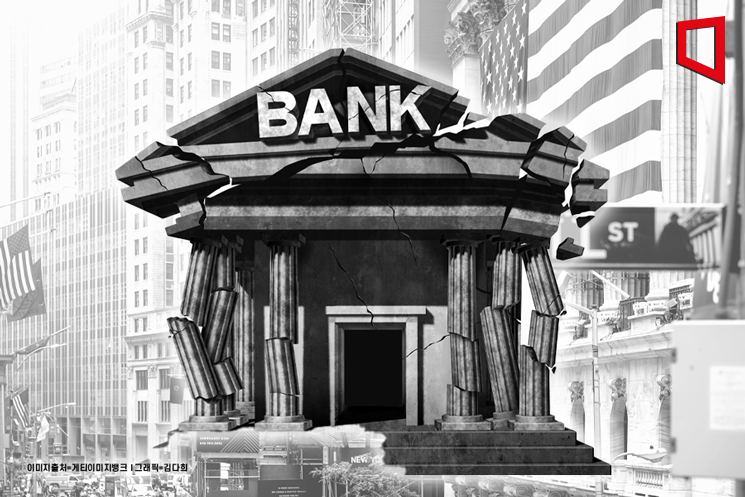
It has been one year as of the 10th (local time) since the collapse of Silicon Valley Bank (SVB), which heightened fears of a so-called bankdemic (bank + pandemic), but the spark of another crisis remains. The New York Community Bank (NYCB) incident, which has shaken the market with concerns over CRE loan defaults since the beginning of the year, is a representative example. More than $1 trillion in CRE loan maturities are due next year.

Major foreign media outlets, including Bloomberg News, reported that at the one-year mark of SVB's collapse, concerns over non-performing loans surrounding regional banks have resurfaced as the NYCB incident unfolds. The Nihon Keizai Shimbun analyzed, "The feared dangerous credit contraction after SVB's collapse has not materialized, and the U.S. economy and stock market have performed better than expected," but added, "Concerns over CRE loan defaults continue, and the caution that the crisis could recur cannot be dismissed." Banking Dive also cited CRE exposure as an area needing improvement at the one-year point of SVB's collapse, alongside the increase in failing banks and inconsistent regulations.
According to Morgan Stanley and others, about 70% of the $1 trillion CRE loans maturing next year are held by small and regional banks. With both interest rates and vacancy rates high, banks face inevitable burdens as they must either repay these loans all at once or refinance them at much higher rates. This is the background for warnings that the banking distress fears triggered by SVB's collapse in March last year could be replayed in the CRE market this time.
Wall Street estimates that double-digit percentages of CRE assets have values far below the loan amounts. The rapid increase in non-performing loans due to the worsening real estate market is also a concern. The FDIC confirmed that the amount of unrecovered CRE loans in the U.S. increased by 13% in the fourth quarter of 2023. The international credit rating agency Fitch forecasted that CRE loan delinquency rates will surge from the low 2% range at the end of 2023 to nearly 5% next year.
Among these, the NYCB incident, which became visible from the end of January, sharply raised market caution surrounding the CRE market. NYCB, a mid-sized bank with assets exceeding $100 billion, recorded unexpected losses due to large loan loss provisions against CRE loan defaults in its fourth-quarter results announced at the end of January, immediately triggering a plunge in its stock price, credit rating downgrades, and deposit outflows, causing turmoil. Although the bank managed to extinguish the immediate crisis by raising $1 billion in investment funds on the 6th, it exposed the vulnerabilities of some banks. For investors, this inevitably recalls the nightmare of SVB’s collapse, which was triggered by a sharp rise in interest rates, a plunge in Treasury prices, and a bank run (massive deposit withdrawals) last year.
According to Quick, a financial information company affiliated with Nihon Keizai, NYCB’s CRE loan ratio relative to its equity capital approaches 500%, far exceeding the U.S. regulatory standard of 300%. Columbia Banking System and Valley National, ranked around 40th in asset size, were also cited as having high CRE exposure. Jerome Powell, Chairman of the Federal Reserve, said last week in Congress, "We are aware of this issue (CRE exposure)" and "We are identifying and discussing banks with concentrated CRE loans." However, he dismissed the possibility of the crisis spreading system-wide, stating that "risk management is at a manageable level."
However, Wall Street warns that the number of failing banks in the U.S. is rapidly increasing and that the situations of large banks such as Goldman Sachs and JP Morgan are not easy either. The FDIC reported that the number of failing banks in the fourth quarter of last year rose by eight (18%) from the previous quarter to 52. Raghuram Rajan, former Governor of the Reserve Bank of India, recently pointed out in a Syndicate column that "At the one-year mark of the SVB incident, it is necessary to revisit it," emphasizing that the ongoing crisis is "not limited to some failing banks but is a systemic issue."
© The Asia Business Daily(www.asiae.co.kr). All rights reserved.
![Clutching a Stolen Dior Bag, Saying "I Hate Being Poor but Real"... The Grotesque Con of a "Human Knockoff" [Slate]](https://cwcontent.asiae.co.kr/asiaresize/183/2026021902243444107_1771435474.jpg)

















