Only Twice Since 1961 Statistics Released
"Government Raised Industrial Electricity Rates More"
Last year, the price of industrial electricity in South Korea was unusually higher than that of residential electricity.
According to Korea Electric Power Corporation (KEPCO) on the 10th, the sales price per kilowatt-hour (kWh) of industrial and residential electricity in 2023 was 153.7 won and 149.8 won respectively, with the industrial electricity sales price being 3.9 won higher.
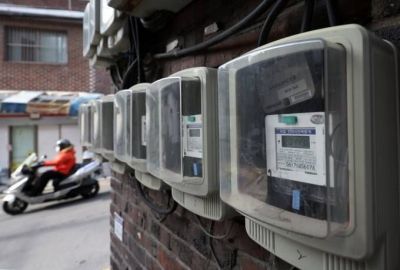
This is because the government raised electricity rates more for industrial electricity in the process of adjusting prices to reflect the reality in response to the surge in international energy prices since 2022.
KEPCO's annual electricity sales price rose 41.4% from 108.1 won in 2021, before the rate hikes began in earnest, to 152.8 won in 2023. During the same period, residential electricity increased by 37.2% and industrial electricity by 45.7%, with industrial electricity seeing a larger increase. In November last year, the government froze all other electricity rates including residential, and raised the average price of large-volume industrial electricity mainly used by large corporations by 10.6 won per kWh.
The industrial electricity sales price being higher than residential electricity is the first time in four years since 2019 (industrial 106.6 won, residential 105 won). It is also only the second time since related statistics have been available since 1961, following 2019.
To supply electricity to homes, substations that reduce high-voltage electricity from transmission lines by region must be built, and a dense distribution network like a spider web must be laid to supply electricity to each household. On the other hand, industrial electricity rates are generally lower than residential rates worldwide because the investment cost for distribution facilities is lower.
Among 38 OECD countries, only Turkey, Lithuania, Hungary, and Mexico have industrial electricity rates higher than residential rates. On average in the OECD, industrial electricity is about 25% cheaper than residential electricity.
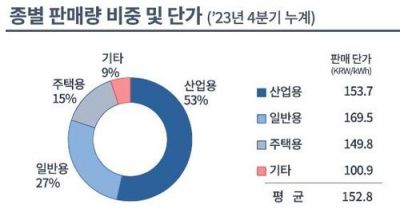 2023 Electricity Sales Share and Unit Price by Type [Image Source=Provided by Korea Electric Power Corporation]
South Korea, which has maintained an export manufacturing-centered industrial structure, has implemented policies to supply industrial electricity at low prices in the past to support competitiveness. Until the 1960s, the industrial electricity price was only about 50% of the residential price.
However, there is also an argument that considering the cost-based principle, industrial electricity being lower than residential electricity does not conform to market principles. It suggests that the cost-based principle should be considered when adjusting electricity rates overall as well as by sector.
Meanwhile, the increase in the unit price of industrial electricity, which accounts for more than half of total usage, is expected to positively contribute to improving KEPCO's revenue structure, which spends more than 4 trillion won annually on interest due to debt exceeding 200 trillion won.
© The Asia Business Daily(www.asiae.co.kr). All rights reserved.
![Clutching a Stolen Dior Bag, Saying "I Hate Being Poor but Real"... The Grotesque Con of a "Human Knockoff" [Slate]](https://cwcontent.asiae.co.kr/asiaresize/183/2026021902243444107_1771435474.jpg)
















