Expanding Public Project Areas Such as Power Plants, Hospitals, and Cold Storage
No Sales Risk and Cash Secured Through Advance Payments
Private Orders Decreased by 10 Trillion Won in One Year, Public Orders Increased by 500 Billion Won
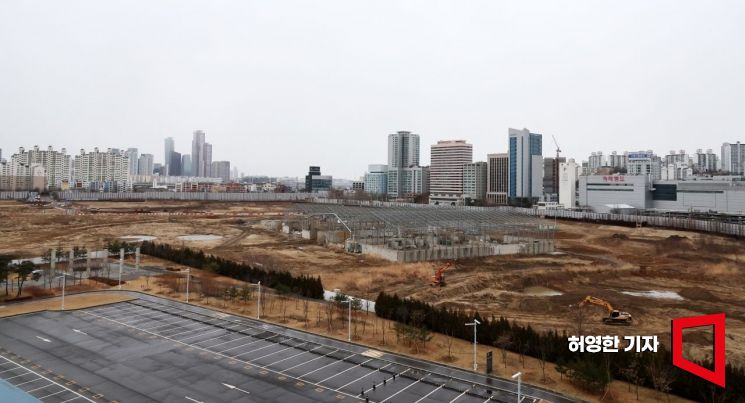 On the 5th, the Seoul Metropolitan Government announced the "Yongsan International Business District Development Plan (Draft)" to construct a 100-story landmark international business district in Yongsan. Panoramic view of the international business district. Photo by Younghan Heo younghan@
Amid the real estate market downturn, construction companies are eagerly competing to win government-commissioned projects. The volume of government orders is increasing, and companies judge that it is more efficient to take on these projects, even with lower profitability, than to bear the risks associated with private projects such as housing sales.
According to industry sources on the 11th, Daewoo E&C has signed a contract with Korea Western Power to purchase main equipment and auxiliary facilities for the natural gas power plant in Gongju. Western Power is constructing a 500MW-class natural gas power plant by April 2027, and this contract involves supplying the main equipment for it. According to the 8th Basic Plan for Strategic Supply and Demand, the government is replacing the old Taean coal-fired power plant Unit 2 with an LNG power plant.
Under this contract, Daewoo E&C will form a consortium with GE to design the power plant and supply major power generation equipment. They are also responsible for construction and technical support related to commissioning. Typically, construction companies handle the construction part of EPC (Engineering, Procurement, and Construction) in public projects, but in this case, Daewoo E&C is in charge of procurement (P).
A Daewoo E&C official said, "Procurement can be simply seen as purchasing agency, and among EPC components, it is the most profitable." He added, "Public institution projects with confirmed clients and funding are popular these days. Such projects usually receive about 10% of the total contract amount as advance payment, which also helps the financial situation." Last month, Daewoo E&C also won a contract for the construction of the 'Korea Ultra-Low Temperature Incheon Logistics Center' worth 493 billion KRW. As it is commissioned by a public institution, the client has secured 100% of the construction funds, ensuring stable payment collection."
Not only Daewoo E&C but also other construction companies are steadily winning government-commissioned projects ranging from power plants and hospitals to cold storage warehouses. A construction industry insider said, "Unlike housing projects where profits depend on sales, projects commissioned by public institutions carry less risk."
Hyundai E&C is currently promoting the construction project of Seoul National University Hospital in Baegot, Siheung. Last month, Hyundai E&C expressed its intention to participate in a negotiated contract for the hospital construction to the Public Procurement Service. The construction cost is estimated at approximately 434.2 billion KRW. Assuming the negotiated contract proceeds smoothly, construction is expected to start as early as the second half of this year. Seoul National University Hospital is a public institution, and the Public Procurement Service is managing the bid evaluation. This project has failed to select a contractor four times since January last year due to low construction costs.
An industry insider said, "As the real estate slump prolongs, the advantages of public procurement projects, which can receive stable progress payments regardless of sales, are becoming more prominent. Several construction companies were simultaneously involved in the GTX (Greater Seoul Metropolitan Area Express Railway) construction promoted by the government, and such projects can secure profits regardless of the real estate market."
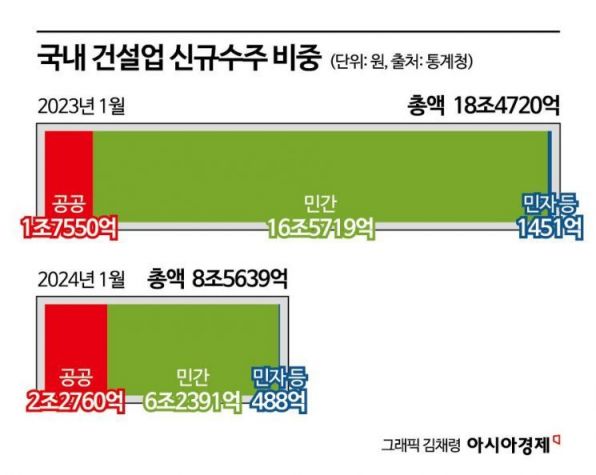
Since the beginning of this year, the total order volume for construction companies has sharply declined compared to last year. However, by sector, only the private sector including housing projects has significantly contracted, while the public sector has actually increased. According to Statistics Korea, new domestic construction orders in January amounted to 8.5639 trillion KRW, down 53.6% from 18.472 trillion KRW in the same month last year. In particular, the private sector (16.5719 trillion KRW → 6.2391 trillion KRW) decreased by more than 10 trillion KRW in one year. On the other hand, the public sector (1.755 trillion KRW → 2.276 trillion KRW) increased by more than 500 billion KRW.
A construction company official said, "Construction companies' projects have been excessively concentrated on housing, so order volumes have sharply declined starting this year. At times like this, the government needs to stimulate SOC projects to support the construction industry."
Meanwhile, to revitalize the sluggish economy, the Ministry of Land, Infrastructure and Transport plans to execute 34 trillion KRW out of the 56 trillion KRW rapid execution budget target in the first half of this year. In particular, 12.4 trillion KRW will be invested in major SOC projects such as roads, railways, and aviation by June this year.
© The Asia Business Daily(www.asiae.co.kr). All rights reserved.
![Clutching a Stolen Dior Bag, Saying "I Hate Being Poor but Real"... The Grotesque Con of a "Human Knockoff" [Slate]](https://cwcontent.asiae.co.kr/asiaresize/183/2026021902243444107_1771435474.jpg)
















