ECB Lowers Inflation and Growth Forecasts for This Year
Positive Reaction to Powell's Message Without 'Surprise Remarks'
Last Week's New Unemployment Claims Slightly Exceed Expectations
The three major indices of the U.S. New York stock market showed an upward trend in the early trading hours on the 7th (local time). The market is relieved that there were no 'surprise remarks' from Jerome Powell, Chairman of the U.S. Federal Reserve (Fed), who appeared before the U.S. House of Representatives the previous day. The European Central Bank (ECB) also raised investors' expectations by keeping the benchmark interest rate unchanged and lowering inflation and growth forecasts.
As of 9:55 a.m. at the New York Stock Exchange (NYSE) on the day, the Dow Jones Industrial Average was trading at 38,831.04, up 0.44% from the previous trading day. The S&P 500 index, centered on large-cap stocks, rose 0.67% to 5,139.14, and the tech-heavy Nasdaq index recorded a 0.84% increase to 16,165.94.
By stock, Nvidia is leading the gains with a 2.26% rise. Danish pharmaceutical company Novo Nordisk surged 9.1% after releasing successful trial results for its obesity treatment. New York Community Bancorp (NYCB) soared 13.87% following the announcement of a $1 billion capital expansion plan the previous day. Lingerie brand Victoria's Secret plunged 28.81% after announcing annual earnings forecasts that fell short of market expectations.
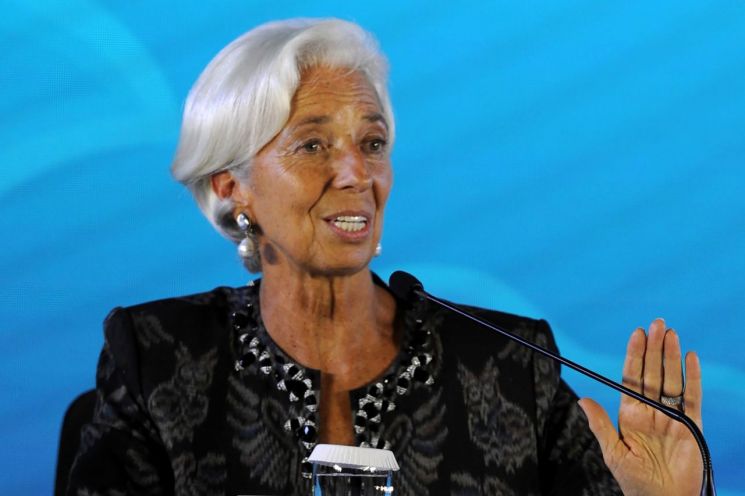
The ECB stimulated investor sentiment by simultaneously keeping the benchmark interest rate unchanged and lowering inflation and growth forecasts. The ECB held the benchmark interest rate steady at 4.5% per annum. This year’s economic growth forecast was lowered to 0.6%, and the consumer price inflation rate was adjusted down to 2.3%. This has led to optimism about a global slowdown in inflation.
Mark Wall, Director at Deutsche Bank AG, assessed, "The ECB is gradually approaching its first rate cut."
The market also positively digested Chairman Powell’s remarks from the previous day.
Powell appeared before the U.S. House Financial Services Committee for the semiannual monetary policy report and reaffirmed a cautious stance while anticipating a rate cut within the year. He stated, "A rate cut is not guaranteed until we gain greater confidence that inflation is moving steadily toward the central bank’s 2% target." However, he added, "We view the policy rate as having peaked in this tightening cycle," and "If the economy broadly evolves as expected, it would be appropriate to reverse policy restraint at some point this year."
Investors took note that Powell did not make any surprise remarks that could act as negative news for the market.
Adam Saran of 50 Park Investments said, "The market has digested the reality that Powell has accepted rate cuts this year. Now the question is when, how often, and by how much."
Powell is scheduled to appear before Congress again on the same day to report semiannual monetary policy to the Senate.
The employment market remains robust. The U.S. Department of Labor announced that new unemployment claims for the week of February 25 to March 2 remained unchanged at 217,000, slightly above the expert forecast of 215,000. Continued claims for unemployment benefits, which count those filing for at least two weeks, rose by 8,000 to 1,906,000 for the week of February 18 to 24 compared to the previous week. According to the February employment report from ADP, a private U.S. labor market research firm released the previous day, private sector job creation was 140,000. Although this was below the expected 149,000, it was an increase from January’s 111,000.
Market attention is now focused on the U.S. Department of Labor’s February employment report, which provides a clearer picture of the employment market situation. The report will be released on the 8th, ahead of the March Federal Open Market Committee (FOMC) meeting scheduled for the 19th-20th.
Government bond yields are slightly down. The U.S. 10-year Treasury yield, a global bond yield benchmark, and the 2-year Treasury yield, sensitive to monetary policy, have both fallen slightly, hovering around 4.09% and 4.53%, respectively.
International oil prices are declining. West Texas Intermediate (WTI) crude oil fell $0.67 (0.8%) to $78.46 per barrel, and Brent crude dropped $0.58 (0.7%) to $82.38 per barrel.
© The Asia Business Daily(www.asiae.co.kr). All rights reserved.
![Clutching a Stolen Dior Bag, Saying "I Hate Being Poor but Real"... The Grotesque Con of a "Human Knockoff" [Slate]](https://cwcontent.asiae.co.kr/asiaresize/183/2026021902243444107_1771435474.jpg)
















