Rapid Spread of Cleaning Robots Across Domestic Industrial Sites
1,000 Units Expected This Year... 5,000 Units by 2026
#. Inside a large shopping mall, amidst a crowd of people, a cleaning robot about waist-high for an adult moves busily. The areas the robot passes over become spotless as dust and stains disappear. Even coffee accidentally spilled by someone is thoroughly cleaned with just one pass of the robot. After finishing cleaning, the robot moves diligently again without a moment’s rest.
Cleaning robots are rapidly being adopted across various industrial sites in South Korea. This is because introducing cleaning robots offers two benefits: preventing industrial accidents and improving working conditions. Demand for cleaning robots is surging in terminals, shopping malls, convention centers, hospitals, hotels, factories, and companies, and the market is expected to grow more than fivefold in two years compared to this year.
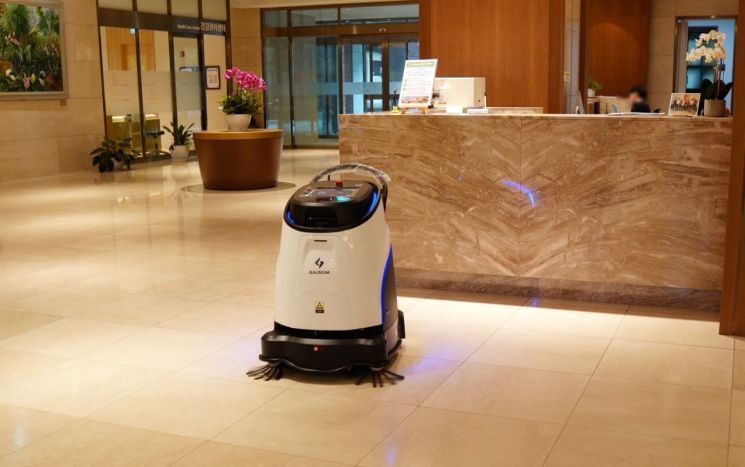
According to Marosol, a robot solutions company, the domestic cleaning robot market is expected to reach a scale of 1,000 units this year. The number of cleaning robots deployed domestically was 300 units until last year. It is anticipated to grow more than threefold this year. If this trend continues, the industry estimates the market will reach 2,000 units in 2025 and 5,000 units in 2026.
Growth is also confirmed in the global market. Global market research firm Straits Research projected that the cleaning robot market size will be $1.122 billion this year and double to $2.218 billion by 2031. This is close to 3 trillion Korean won. In Japan, which has a similar industrial structure to South Korea, the number of cleaning robots increased from 7,000 units in 2022 to 8,200 units last year. An industry insider explained, "Due to recent increases in labor costs and labor shortages, companies seeking automation of cleaning tasks are increasing, rapidly boosting demand for cleaning robots."
Cleaning robots are mainly introduced in workplaces that require clean environment management. They are equipped with powerful cleaning functions and some models have autonomous driving capabilities, allowing cleaning at desired times and locations without manual operation. Previously, in large workplaces, tasks such as cleaning floor grease and dust removal were performed by production workers or outsourced cleaning services, but now these tasks are entrusted to cleaning robots.
As the market grows, competition is intensifying. Currently, the market leader in the domestic market is the global cleaning robot company Gaushium. Gaushium holds more than 70% of the global cleaning robot market share. Domestic robot company Marosol has formed a strategic partnership with Gaushium and provides the independently developed robot integrated control service called 'Solink.' This enables 24-hour real-time monitoring service, easy real-time adjustment of cleaning zones, and analysis of work volume on weekly and monthly bases. Integration with elevators allows the robot to work across multiple floors. Kim Min-kyo, CEO of Marosol, said, "More companies are adopting cleaning robots to maintain a clean working environment, secure workers’ health rights, and prevent the departure of cleaning staff. We will enhance satisfaction by supporting not only the necessary control for optimal effects after introduction but also aftercare."
Serving robot company VD Company has also entered this market with its autonomous cleaning robot 'Clever.' This robot supports multiple cleaning modes including wet cleaning, dry cleaning, sweeping, and mopping. It features a separate workstation that enables automatic charging, automatic water supply, and drainage, eliminating the need for manual intervention. When the battery or water runs low, it autonomously moves to the workstation to refill and then resumes unfinished tasks. Equipped with automatic position recognition and navigation functions, it safely avoids obstacles while cleaning. Ham Pan-sik, CEO of VD Company, said, "Cleaning robots are not just about reducing labor costs but are necessary for the safety of workers and the working environment."
© The Asia Business Daily(www.asiae.co.kr). All rights reserved.
![Clutching a Stolen Dior Bag, Saying "I Hate Being Poor but Real"... The Grotesque Con of a "Human Knockoff" [Slate]](https://cwcontent.asiae.co.kr/asiaresize/183/2026021902243444107_1771435474.jpg)
















