"No Legalization of Illegal Medical Practices by PAs Due to Lack of Residents"
"Indiscriminate Telemedicine Encourages Overconsumption and Delays Diagnosis"
The medical community urged the government to halt its policy push, expressing concerns that the legalization of medical acts performed by PA (Physician Assistant) nurses could lead to a decline in the quality of healthcare.
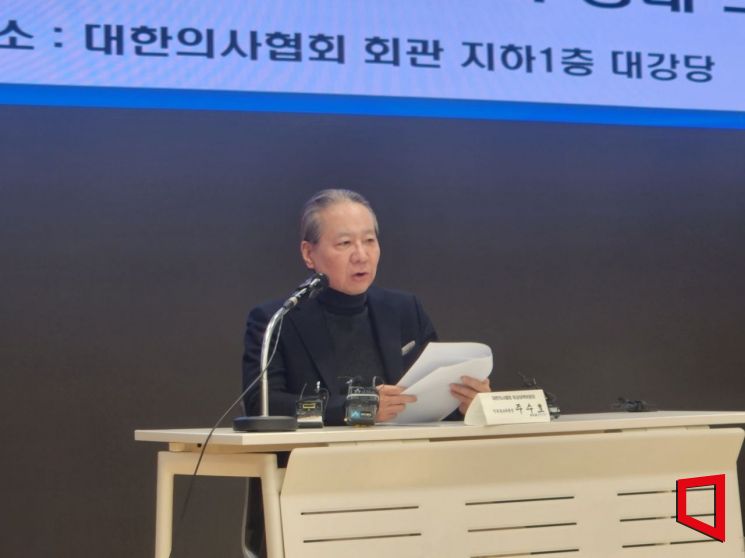 Joo Suho, Chairman of the Emergency Response Committee Public Relations Committee of the Korean Medical Association. / Photo by Choi Taewon peaceful1@
The Emergency Response Committee of the Korean Medical Association held a regular briefing at 2 p.m. on the 7th at the KMA headquarters in Yongsan-gu, Seoul, stating, "They are trying to resolve the lack of residents by legalizing illegal medical acts performed by PA nurses, which should rightfully be done by doctors." They added, "If illegal medical acts by PA nurses, who are not properly qualified, are legalized, the scope of medical licenses will collapse, and the medical field will be transformed into a place rife with illegal and low-quality medical care."
They also criticized the government's plans to allow telemedicine and to expand the influx of graduates from overseas medical schools into Korea. The committee said, "Indiscriminate allowance of telemedicine will promote excessive medical consumption and delay the diagnosis of serious diseases." They continued, "Currently, 159 overseas medical schools from 38 countries are permitted to take the Korean medical licensing examination. However, unlike domestic medical schools, which have a pass rate of over 95%, the pass rate for graduates of overseas medical schools is around 30%, resulting in only about 30 to 40 graduates from overseas medical schools becoming doctors in Korea each year." They explained, "This inevitably raises suspicions about the quality of education at overseas medical schools."
The committee also pointed out that the government is presenting inaccurate interpretations of statistics. Chairman Joo stated, "President Yoon Suk-yeol said that since the introduction of health insurance in 1977, Korea's GDP has increased 116-fold and national medical expenses 511-fold, while the number of doctors has only increased sevenfold, implying that the number of doctors should naturally increase proportionally with income or medical expenses, and that the lack of such proportional increase is evidence of a doctor shortage." He rebutted, "It is obvious by international standards that GDP and the number of doctors do not correlate proportionally, and the fact that medical expenses increased 511-fold while the number of doctors increased sevenfold should be interpreted inversely?that as the number of doctors increases, the national medical expense burden increases exponentially."
He added, "The population of the Republic of Korea increased only 1.4 times from 36.41 million in 1977 to 51.75 million in 2024, but the number of doctors increased sevenfold from 18,913 in 1977 to about 140,000 in 2024. Who exactly is it that clouds the president's judgment with such illogical statistical interpretations?"
© The Asia Business Daily(www.asiae.co.kr). All rights reserved.
![Clutching a Stolen Dior Bag, Saying "I Hate Being Poor but Real"... The Grotesque Con of a "Human Knockoff" [Slate]](https://cwcontent.asiae.co.kr/asiaresize/183/2026021902243444107_1771435474.jpg)
















