The Supreme Court has ruled that even in a multi-family housing complex without security devices such as door locks at the building entrance, if someone enters the shared entrance, stairs, or in front of the private entrance door of each unit, the crime of residential intrusion can be established depending on the intent of intrusion.
According to the legal community on the 7th, the Supreme Court's Second Division (Presiding Justice Kwon Young-jun) overturned the original ruling that acquitted Mr. A, who was charged with residential intrusion, and remanded the case to the Seoul Northern District Court.
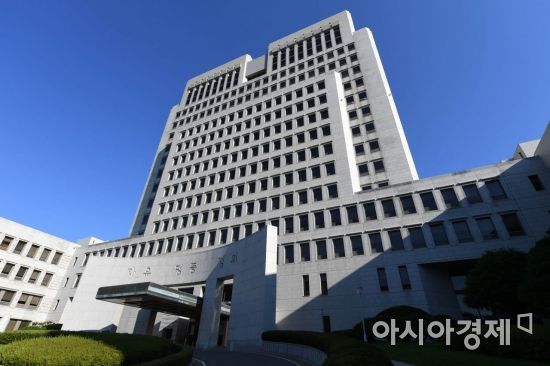
Mr. A was prosecuted for trespassing three times between June and July 2021 into a multi-family housing complex where his ex-girlfriend Ms. B lived.
Mr. A entered the shared entrance of the building, which had no special locking device, around 9 or 10 p.m., then went up to the second floor where Ms. B's home was located. Outside her door, he recorded conversations inside the house, or left a mask with the phrase "The game has begun" or a photo of Ms. B on her front door. However, he did not knock on the door or attempt to enter the house, so Ms. B did not notice that Mr. A had come to her doorstep at the time of the incidents.
The first trial court found Mr. A guilty of residential intrusion and sentenced him to a fine of 5 million won.
Mr. A's side argued that since there were no security or locking devices at the entrance of the multi-family housing complex where Ms. B lived, and Mr. A did not enter Ms. B's home but stayed quietly in the stairs or hallway before leaving, it could not be considered that Ms. B's actual peace was disturbed, and therefore the crime of residential intrusion could not be established.
However, the court rejected this, stating, "It is reasonable to find that the defendant intruded into the victim's residence as described in the criminal facts of this case and actually disturbed the peace of the residence."
The court first cited a Supreme Court ruling that the shared stairs or hallways inside a multi-family housing complex can also be objects of residential intrusion.
Previously, the Supreme Court ruled, "In the crime of residential intrusion, 'residence' does not simply mean the house itself but also includes the yard and surrounding land. In multi-family detached houses, multi-family housing complexes, row houses, and apartments, the shared stairs and hallways used commonly inside the building are essential parts attached to the exclusive parts of each household or unit. These areas are expected to be monitored and managed by the residents in daily life and require protection of the actual peace of residence. Therefore, unless there are special circumstances, the shared stairs and hallways inside multi-family detached houses or apartment complexes should be considered as 'human residences' subject to residential intrusion."
The court held that regardless of whether Ms. B was aware, Mr. A's actions themselves constituted residential intrusion.
The court stated, "Each of the defendant's acts, such as recording the victim's conversations without permission or leaving a mask with a message or a private photo of the victim in front of the entrance door, reasonably infringed upon the victim's right to privacy that should be enjoyed within her residence. The fact that the victim did not recognize this at the time does not change this view."
The court judged that considering Mr. A continuously sent messages criticizing Ms. B's relationships via KakaoTalk and threatened to distribute the recorded conversation (which included sounds of Ms. B during sexual intercourse) recorded at the front door, there was no situation where Ms. B could have explicitly or implicitly permitted Mr. A to enter the stairs or hallway.
Although Ms. B told Mr. A to come and pick up clothes she had given him as gifts, the court found that, given their relationship at the time, Mr. A's unannounced visit late at night without prior arrangement on time or place was against common experience.
However, the verdict was reversed in the second trial.
The second trial court stated, "Based solely on the evidence submitted by the prosecution, it is difficult to conclude beyond reasonable doubt that the defendant intruded into the victim's residence as described in the indictment," and overturned the first trial ruling, acquitting Mr. A.
The court pointed out, "The shared entrance of the villa building where the victim resides did not have a door lock installed, and there was no security guard. The first floor of the villa building has a parking lot along with the shared entrance, and although CCTV is installed on the parking lot ceiling, it was not operational." The court added, "There is no evidence indicating that unauthorized entry by outsiders was controlled or managed at the villa building where the victim resides."
Additionally, the court noted, "The defendant testified to the police that the shared entrance was always open, so he just entered at the time of the incident. The victim testified at the original trial that she was completely unaware that the defendant came to the entrance of her residence and that he did not try to open or knock on the door." The court concluded, "Based solely on the evidence submitted by the prosecution, it is difficult to definitively say that the defendant's actions in this case constitute behavior that disturbs the actual peaceful state of the residence of a multi-family housing resident."
However, the Supreme Court again reversed the judgment on guilt.
The court stated, "It is difficult to accept the lower court's judgment that the defendant's actions in this case do not constitute 'intrusion.'"
The court based this judgment on the following: ▲ The shared entrance, common stairs, and the area in front of the entrance door in a multi-family housing complex are essential spaces attached to the exclusive parts of each unit, and it is generally difficult to consider that outsiders are allowed to enter freely; ▲ Even if the CCTV was not operational, the signs stating 'CCTV in operation' and 'No parking for outside vehicles' outside can be interpreted as controlling and managing unauthorized entry of outsiders to the entire building; ▲ The defendant entered up to the front door with the intention of hanging a mask or photo that could cause anxiety to the victim, with whom he had a relationship and then broke up; ▲ The victim consistently testified that she reported to the police after becoming aware of this and felt fear due to the defendant's actions.
The court stated, "This building is a typical multi-family housing complex where about 10 households, including the victim, reside. The shared entrance, common stairs, and the area in front of each unit's entrance door that the defendant entered are essential spaces attached to the exclusive parts of each household where residents of the apartment complex live their daily residential lives."
It continued, "Considering the form, use, and nature of these spaces, they have a strong character as an extended residential area for residents. Compared to commercial buildings or public institutions open to the general public, the need to protect privacy and residential peace is relatively high, so it is difficult to consider that entry by outsiders is generally permitted."
Unlike the second trial court, the Supreme Court judged that regardless of whether the CCTV was actually operational, the mere installation of CCTV expressed the residents' intention to prohibit unauthorized entry to the building to the outside.
The court stated, "There are two or more CCTVs installed on the ceiling of the first-floor parking lot, and signs stating 'CCTV in operation' and 'No parking for outside vehicles' are posted on the pillar walls below."
The court added, "Although the CCTV was not actually operating at the time of the defendant's entry, and there was no security guard assigned to the building, and no separate security devices such as door locks requiring a password were installed at the shared entrance, the residents or managers of the building can be evaluated as having externally expressed their intention to control and manage unauthorized entry of outsiders to the entire building, including the parking lot and connected residential spaces, through the installation of CCTV and the signs on the pillar walls. Also, people entering the building can easily recognize these signs while passing through the parking lot."
The court stated, "The victim did not consent to the defendant's entry. Although the victim did not recognize the defendant's entry up to the front door at the time, she immediately reported to the police after becoming aware and consistently testified that she felt fear due to the defendant's actions." The court concluded, "Considering the nature of the shared parts of the building, the control and management of unauthorized entry by outsiders, the relationship between the defendant and the victim, the defendant's purpose, circumstances, and time of entry, the defendant's behavior before and after the incident, the victim's intentions and actions, and social norms regarding unauthorized entry into residential spaces, it is reasonable to conclude that the defendant entered the building in a manner that disturbed the actual peaceful state of the victim's residence."
© The Asia Business Daily(www.asiae.co.kr). All rights reserved.
![Clutching a Stolen Dior Bag, Saying "I Hate Being Poor but Real"... The Grotesque Con of a "Human Knockoff" [Slate]](https://cwcontent.asiae.co.kr/asiaresize/183/2026021902243444107_1771435474.jpg)















