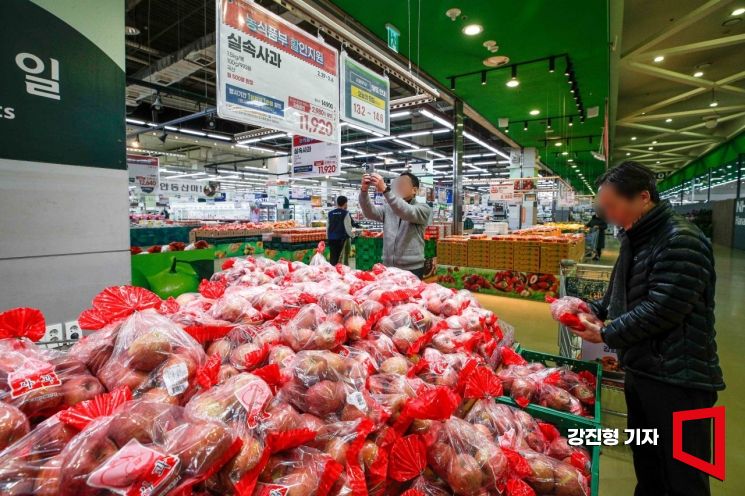
 Due to the surge in agricultural product prices, especially fruits, consumer prices, which had stabilized at 2.8% in January, returned to the 3% range within a month. On the 6th, a customer visiting the Hanaro Mart Yangjae branch in Seocho-gu, Seoul, hesitated to purchase apples. Photo by Jinhyung Kang aymsdream@
The Bank of Korea evaluated that the consumer price inflation rate for February, announced on the 6th, was in line with previous forecasts. It is expected that the inflation rate will gradually slow down if oil prices do not surge sharply.
Kim Woong, Deputy Governor of the Bank of Korea, held a "Price Situation Review Meeting" at the Bank's headquarters in Jung-gu, Seoul, on the same day to review the recent price situation and future price trends. The Statistics Korea announced that the consumer price index for last month was 113.77 (2020=100), up 3.1% compared to the same month last year.
Deputy Governor Kim said, "Although the core inflation rate remained at the previous month's level, the consumer price inflation rate increased compared to last month, mainly due to agricultural products, which is consistent with the level expected in the previous forecast."
He added, "While the core inflation continues a gradual easing trend, the consumer price inflation rate rose mainly due to living expenses such as agricultural products. Going forward, if oil prices do not surge sharply, the consumer price inflation rate is expected to gradually slow down due to low domestic demand pressure."
However, he emphasized, "Considering that living expenses such as agricultural products may remain at a high level for some time, the trend may be uneven rather than smooth. There is significant uncertainty regarding geopolitical risk developments and domestic and international economic trends on the inflation forecast path."
© The Asia Business Daily(www.asiae.co.kr). All rights reserved.
![Clutching a Stolen Dior Bag, Saying "I Hate Being Poor but Real"... The Grotesque Con of a "Human Knockoff" [Slate]](https://cwcontent.asiae.co.kr/asiaresize/183/2026021902243444107_1771435474.jpg)















